
Bottles Break, Racks Waste Space: Solving Wine Storage with Wire Containers
Short answer: bottled wine is stored badly when the container is chosen for the pallet instead of the bottle. A wine-specific wire container combines an open mesh sized to the bottle, a load rating that covers a full batch, and a stackable frame that uses height rather than floor area. HM Group's wine range includes HM-WEU005, with a 51×118 mm grid and a stated 800 kg load capacity, and HM-WEU001, with a 55×113 mm grid; both are built from mild steel Q235 on a 5–12 mm wire gauge basis. The work that follows is project fit: why general-purpose storage fails bottled wine, and how to check grid, dimensions, load per batch and stacking before the purchase order is signed.
Wine distributors rarely lose money on the container itself. They lose it in the second and third handling cycles: a chipped capsule found at picking, a label scuffed after eight months in a cellar, a bay that holds four hundred bottles while the air above it holds nothing. Those are specification problems, and they are cheaper to fix before the order than after the first shipment.
This guide is written for buyers in the Research and Evaluation stage — importers comparing storage options, bonded warehouses planning a re-slotting project, and winery logistics teams moving from floor stacking to a structured system.
Where generic storage loses bottles and cube
Three failure modes account for most wine storage complaints, and none of them is caused by careless staff.
1. Contact points designed for something else. Racking built around a carton dimension, or a mesh bin designed for metal parts, holds the bottle somewhere other than where the bottle is strong. When the format changes — a wider Burgundy shoulder, a heavier Champagne bottle — the same bay either presses on the label or leaves the bottle free to shift a few millimetres per movement. Multiplied across a season of forklift trips, that movement shows up as scuffed labels and chipped glass.
2. Closed walls that hide the load. Solid pallet boxes protect against impact, but they also stop air moving and stop anyone seeing the stock. In a cellar held at high humidity, trapped moisture is the wrong environment for labels, capsules and any untreated steel nearby, and a damaged bottle at the bottom of a closed box is usually discovered at dispatch rather than at intake.
3. Vertical space that cannot be used. Fixed racking is sized to one bottle format and one bay height. Empty pallet boxes and non-stackable bins keep their footprint whether they hold four hundred bottles or none, so the cube above them is leased and never used. The cost never appears on an invoice; it appears as extra square metres, extra aisles and slower counts.
A wine storage decision, therefore, is not about the lowest cost per unit. It is about which container keeps the bottle still, keeps the stock visible, and keeps the third and fourth level usable.
What bottled wine asks of a storage unit
Four conditions separate wine from general industrial cargo, and each one maps to a different part of the container specification.
- Bottle geometry. Bordeaux, Burgundy and Champagne shapes differ in body diameter, shoulder and base. Sizing has to follow the bottle, not the case. HM Group's wine-industry application data describes dimensions engineered for these three shapes rather than a single generic opening.
- Humidity. Cellar storage commonly runs above 75% relative humidity. That makes corrosion protection a functional requirement rather than a cosmetic option; hot-dip galvanizing or a high-micron zinc coating is specified for humid cellar environments in the same application data.
- Movement. Cross-border sea or rail freight, then internal transfers, then picking. Every transfer is a vibration and impact event, and a container that constrains the bottle at the right point reduces how many of those events reach the glass.
- Traceability. Vintage and SKU management depend on seeing and scanning stock. Open mesh supports visual checks, and barcode or RFID labels work with the frame instead of against it.
The practical consequence: a container that is adequate for PET preforms or automotive parts is not automatically adequate for wine, even though both are described as wire containers.
The wine-specific wire container: what actually changes
HM Group — Dalian HuaMao Logistics Equipment Group Co., Ltd., a wire mesh container manufacturer founded in 2003 with production bases in Xiamen, Nanjing and Qingdao and a 62,000 m² factory footprint — lists dedicated wine-bottle containers alongside its general industrial range. Two models define the choice.
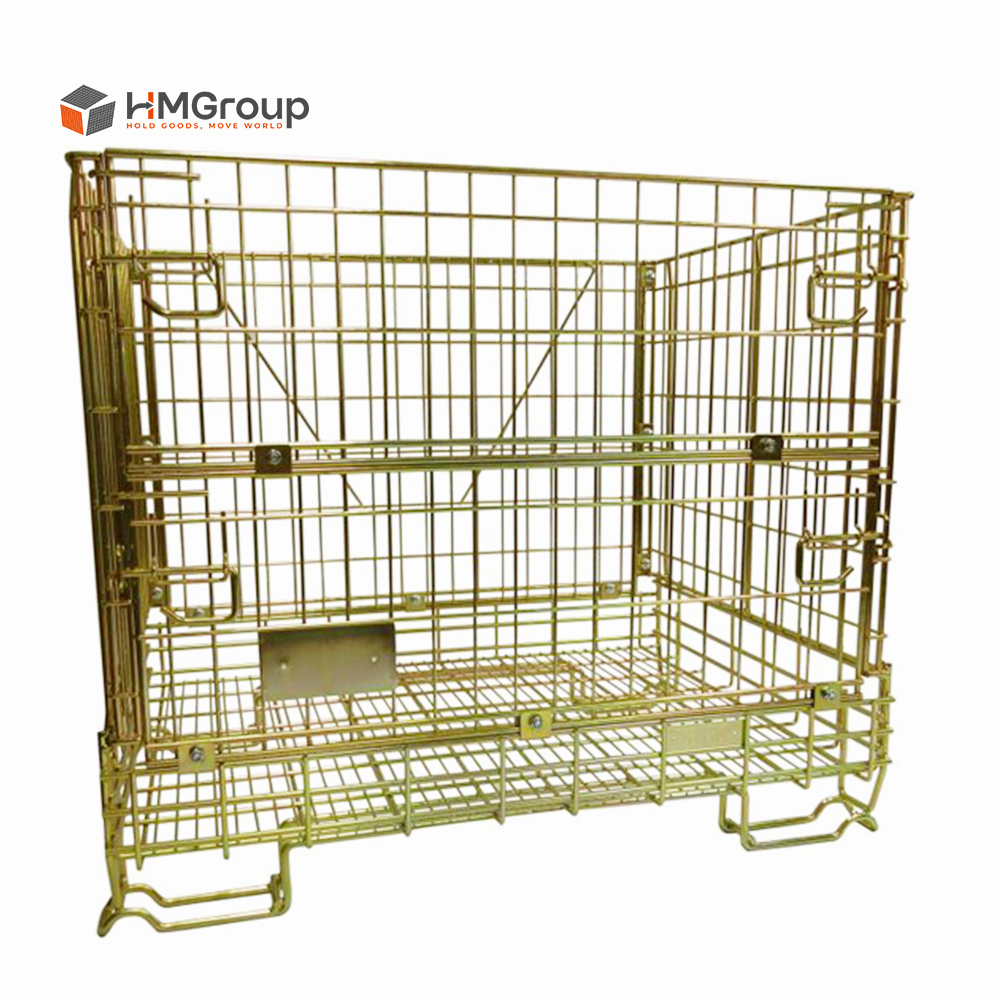
HM-WEU005 is the larger wine model. It measures 1200L × 920W × 1018H mm externally, is built from mild steel Q235 with a 5–12 mm wire gauge, uses a 51×118 mm grid, carries a stated load capacity of 800 kg, holds 400 Bordeaux bottles, stacks 4+1 high, and loads 228 sets into a 1×40-foot high-cube container. Finish options are zinc, hot-dip galvanized or powder coating.
HM-WEU001 is the second wine-bottle model in the range, catalogued as a metal wire container for wine bottles and specified with a 55×113 mm grid on the same mild steel Q235 and 5–12 mm wire basis. Because its grid proportions differ from HM-WEU005's, the two are not interchangeable across every bottle format; the pair exists so the mesh can be matched to the bottle instead of the bottle being forced into one standard opening.
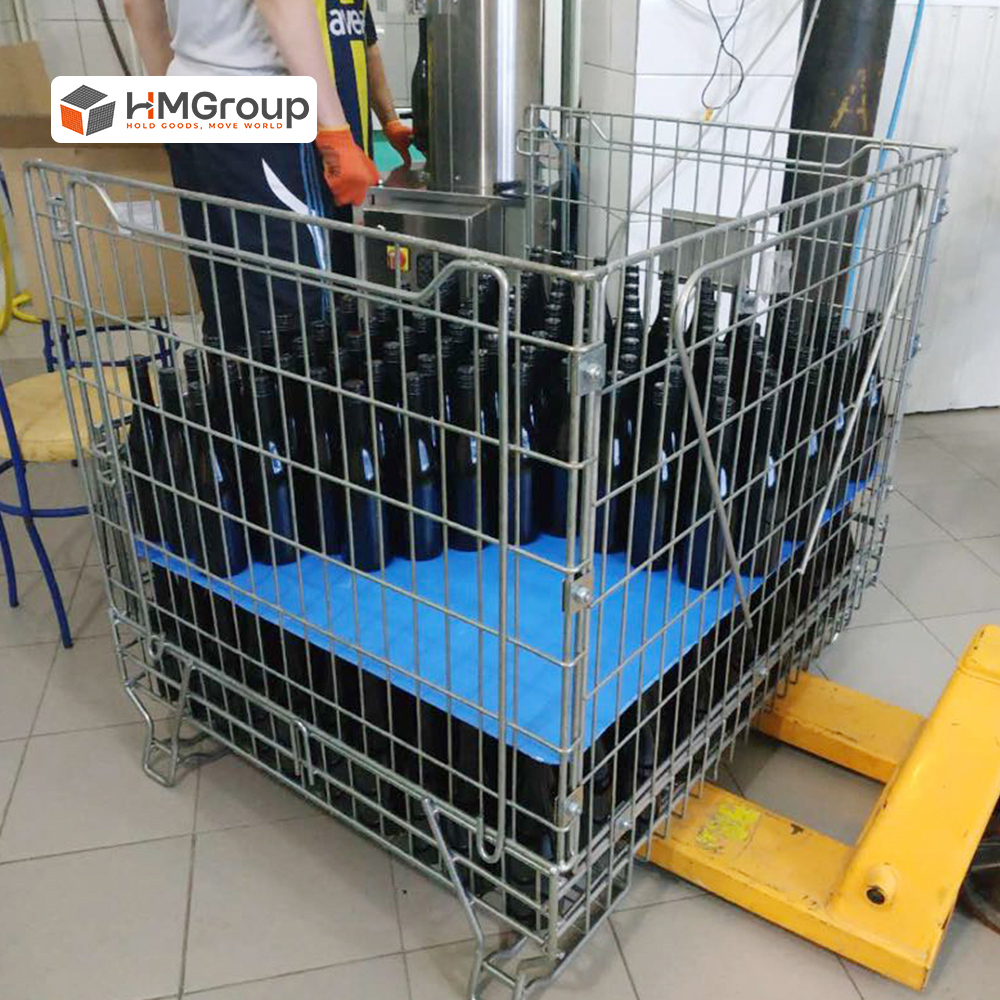
Two details matter more than they look. The first is the grid. A figure such as 51×118 mm or 55×113 mm is not arbitrary: the opening has to support the bottle body, prevent the neck from slipping through, and place the mesh contact on glass rather than on the label. The second is the open structure. Mesh sides let air move through a stack, let a supervisor count a batch without unloading it, and let condensation dry instead of sitting between bottle and wall.
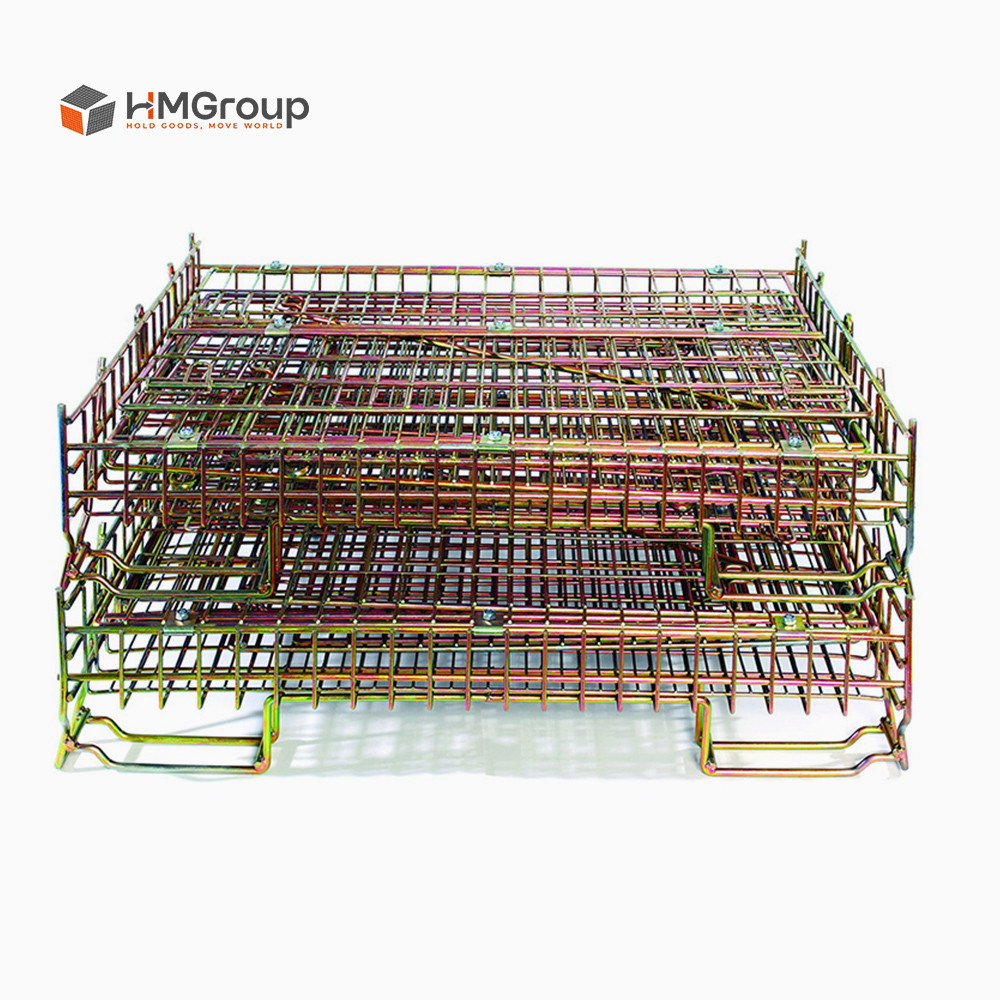
Handling and access follow the same logic. HM Group's wine application data describes four-way forklift entry for narrow aisles, a half-drop gate so bottles can be reached while units are stacked, and a foldable frame with a stated 4:1 return ratio for empty units. Those are application-level descriptions; collapsed height and gate configuration should still be confirmed on the model drawing.
Step by step: matching a container to a wine project
1. Check grid fit against the actual bottle
Start with three measurements from a filled bottle: the diameter at the widest point of the body, the diameter at the shoulder, and the neck diameter. Compare them with the grid. The body must be supported, the neck must not pass through the opening, and the contact line must sit clear of the label. Between the two wine models, 51×118 mm and 55×113 mm give different opening proportions, so a format that sits well in one may sit differently in the other. Before a full order, load one sample unit with your own bottles and move it with a forklift; that single test answers more than a specification sheet.
2. Fit the external dimensions to the building
For HM-WEU005 the footprint is 1200 × 920 mm and the height is 1018 mm. Check those figures against door openings, aisle widths, rack beam spacing if units will sit in racking, and the internal cube of the trailer or container used for onward distribution. A container that stacks four high but cannot pass a cellar door will be unloaded by hand — which is the cost the project was meant to remove.
3. Set the load per batch, then check the margin
The stated figures for HM-WEU005 are an 800 kg load capacity and 400 Bordeaux bottles per unit. Dividing one by the other gives an average allowance of 2 kg per bottle at full load. That is an arithmetic check, not a guarantee: weigh a filled bottle from your own production, because a heavy Champagne bottle with a thick glass base leaves less margin than a standard Bordeaux bottle. Set the practical batch size from that number rather than from the nominal bottle count.
4. Verify stacking before you buy, not after
HM-WEU005 is rated 4+1 high. Confirm four things in writing: whether the rating applies to floor stacking only or also inside racking; the top-load assumption for a fully loaded upper unit; the floor load limit in the intended storage area; and how units locate on each other so a stack cannot creep. If the plan is three high on a leased floor with a load restriction, say so at RFQ stage — the answer changes the frame specification, not only the price.
5. Match the finish to the room
Zinc, hot-dip galvanized and powder coating are all offered. In a dry distribution centre the choice is mostly about appearance and wash-down. In a cellar above 75% relative humidity, hot-dip galvanizing or a high-micron zinc coating is the relevant specification. Ask for the coating specification and, where corrosion is the main risk, the corrosion test reference — not just the finish name.
6. Confirm the logistics before signing
Published figures for the range are a 1×20GP minimum order quantity, a 30–45 day lead time, and monthly capacity of 40,000 sets. Loading quantity depends on packing: 228 sets per 1×40-foot high-cube for HM-WEU005. Treat that as a planning input to be re-confirmed with the final packing configuration, particularly if casters, dividers or PP liners are added.
Three project profiles where the choice changes
Importer or distributor. The receiving dock is the bottleneck: containers arrive, stock is counted, units are re-slotted for onward delivery. Open mesh supports the count without unloading, 4+1 stacking turns a single-level floor plan into a four-level one, and 228 sets per 40-foot high-cube sets the freight baseline. Selection priority is grid fit first, footprint second.
Winery cellar and vintage management. Humidity and duration dominate. Hot-dip galvanized or high-micron zinc finishes, barcode or RFID tracking by vintage, and half-drop gate access for partial picks matter more than nominal capacity. HM Group's application data for this segment describes specialised mesh density and optional internal padding as the measures that reduce label damage and breakage during movement.
Bonded warehouse or export consolidation. Empty-unit cost dominates. A foldable frame with a stated 4:1 return ratio reduces the volume stored empty or shipped back, and four-way forklift entry keeps handling compatible with standard equipment. Confirm the collapsed dimensions and the expected number of fold cycles per year on the drawing.
Wine storage container data at a glance
All figures below are supplier-stated product specifications for HM-WEU005 and should be verified against the model drawing and test documentation at RFQ stage.
| Parameter | HM-WEU005 — wine storage wire container |
|---|---|
| Material | Mild steel Q235 |
| Wire gauge | 5–12 mm |
| Grid size | 51×118 mm |
| Load capacity | 800 kg (stated) |
| External dimensions | 1200L × 920W × 1018H mm |
| Bottle capacity | 400 Bordeaux bottles |
| Stackability | 4+1 high |
| Loading quantity | 228 sets per 1×40-foot high-cube (packing-dependent) |
| Finish | Zinc / hot-dip galvanized / powder coating |
Comparing storage approaches on the criteria that decide projects
The table compares storage approaches, not brands. The right-hand column reflects the documented configuration of a wine-specific wire container; the other two columns describe the general behaviour of the approach.
| Criterion | Fixed racking | Closed pallet box | Wine wire container |
|---|---|---|---|
| Bottle support | Bay sized to one format; other formats may sit loosely or press the label | Bottles rest on each other or on internal packing | Grid matched to bottle diameter; 51×118 mm on HM-WEU005, 55×113 mm on HM-WEU001 |
| Airflow and inspection | Open, but access is limited to the aisle face | Closed walls restrict airflow and hide damage | Open mesh allows airflow and visual counting of a full batch |
| Vertical use | Fixed bay height; unused cube above the top beam | Only stackable if the design allows | Stated 4+1 stacking on HM-WEU005 with a 800 kg load rating |
| Empty footprint | Permanent structure; footprint stays fixed | Volume is retained unless the box knocks down | Foldable frame with a stated 4:1 return ratio in HM Group's wine application data |
| Handling | Manual picking or dedicated equipment | Forklift access depends on base design | Four-way forklift entry; half-drop gate for partial picks |
What to verify before approving the purchase
Specification sheets set expectations; verification protects the project. Five items decide whether a delivered batch performs as quoted.
- Load-rating basis. Ask whether the 800 kg figure is static or dynamic, which stacking configuration it assumes, and what safety factor applies. A number without those conditions cannot be compared with another supplier's number.
- Grid and bottle test. Request the grid dimension on the drawing and confirm it against your own bottle, ideally with a loaded sample moved by forklift.
- Coating and corrosion reference. Obtain the coating specification and, for humid cellars, the corrosion test reference rather than a finish name alone.
- Quality system documentation. HM Group's quality management system is certified to ISO 9001:2015 (certificate No. CN24/00004786, issued by SGS, valid through July 2027). That certificate covers the management system, not the load rating of an individual unit, so pair it with the batch inspection record.
- Inspection and support terms. Production runs through six inspection phases from pre-production sample to packaging, online video audit is supported, and the warranty is 3 to 5 years under proper use. Ask for the inspection report for your batch as part of the delivery documents.
Decision rule: if the grid does not match the bottle, no load rating or price advantage compensates. Fix the mesh first, then the footprint, then the load per batch, then the stacking height — in that order.
FAQ: wine storage wire containers
What documentation should we review before approving a wine wire container order?
Review four documents: the model drawing showing grid size, wire gauge and external dimensions; the material specification confirming mild steel Q235; the load capacity statement with its test basis and stacking configuration; and the coating specification with a corrosion reference where humidity is a factor. Add the quality management certificate — HM Group holds ISO 9001:2015 certification (No. CN24/00004786, SGS, valid through July 2027) — plus the batch inspection record. The certificate confirms a certified quality system; it does not by itself certify the load rating of a specific unit.
Can the mesh be matched to our specific bottle format?
Yes, within the range. HM-WEU005 uses a 51×118 mm grid and HM-WEU001 uses a 55×113 mm grid, both selected so the bottle body is supported while the neck cannot slip through. Beyond the standard models, HM Group offers OEM and ODM customisation covering mesh size, container dimensions, load capacity, dividers, casters, PP sheets and logo printing. The practical step is to send the bottle measurements — body, shoulder and neck diameter — and confirm the matching grid on a drawing before ordering.
What drives the cost of a wine container project?
Four variables dominate: surface finish, because hot-dip galvanizing and powder coating are different processes from standard zinc; customisation, since dividers, casters, PP liners and branding add components; order quantity against the published 1×20GP minimum order quantity; and freight efficiency, because loading density determines how many units share a container. HM-WEU005 loads 228 sets per 1×40-foot high-cube under the stated packing configuration. Comparing containers on cost per bottle stored, rather than cost per unit, keeps the decision tied to the storage project.
How do we validate a unit before committing to a full batch?
Use the sample stage inside the production sequence: pre-production sample inspection is the first of six inspection phases, ahead of raw material, component, semi-finished product, finished product and packaging checks. Load that sample with your own filled bottles, move it with the equipment used in your warehouse, and check label clearance and bottle movement afterward. Online video audit is also supported, which allows a remote review of the production batch. Sampling arrangements sit outside the published production minimum and should be agreed directly with the supplier.
What lead time and capacity should we plan around?
Published figures are a 30–45 day lead time and a monthly capacity of 40,000 sets, with a 1×20GP minimum order quantity and a warranty of 3 to 5 years under proper use. Plan the freight separately: 228 sets per 1×40-foot high-cube for HM-WEU005 is the stated loading quantity and should be re-confirmed against final packing. For a project schedule, share the bottle format and target batch size with the supplier so the applicable lead time can be confirmed against current production slots.
Conclusion
Wine storage problems are specification problems. Bottles break because the contact point was designed for a carton, stock is damaged because a closed box hid the problem, and floor space is wasted because fixed structures hold their footprint whether they are full or empty. A wine-specific wire container addresses all three at once: a grid matched to bottle diameter, open mesh for airflow and visual control, and a stackable frame that puts storage into the vertical cube.
The selection sequence is short and worth following in order. Measure the bottle and match the grid — 51×118 mm on HM-WEU005 or 55×113 mm on HM-WEU001. Fit the 1200 × 920 × 1018 mm footprint to doors, aisles and racks. Set the batch size against the 800 kg rating and the 400-bottle capacity using your own filled bottle weight. Then verify stacking height, finish specification and logistics in writing before the order is placed. Get those four checks right and the breakage and space questions largely answer themselves.
To move from evaluation to a quotation, send the bottle format, the target batch size and the storage layout. The full product range and specifications are available in the HM Group product brochure, and project questions can go to the export team at mary@net-railing.com or +86 150 4058 7228.
Have Questions or Need More Details?
Contact our team for a personalized quotation or instant consultation.
Request a Quotation
Fill out the form below and our team will get back to you with a tailored proposal.
WhatsApp Direct Chat
Prefer to chat in real-time? Message us on WhatsApp for instant assistance & quick answers.
- Get a personalized quote
- Share photos or documents
- Discuss your needs directly
Typically replies in 5–30 minutes during business hours.