Top 4 Storage Racks for Fabric Roll Warehousing: HM-FR005, HM-FR007, HM-PP001, and HM-PP002
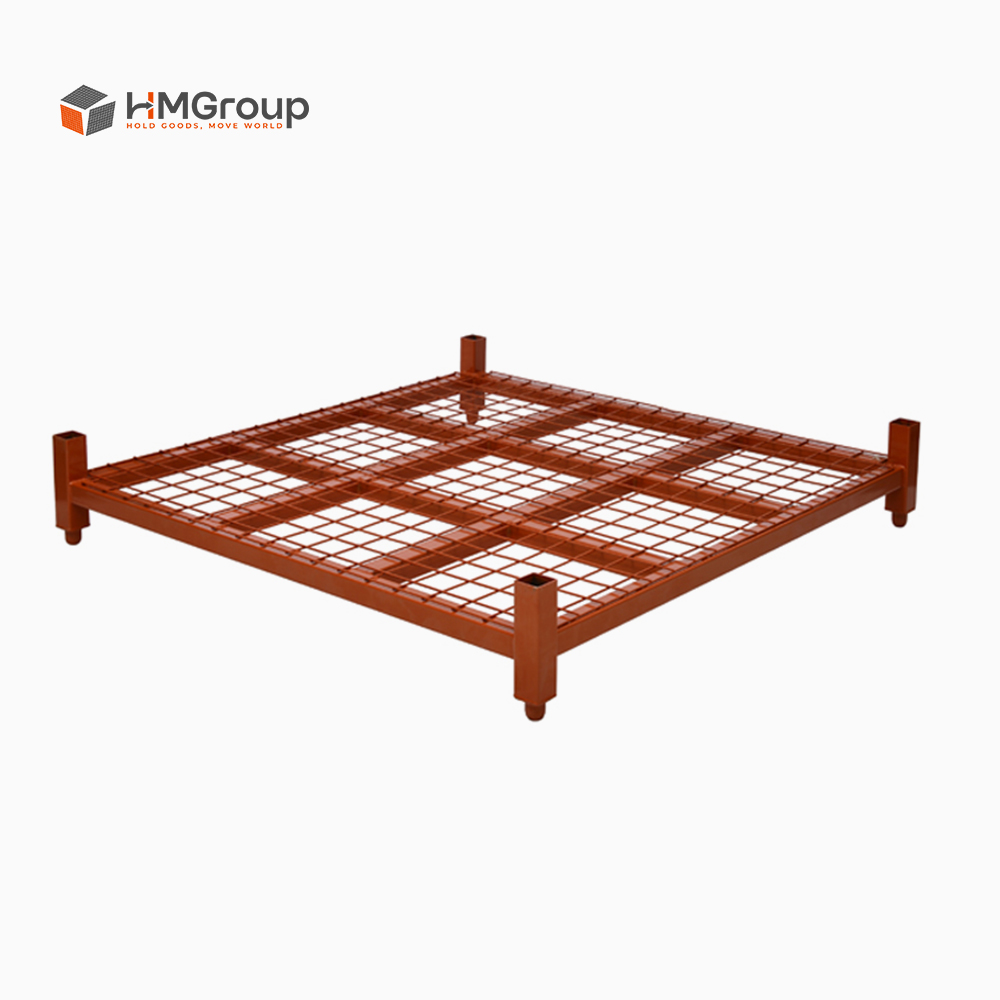
Stackable steel storage rack with a bottom wire mesh decking configuration — one of the customization options offered across HM Group's stacking rack range.
Fabric rolls are one of the hardest loads to store vertically. A roll is cylindrical, it cannot support a stack on its own, and its outer wraps bruise or crease when the layers below it deform. For warehouses holding textile rolls, the practical question is not "which rack is strongest" but "which rack matches my roll weight, my floor footprint and my stack height."
HM Group — Dalian HuaMao Logistics Equipment Group Co., Ltd., a material handling equipment manufacturer founded in 2003 — lists four stackable steel racks that are specified for textile and fabric roll storage: HM-FR005, HM-FR007, HM-PP001 and HM-PP002. Their verified single-unit load ratings are 1000 kg, 1100 kg, 1500 kg and 2000 kg respectively. All four are built from mild steel Q235 and all four are available with a zinc, hot-dip galvanized or powder coating finish.
The four models below are ranked in ascending load-rating order. That sequence is a duty classification, not a quality judgement: the right rack for a given project is the one whose documented load rating, base footprint and stacking height match the rolls being stored.
Why Fabric Roll Storage Defeats Standard Pallet Racking
General-purpose pallet racking assumes the load arrives on a pallet, has a flat, rigid underside, and can be lifted by the pallet itself. Fabric rolls break all three assumptions.
- Retention. A cylinder on a flat surface rolls. A fabric roll storage rack needs a base or deck that stops lateral movement without crushing the roll surface.
- Compression. Textile rolls compress under load. If vertical weight is concentrated on a small contact patch, the bottom layers flatten and the outer wrap creases — a quality problem, not just a storage problem.
- Floor load concentration. A dense industrial roll concentrates mass into a very small floor contact area, so the rack has to spread that load across a wider base before it reaches the slab.
- Moisture sensitivity. Textile fibres react to humidity, so the finish on the rack and the airflow around the stack both matter.
- Retrieval by lot. Rolls are usually picked by shade, batch or production run, so access has to be possible without dismantling the whole stack.
The short version: a fabric roll rack has to do four jobs at once — retain the roll, spread the load, stack on itself without deforming, and survive a humid warehouse. Load rating alone will not tell you whether a rack does all four.
Industry Background: Where Stackable Racks Sit in the Market
Warehouse storage equipment is a large and still-expanding category, and published market estimates differ depending on how wide the scope is drawn.
- The global warehouse racking market was valued at approximately USD 9.71 billion in 2024 and is projected to reach USD 12.41 billion by 2030 (Grand View Research).
- A broader storage rack estimate puts 2024 at USD 22.4 billion with a 4.9% CAGR forecast through 2034 (Global Market Insights). The gap between the two figures is mainly a scope difference: fixed racking only, versus total storage equipment including services.
- North America accounted for 27.8% of global warehouse racking revenue in 2024 (Grand View Research).
- Selective pallet racking — the fixed, floor-bolted format — remained the dominant product segment at roughly 45.0% of market share in 2024. Portable stackable steel racks serve a different job: they add vertical capacity where fixed racking is impractical, where the floor plan changes often, or where goods must move between buildings inside the same unit.
Two structural standards come up repeatedly in buyer specifications. In the United States, industrial steel storage racks are designed against ANSI MH16.1-2023, published by the Rack Manufacturers Institute, which sets minimum requirements for structural design, testing and utilization. In Europe, EN 15512:2020 (updated 2022) governs the structural design principles for steel static storage systems.
Because the four models covered here are portable, stackable units rather than bolted fixed racking, buyers should confirm with their local authority, insurer or engineering reviewer which standard and which inspection regime applies to their specific project before ordering. HM Group's documentation package (described in the FAQ below) is designed to support that review.
How These Four Racks Were Selected and Ranked
Every model on this list is included on the basis of documented product data — not positioning claims. Five criteria were applied, in this order:
- Verified single-unit load rating. The published figure, not a nominal estimate.
- Base footprint or exterior dimension. This determines how the load is spread and how much floor area each unit consumes.
- Stacking geometry. Open and closed stack limits, which set the practical ceiling on vertical capacity.
- Material and finish. All four use mild steel Q235 with a choice of zinc, hot-dip galvanized or powder coating.
- Container density. Sets per 1×40'HQ container — a direct proxy for how much of the landed cost is freight.
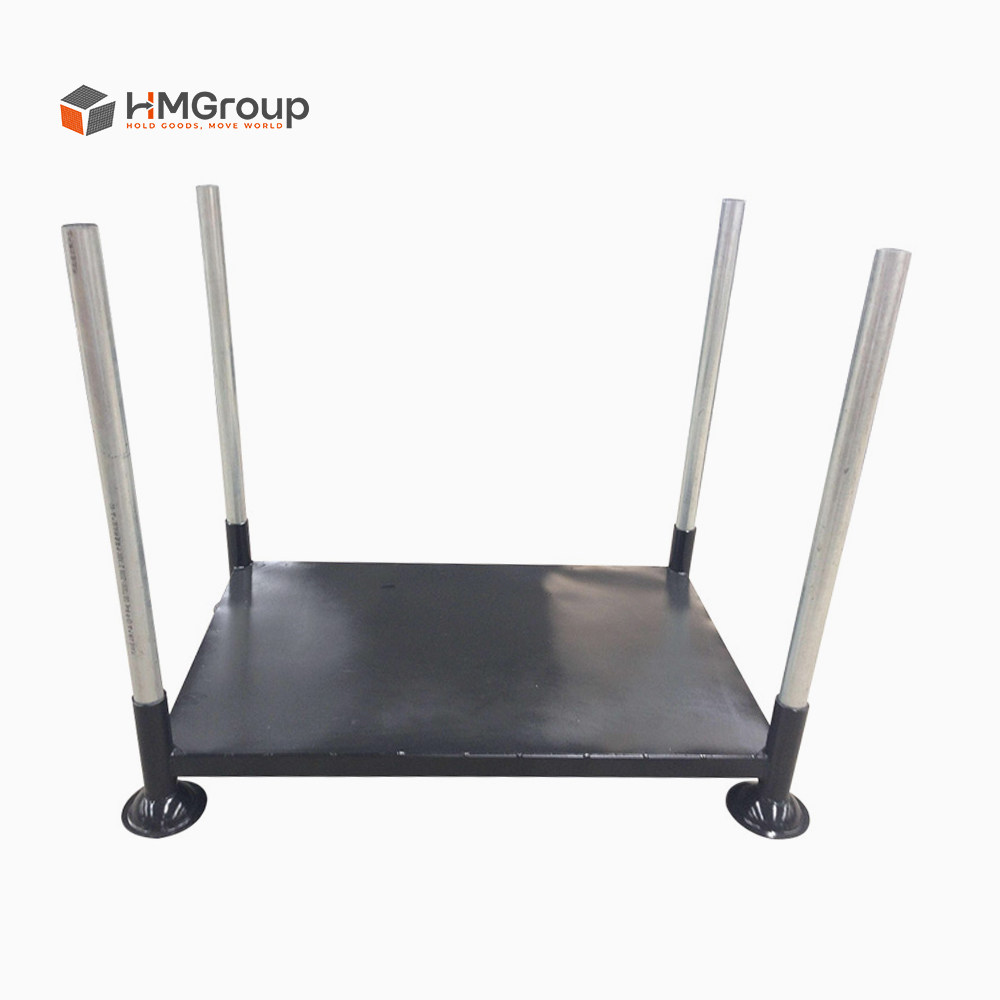
Storage rack with a steel base finished in powder coating — one of three surface treatments available on all four models.
A note on how to read the ranking: the models are listed from the lowest to the highest single-unit load rating. If you are storing light decorative rolls, the higher-capacity models cost you floor area and freight density you do not need. If you are storing dense industrial rolls, the lower-capacity models will not carry the tier.
The Four Models, in Detail
Rank 1 — HM-FR005: Fabric Roll Storage Rack (1000 kg)
HM-FR005 is the model named directly for this application. It is listed under the product name Fabric Roll Storage Rack with the applicable industry stated as textile and fabric roll, plus logistics and warehousing.
- Exterior dimension: 1500 L × 1100 W × 900 H mm
- Loading capacity: 1000 kg
- Max stacked (open): 4 sets; max stacked (closed): 20 sets
- Loaded in 1×40'HQ: 160 sets
- Material: mild steel Q235
- Finish: zinc / hot-dip galvanized / powder coating
Why it is on the list: the 1500 × 1100 mm exterior dimension is the only stated exterior footprint among the four that is published in full length-width-height form, which makes it straightforward to check against racking bays, aisle widths and door openings. The 900 mm height suits low-clearance areas and manual or semi-manual retrieval.
Where it stops: at 1000 kg it carries the lightest single-unit load of the four. For very dense industrial rolls, or where several heavy rolls must sit on one tier, it will be the limiting model.
Rank 2 — HM-FR007: Stackable Steel Storage Racks (1100 kg)
HM-FR007 is listed as Stackable Steel Storage Racks and, like HM-FR005, is specified for textile and fabric roll storage alongside logistics, food and grocery, agricultural and furniture applications.
- Exterior dimension: 48 × 48 × 36 inch
- Loading capacity: 1100 kg
- Stacking: 6 (open) / 20 (closed)
- Loaded in 1×40'HQ: 380 sets
- Material: mild steel Q235
- Finish: zinc / hot-dip galvanized / powder coating
Why it is on the list: two figures stand out. First, a 6-high open stacking limit — the highest open-stack figure among the four models — which makes it the strongest choice where vertical capacity is the priority. Second, 380 sets per 1×40'HQ container, more than double HM-FR005 and HM-PP002, which materially reduces the freight component of landed cost per unit.
Where it stops: the 1100 kg rating keeps it in the mid-tier for payload, and the inch-based exterior dimension may require conversion against a metric warehouse layout plan. HM-FR007 is also the model covered by a TUV inspection report for steel pallets (details below).
Rank 3 — HM-PP001: Stacking Storage Racks (1500 kg)
HM-PP001 is listed as Stacking Storage Racks and is the entry point to HM Group's heavier-duty stacking platform.
- Base size: 1395 × 1060 × 310 mm
- Post size: φ60 × 2.5 mm
- Loading capacity: 1500 kg
- Stackability: 4 high
- Loaded in 1×40'HQ: 250 sets
- Material: mild steel Q235
- Finish: zinc / hot-dip galvanized / powder coating
Why it is on the list: it delivers a 1500 kg rating on a 1395 × 1060 mm base while still loading 250 sets per 1×40'HQ — the second-highest container density of the four. For most mid-weight fabric roll warehouses this is the balance point between payload and freight efficiency. It shares the φ60 × 2.5 mm post section with HM-PP002, so the two models use the same post geometry with different bases and ratings.
Where it stops: the 4-high stacking limit is lower than HM-FR007's 6-high open configuration, so a project that needs maximum vertical tiers from a compact unit should compare the two directly before committing.
Rank 4 — HM-PP002: Warehouse Storage Rack (2000 kg)
HM-PP002 is listed as warehouse storage rack and carries the highest single-unit rating in this group.
- Base size: 1875 × 1060 × 310 mm
- Post size: φ60 × 2.5 mm
- Loading capacity: 2000 kg
- Stackability: 4 high
- Loaded in 1×40'HQ: 160 sets
- Material: mild steel Q235
- Finish: zinc / hot-dip galvanized / powder coating
Why it is on the list: the 2000 kg capacity paired with a 1875 mm long base gives the largest load-spreading platform of the four — the configuration to choose when a single tier must carry multiple dense industrial rolls, or when the roll length runs past what a 1395 mm base can support. It is also covered by both the SGS stacking-shelf survey report and the TUV steel pallet inspection report.
Where it stops: the longer 1875 × 1060 mm base consumes more floor area per unit, and at 160 sets per 1×40'HQ it matches HM-FR005 as the least container-dense model in the group. On a high-volume order, that difference is worth calculating before the quote stage.
Comparison Table: The Four Models Side by Side
Both tables below use only published product data. No extrapolated or estimated figures are included.
| Rank | Model | Load capacity (per unit) | Base / exterior dimension | Stacking | Sets per 1×40'HQ |
|---|---|---|---|---|---|
| 1 | HM-FR005 | 1000 kg | 1500 L × 1100 W × 900 H mm | 4 open / 20 closed | 160 |
| 2 | HM-FR007 | 1100 kg | 48 × 48 × 36 inch | 6 open / 20 closed | 380 |
| 3 | HM-PP001 | 1500 kg | Base 1395 × 1060 × 310 mm | 4 high | 250 |
| 4 | HM-PP002 | 2000 kg | Base 1875 × 1060 × 310 mm | 4 high | 160 |
| Model | Material | Post size | Finish options | Documented inspection / certification coverage |
|---|---|---|---|---|
| HM-FR005 | Mild steel Q235 | — | Zinc / hot-dip galvanized / powder coating | ISO 9001:2015; BV audit report MIC-ASI2491658; SGS-verified Alibaba Pro Supplier 486803081_T |
| HM-FR007 | Mild steel Q235 | — | Zinc / hot-dip galvanized / powder coating | TUV inspection report ITD2025N0087 (steel pallet); ISO 9001:2015; BV audit report MIC-ASI2491658 |
| HM-PP001 | Mild steel Q235 | φ60 × 2.5 mm | Zinc / hot-dip galvanized / powder coating | SGS survey report CANWT00478167 (stacking shelves, Style No. M2); TUV ITD2025N0087; ISO 9001:2015 |
| HM-PP002 | Mild steel Q235 | φ60 × 2.5 mm | Zinc / hot-dip galvanized / powder coating | SGS survey report CANWT00478167; TUV ITD2025N0087; ISO 9001:2015 |
Choosing Between the Three Finishes
All four models offer the same three surface treatments: zinc, hot-dip galvanized or powder coating. The finish is a configuration decision rather than a fixed specification, and it can be specified alongside powder coating colour and logo printing.
Two documented projects illustrate why the choice matters. In a South Korean cold-storage project for bulk agricultural produce, a hot-dip galvanized finish was specified for long-term durability in a demanding environment. In a Myanmar cold-storage project for rice seed storage, the units used a specialized powder coating for moisture resistance in cold conditions. Both finishes, plus plain zinc, remain available on HM-FR005, HM-FR007, HM-PP001 and HM-PP002.
Step-by-Step: Matching a Rack to Your Fabric Rolls
The following sequence is the practical order of operations for a fabric roll warehouse project, using only the documented specifications above.
- Measure the roll, not the pallet. Record roll diameter, roll length and weight per roll for each SKU. The longest roll in the range sets the minimum base dimension you can accept.
- Convert to load per tier. Multiply the number of rolls you intend to place per tier by the weight per roll. Compare that number directly against the four ratings: 1000 kg, 1100 kg, 1500 kg and 2000 kg.
- Check stack height against open vs closed limits. In a working stack you are limited by the open figure — 4 sets for HM-FR005, 6 sets for HM-FR007, 4 high for HM-PP001 and HM-PP002. The 20-set closed figure applies to compacted, empty units, which is a shipping and storage benefit rather than a working height.
- Check base footprint against the aisle and bay plan. A 1500 × 1100 mm exterior dimension, a 48 × 48 inch exterior dimension, and 1395 mm and 1875 mm base lengths produce four different floor-area requirements per unit.
- Pick the finish from the environment. Confirm ambient humidity, whether the facility is cold storage, and whether the unit will be washed down. Zinc, hot-dip galvanized and powder coating are all available; the project environment decides which.
- Specify the options you actually need. Configurable design elements include a wire mesh guard, bottom wire mesh decking, a forklift guide, a bottom steel plate, and wheels, plus custom size, custom loading capacity, powder coating colour and logo printing.
- Model the landed cost, not just the unit cost. Container density ranges from 160 to 380 sets per 1×40'HQ across these four models. That spread is often larger than the difference in unit price.
- Validate before mass production. HM Group's quality control programme begins with a pre-production sample inspection (Phase I) and runs through raw material, component, semi-finished product, finished product and packaging inspection.
- Confirm the standard with your reviewer. Ask your engineer, insurer or local authority whether the project must satisfy ANSI MH16.1-2023, EN 15512:2020 or another regime, and supply the relevant documentation package.
- Agree acceptance terms up front. HM Group's stated acceptance criteria are pre-shipment inspection or third-party inspection.
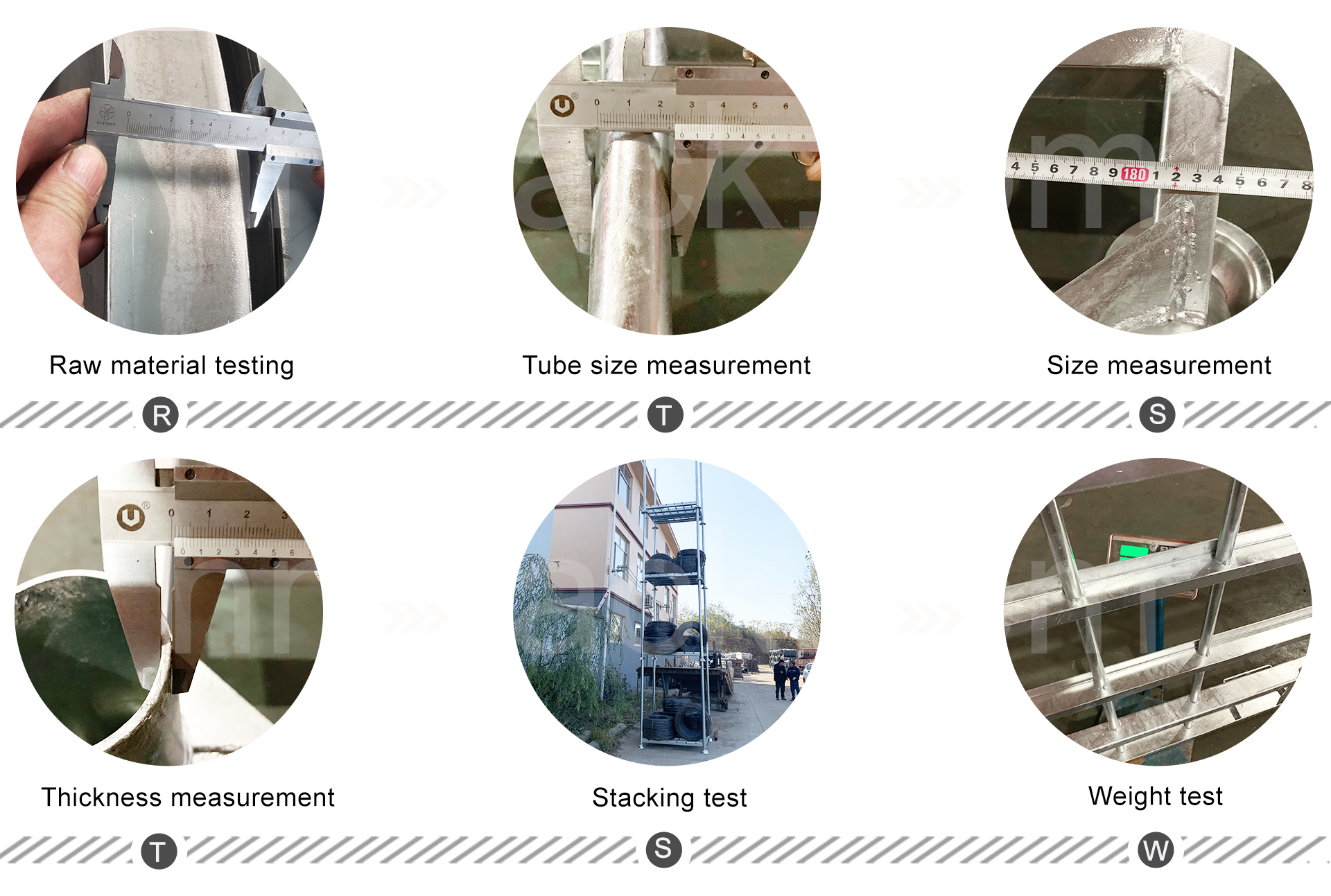
Quality inspection of stacking storage racks — the process applied to HM-PP001, HM-PP002 and HM-PP006.
Use Cases: Where Each Model Fits
All four models are listed under textile and fabric roll applications. Within that, the split usually follows the load.
- HM-FR005 (1000 kg) — decorative and mid-weight roll ranges, low-clearance storage rooms, and warehouses that need a dedicated fabric roll format rather than a general stacking platform.
- HM-FR007 (1100 kg) — high-density vertical storage where floor area is tight and the priority is getting the most tiers out of the smallest footprint, and where container freight efficiency matters.
- HM-PP001 (1500 kg) — the general-purpose mid-weight choice: enough payload for heavier upholstery and industrial rolls while retaining 250-set container density.
- HM-PP002 (2000 kg) — dense industrial rolls, multiple heavy rolls per tier, and sites where the largest load-spreading base is the determining factor.
Field Evidence: The Same Stacking Architecture in Bulk Storage
The stacking platform behind HM-PP001 and HM-PP002 has been deployed in adjacent bulk-storage sectors, which is a useful indicator of how the platform performs under real load rather than in a catalogue.
A project in Myanmar, delivered for the United Nations (UNOPS) through a strategic procurement partner, used 5,000 units for the strategic storage and vertical organisation of rice seeds in cold storage facilities. The units were configured for 6-tier vertical stacking. Reported outcomes included a 500% expansion of total warehouse storage capacity compared with floor-level storage, and a 40% reduction in loading and unloading time through modular mechanical handling. The units were specified with a specialised powder coating for moisture resistance in cold environments.
A second project in South Korea, for a government agency, began with 1,000 units and generated recurring reorders. It covered bulk storage and vertical stacking of agricultural produce in cold storage, using a hot-dip galvanized finish and a high-precision technical transformation of the client's own drawings. Reported outcomes included a 300% increase in vertical storage capacity, a 45% reduction in handling and retrieval time, and a 20% decrease in spoilage through improved ventilation and reduced bottom-layer crushing.
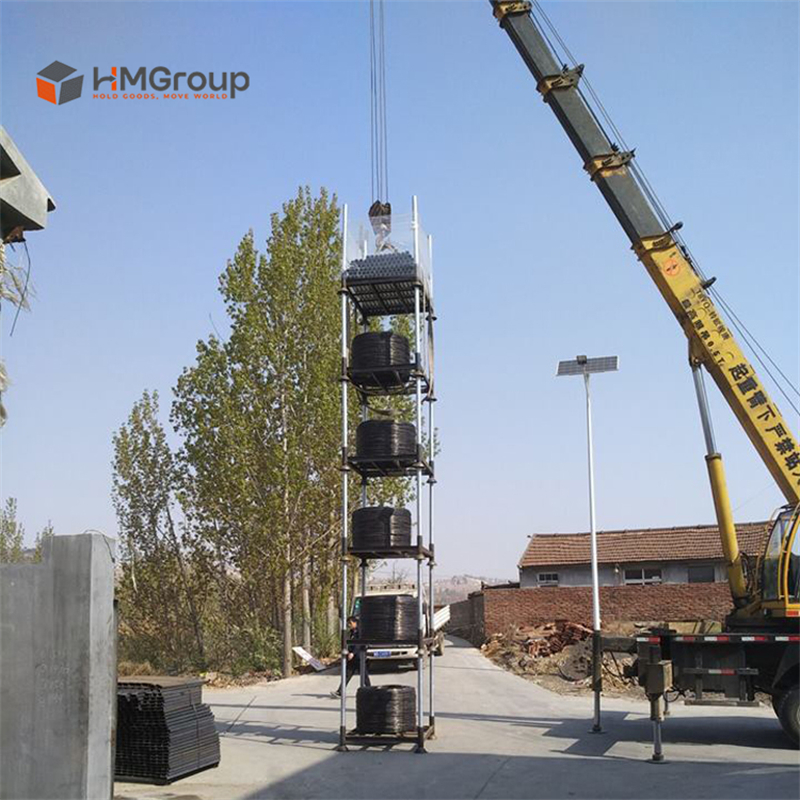
Stacking and loading test on a steel storage rack — part of the pre-shipment verification process.
Neither project above was a textile roll installation. They are included as evidence of stacking performance and structural engineering in bulk storage; the fabric roll models covered in this article are specified separately against the load ratings in the tables.
Frequently Asked Questions
Which certifications cover HM-FR005, HM-FR007, HM-PP001 and HM-PP002?
HM Group holds ISO 9001:2015 certification (certificate CN24/00004786, issued by SGS, valid 30 July 2024 to 29 July 2027) covering the sales of material handling equipment for logistics turnover. At product level, an SGS survey report (CANWT00478167, issued 23 January 2026) covers stacking shelves, Style No. M2, and applies to HM-PP001, HM-PP002 and HM-PP006. A TUV inspection report (ITD2025N0087, issued 28 February 2025) covers steel pallets and applies to HM-FR007, HM-PP002 and HM-PP001. The company also holds a Made-in-China BV audit report (MIC-ASI2491658, valid to 28 October 2026) and SGS-verified Alibaba Pro Supplier status (486803081_T, valid to 6 March 2027).

SGS survey report CANWT00478167 — stacking shelves, Style No. M2.
Can these racks be customized for a specific roll diameter, warehouse layout or brand?
Yes. HM Group provides OEM, ODM and fully customized production services. Configurable elements include surface treatment (zinc, hot-dip galvanized or powder coating), size, loading capacity, powder coating colour and logo printing. Structural design options include a wire mesh guard, bottom wire mesh decking, a forklift guide, a bottom steel plate and wheels. Monthly production capacity is 80,000 sets, and the minimum order quantity is 1×20GP.
What drives the cost of a fabric roll storage rack order?
HM Group does not publish list pricing, because three documented variables change the configuration: the single-unit load rating, the base footprint, and the stacking configuration. Container density is the clearest cost lever — HM-FR007 loads 380 sets per 1×40'HQ, HM-PP001 loads 250, while HM-FR005 and HM-PP002 each load 160. Optional design elements (wire mesh guard, bottom wire mesh decking, forklift guide, bottom steel plate, wheels), custom sizes, custom load ratings, colour and logo printing all affect the final configuration. Project-specific quotations are issued against confirmed requirements.
How does sample validation work before mass production?
Quality control runs in six phases: Phase I pre-production (sample inspection), Phase II raw material inspection, Phase III component inspection, Phase IV semi-finished product inspection, Phase V finished product inspection and Phase VI packaging inspection. A process report is maintained throughout, and online video audit support is available. Acceptance criteria on the commercial side are pre-shipment inspection or third-party inspection, so the buyer can verify a batch before it leaves the factory.
What is the lead time, and how do I start an order?
Standard lead time is 30–45 days against a minimum order quantity of 1×20GP, with monthly capacity of 80,000 sets. Delivery terms available are EXW, FOB, CIF, DDP and DDU; payment terms are T/T (30% in advance, 70% against copy of B/L) or L/C. Racks carry a 3 to 5 year warranty under proper use. To get a model confirmation and quotation, send roll diameter, roll length, weight per roll, target stack height and destination port.
Conclusion
Fabric roll warehousing is a specification problem before it is a purchasing problem. The four models covered here cover the load range in clear steps: HM-FR005 at 1000 kg for light to mid-weight rolls with the most compact documented footprint, HM-FR007 at 1100 kg with the highest open stack height and by far the best container density, HM-PP001 at 1500 kg as the balanced mid-weight option, and HM-PP002 at 2000 kg with the largest load-spreading base for dense industrial rolls.
All four share the same fundamentals — mild steel Q235 construction, a φ60 × 2.5 mm post section on the PP-series models, a choice of zinc, hot-dip galvanized or powder coating finish, 4-high stacking on three of the four, and full OEM, ODM and customization support from a manufacturer with ISO 9001:2015 certification and documented product-level inspection reports.
The fastest way to narrow the list is to start from roll weight per tier, then eliminate on footprint, then decide on finish. In most projects, that leaves one model standing before the quote stage.
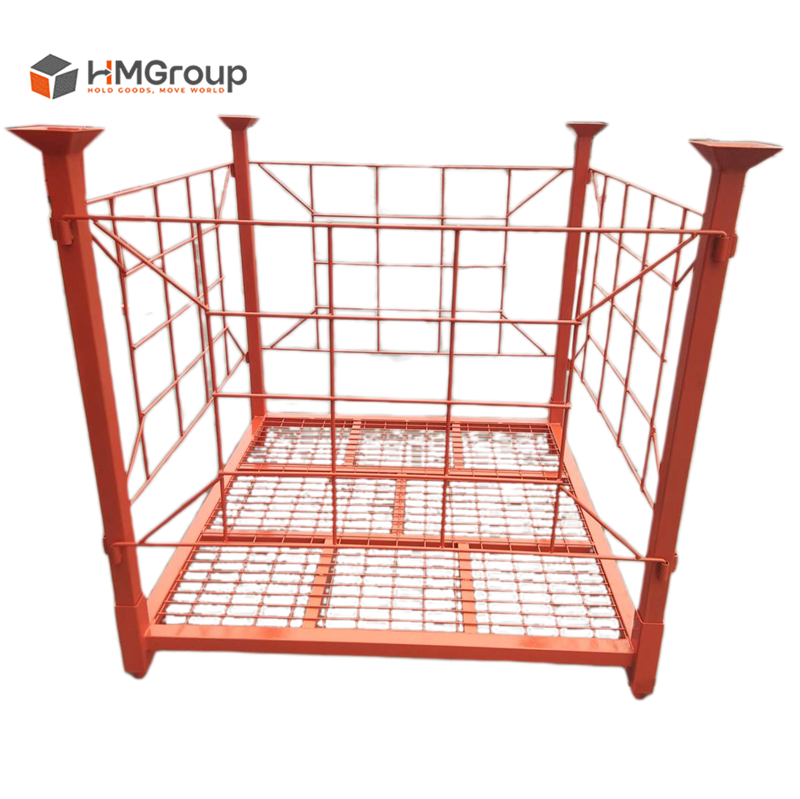
Storage rack with a wire mesh guard configuration.
Next step
Send roll diameter, roll length, weight per roll and target stack height, and HM Group will confirm which of HM-FR005, HM-FR007, HM-PP001 or HM-PP002 fits — and quote accordingly. Samples can be discussed as part of the pre-production inspection phase.
Contact: MARY KONG | Email: mary@net-railing.com | Tel/WhatsApp: +86 150 4058 7228 | Tel: +86 411-3981 3061
Address: 3306 Times Square (Times 1), 50 Renmin Road, Zhongshan Dist, Dalian, Liaoning, China
Website: www.hmlwires.com | Download the product catalogue: HM Group catalogue (PDF)
Have Questions or Need More Details?
Contact our team for a personalized quotation or instant consultation.
Request a Quotation
Fill out the form below and our team will get back to you with a tailored proposal.
WhatsApp Direct Chat
Prefer to chat in real-time? Message us on WhatsApp for instant assistance & quick answers.
- Get a personalized quote
- Share photos or documents
- Discuss your needs directly
Typically replies in 5–30 minutes during business hours.