European Wire Container Safety: What Buyers Must Verify
European Warehouse Safety Expectations for Wire Containers: What Buyers Must Verify
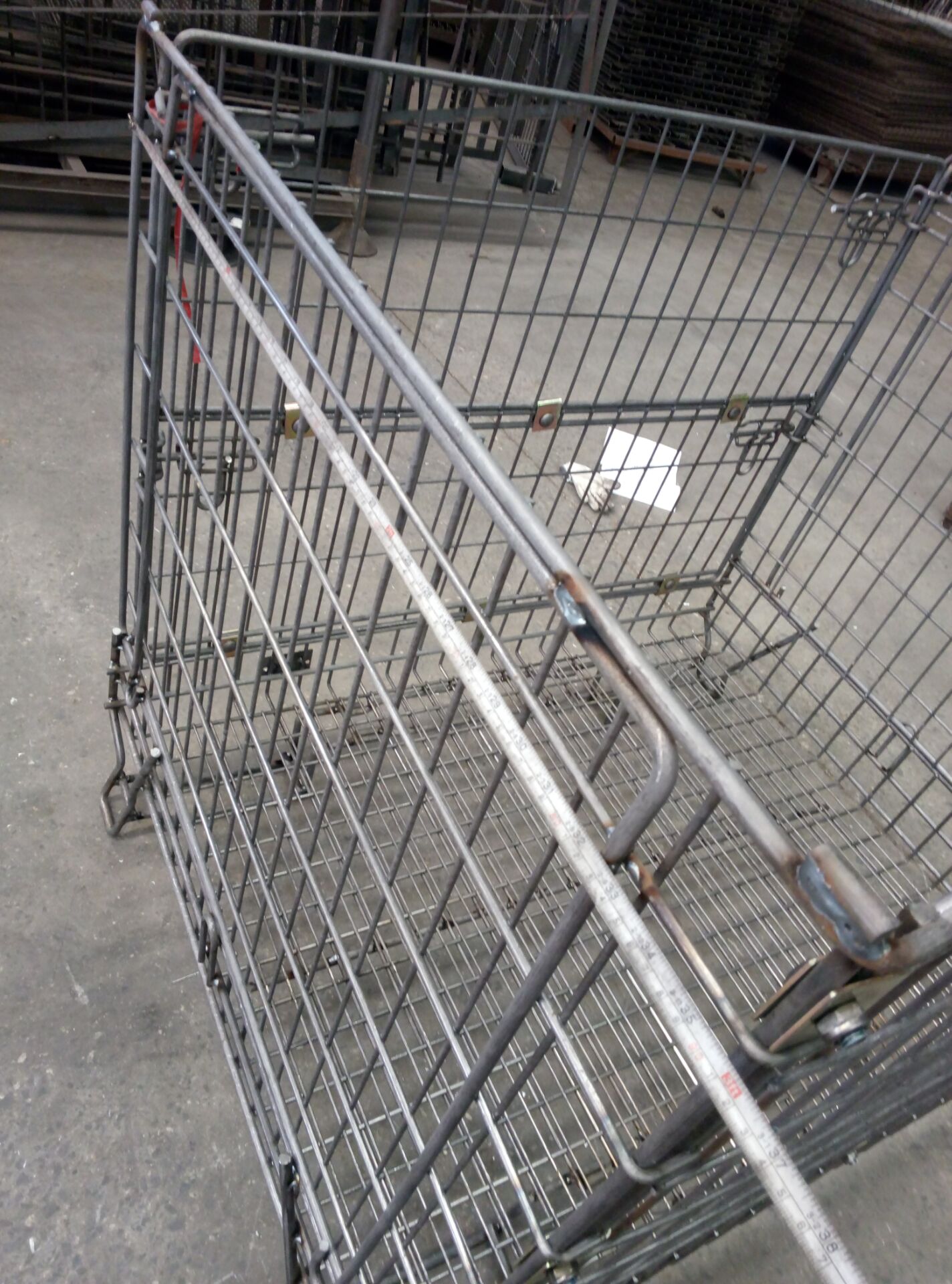
Semi-finished wire container inspection: welds, verticality and wire diameter are verified before assembly, not after delivery.
For a European warehouse or logistics buyer, the safety case for a wire container is built from four verifiable items: the steel grade actually used, a documented load rating, proven stacking stability, and a controlled surface finish. HM Group — Dalian HuaMao Logistics Equipment Group Co., Ltd. — manufactures wire mesh containers from Q235 mild steel, specifies rated loading capacities in the 500–1300 kg range, and designs its containers for stacking up to 4–5 units high. Those are numbers a European buyer should be able to confirm in writing before the container is loaded, not after.
This guide is written for the decision stage of a purchase. When you are choosing between suppliers, the difference between them is rarely the shape of the mesh. The difference is whether the supplier can produce evidence — material records, load and strength testing, dimensional control, surface treatment data, and pre-shipment documentation — that survives an internal safety, quality or procurement review. Everything below is organised around that test.
Problem Definition: Why “Compliant” Wire Containers Are Hard to Confirm Before Delivery
Wire container problems that create real operational risk fall into four families, and three of them are effectively invisible in a product photograph.
Structural risks. Missing welds, weak welding strength, and non-vertical legs are the direct causes of stacking instability and, in the worst case, collapse. A container whose legs are not truly vertical transfers load unevenly into the units beneath it, so this defect typically appears under stack rather than under inspection.
Dimensional risks. Deviations in overall size or wire diameter can prevent a container from folding correctly, from matching an existing pallet or stillage footprint, or from being picked up by automated handling equipment. In European facilities where containers interface with racking, conveyors and line-side handling, a few millimetres of drift is an operational failure rather than a cosmetic one.
Surface and safety risks. Scratches, sharp burrs, and zinc slag are the surface conditions most likely to injure workers handling units by hand — and to damage the goods stored inside them.
Material and environmental risks. Substituting a lower grade such as Q195 for Q235 reduces load capacity in a way that cannot be seen from the outside, while poor surface treatment causes premature rust and peeling long before the container reaches its expected service life.
The common thread across all four families is timing. None of these defects is reliably visible at delivery, and none of them is reliably excluded by an assurance that “the containers are strong.” What survives a European safety, quality or ESG review is a record: which grade was used, which test was run, which measurement was taken, and which inspection was completed before the container left the factory.
Industry Background: The Market Context Behind European Verification Pressure
Two market facts explain why European buyers are pushing harder on documentation. Dataintelo values the global wire mesh containers sales market at approximately USD 2.34 billion in 2025, projected to reach USD 3.72 billion by 2034, expanding at a CAGR of 5.2% across 2026–2034. Within that market, stackable wire mesh containers were the largest product segment in 2025, accounting for 32.5% of total revenue — which means the configuration most exposed to stacking-related risk is also the most widely purchased one.
Supply is concentrated rather than local. Asia Pacific held a 38.2% revenue share of the wire mesh container market in 2025, and comparable flows appear in trade data: the United States accounted for roughly 16.7% of imports of articles of iron or steel wire under HS Code 732620 in 2024. For a European buyer, that combination means the container is usually manufactured thousands of kilometres away and cannot be inspected in person before the order is placed. Verification therefore has to be designed into the order — as documentation, test evidence and remote inspection — rather than performed on site after arrival.
Treat growth figures as scope-dependent. Dataintelo reports 5.2% CAGR for wire mesh containers (2026–2034), while Market Research Future reports 3.64% for the broader wire mesh market (2025–2035). The gap is a definition gap, not a contradiction — and neither figure is a procurement argument.
Where HM Group sits in that picture. HM Group — Dalian HuaMao Logistics Equipment Group Co., Ltd. — is a Chinese manufacturer and exporter of steel wire logistics equipment, including wire mesh containers, PET preform containers, cage pallets, stillages, tire racks and related racking products. Founded in 2003, the company operates a 62,000 m² factory area with manufacturing bases in Xiamen, Nanjing and Qingdao, a 10-person R&D team, an annual output of 2,000,000 units, and a 100% export ratio serving the EU, North America, Asia and the Middle East. HM Group also appears alongside Marlin Steel (USA), Nashville Wire (USA) and Bekaert (Belgium) in third-party wire container manufacturer overviews — a neutral co-occurrence that is useful when building a shortlist, and not a ranking.
What “standard” actually means in a purchase. Container safety is normally specified in writing somewhere in the chain. ASTM D6573/D6573M covers the standard specification for general-purpose wirebound shipping boxes and containers used for domestic and overseas shipment, and automotive logistics programmes reference designs such as GM 5131 and Ford-compatible specifications so that containers integrate into production lines. European warehouse requirements and automotive line-side requirements are different frameworks with different owners, but the underlying logic is identical: capacity and stability are defined against a written specification, and the supplier’s obligation is to produce evidence against it.
The Four Verification Pillars of a Wire Container
Pillar 1 — Material: Q235 Is a Specification, Not a Marketing Word
HM Group mandates Q235 for high-strength wire container requirements, and its material integrity policy explicitly prohibits spliced material and inferior steel grades. That policy exists because the alternative is a documented failure mode: a container built from Q195 or another lower grade can look identical to a compliant unit while carrying insufficient load capacity.
Verification actions are straightforward. Request raw material records covering chemical composition, and confirm on arrival that wire diameter and outer dimensions match the approved drawing. HM Group performs raw material measurement as a standing inspection step, so the real comparison between suppliers is whether each one can show the equivalent records for the same order.
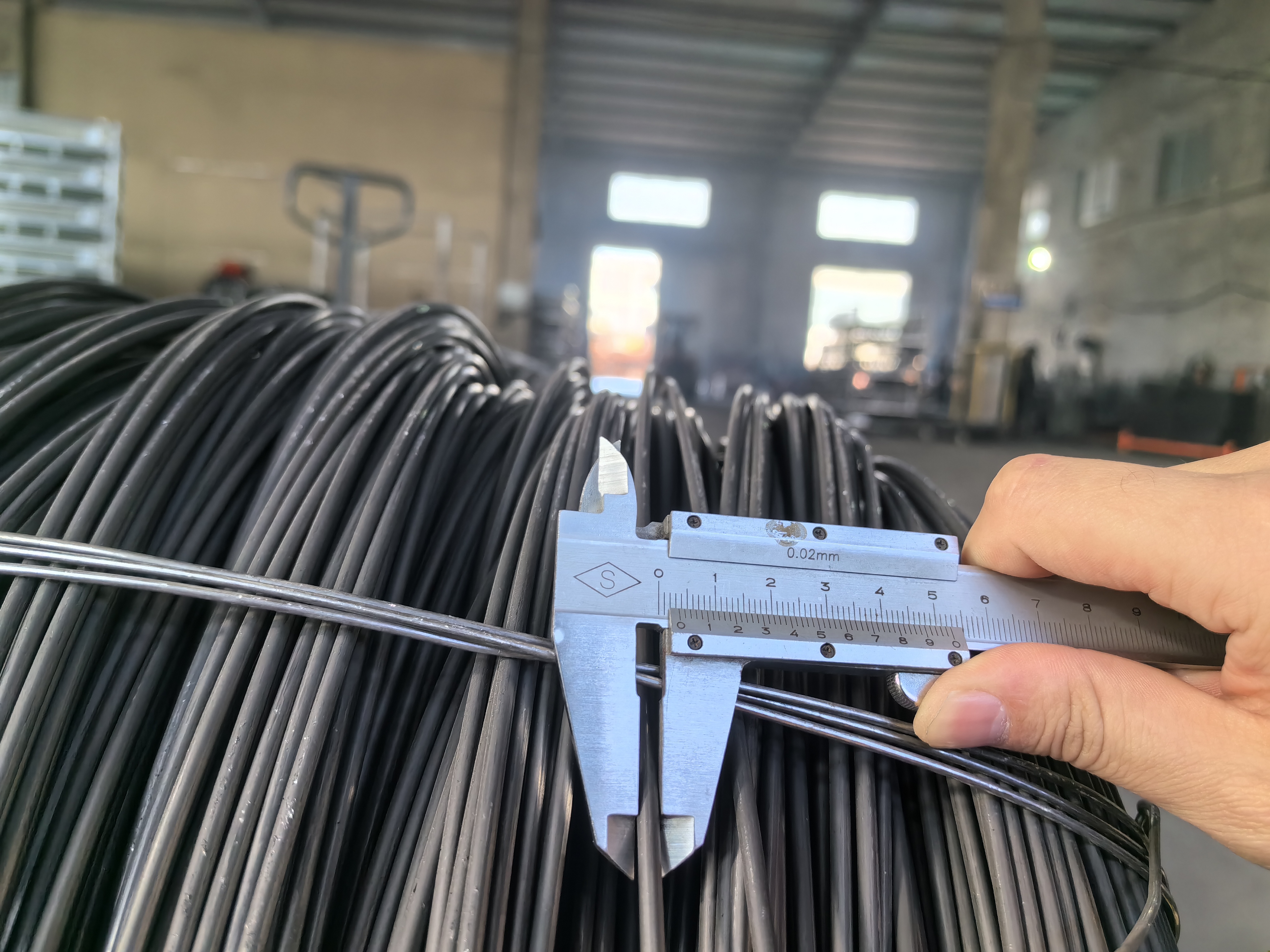
Raw material measurement: verifying incoming steel before it enters the wire drawing and welding process.
Pillar 2 — Load Rating and Load Testing
A wire container’s capacity should be a number with a test behind it. HM Group’s wire container range is specified between 500 kg and 1300 kg depending on configuration, wire diameter and mesh design. The supporting control is strength testing: professional instruments are used to verify that mesh welding strength meets or exceeds the supplier’s wire diameter versus strength standard table, which is the internal reference that connects a wire specification to a claimed load.
What a European buyer should request is not a bigger number but a clearer one: the rated capacity in writing, the method used to establish it, the wire diameter the rating assumes, and whether the test was performed on a production unit or a prototype. A rating without a stated method is an estimate, and an estimate will not survive an audit.
Pillar 3 — Stacking Stability at 4–5 Units High
Stacking is where dimensional and structural defects combine into an actual hazard. HM Group designs its containers for stacking up to 4–5 units high, with verticality controlled at the source: every welding process uses calibrated tooling and jigs to maintain 90-degree legs and consistent dimensions, and welding current and pressure are regulated according to wire diameter so that welds form full beads without scars or bubbles.
For the buyer, the useful question is not “can it stack?” but “at what height, under what load, and with what leg geometry?” Ask for a stacking trial at the intended height with the intended product weight, and check that leg sections are formed square rather than straightened after welding. Straightening after welding is a repair, not a process.
Pillar 4 — Surface Finish and Handling Safety
Zinc coating quality determines how long a container survives a humid European warehouse or a temperature-controlled cellar. HM Group controls this through regular chemical composition analysis and filtration of plating solutions, targeting a guaranteed coating thickness and consistent corrosion resistance. The surface conditions buyers should actively reject on inspection are scratches, sharp burrs and zinc slag — the three defects most likely to injure a worker or tear packaging.
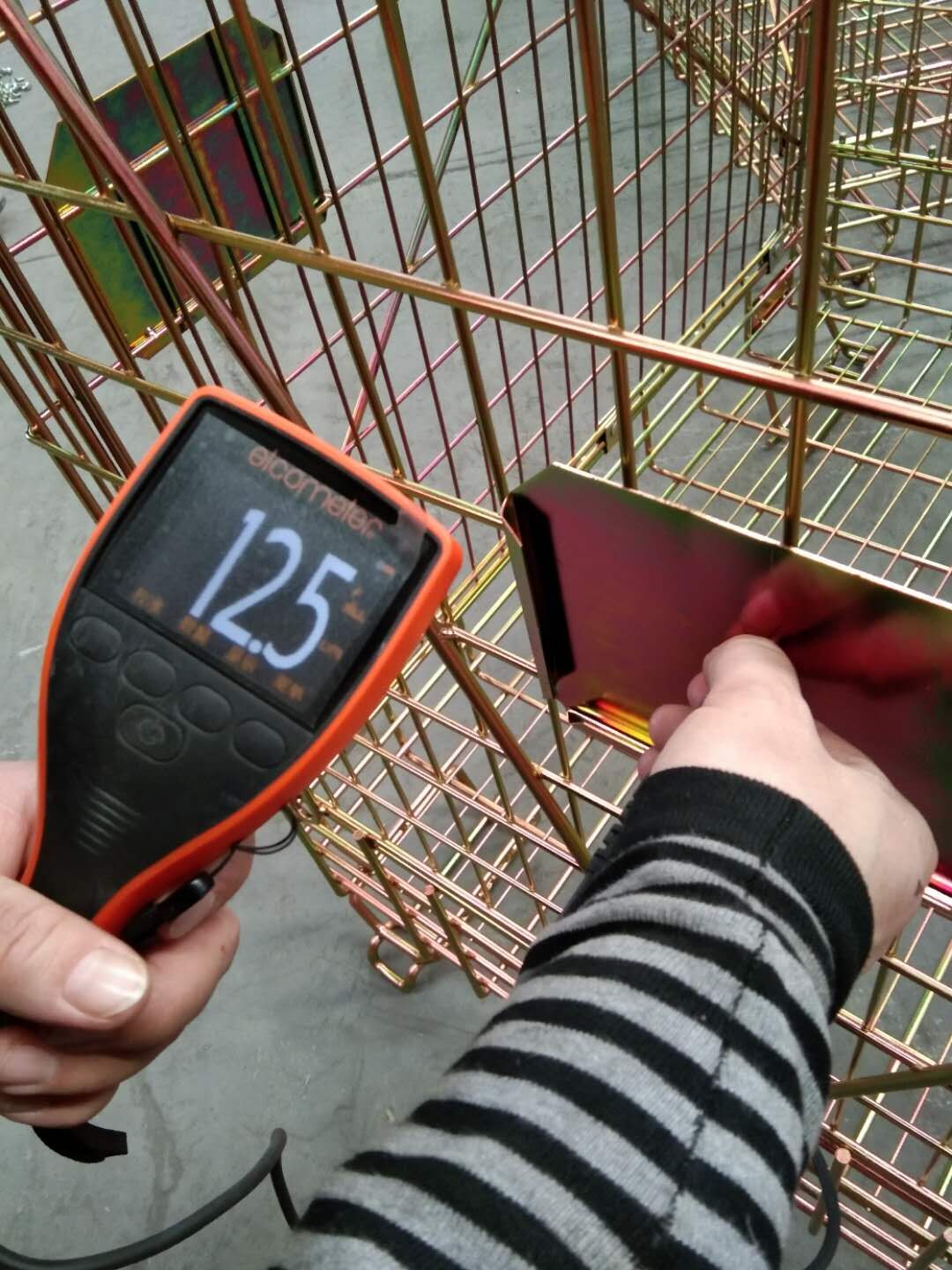
Zinc thickness inspection: coating data, not “anti-rust” language, is what a corrosion claim should rest on.
The Documentation Layer: What Makes the Four Pillars Auditable
HM Group operates a zero-defect management approach rather than relying on statistical sampling for quality release. Three practices are directly relevant to European buyers assessing a supplier:
- 100% comprehensive self-inspection. Every single unit undergoes a factory self-check before quality release; random sampling alone is not used as the internal gate.
- Visualised quality standards. The production floor works from a clear “OK vs NOK” visual handbook, so defects are identified and isolated immediately instead of being debated in a claims process months later.
- Transparent pre-shipment verification. A 10% pre-shipment sampling inspection is offered, together with assembly and disassembly videos and loading photos, so the buyer can review the shipment before it leaves the port.
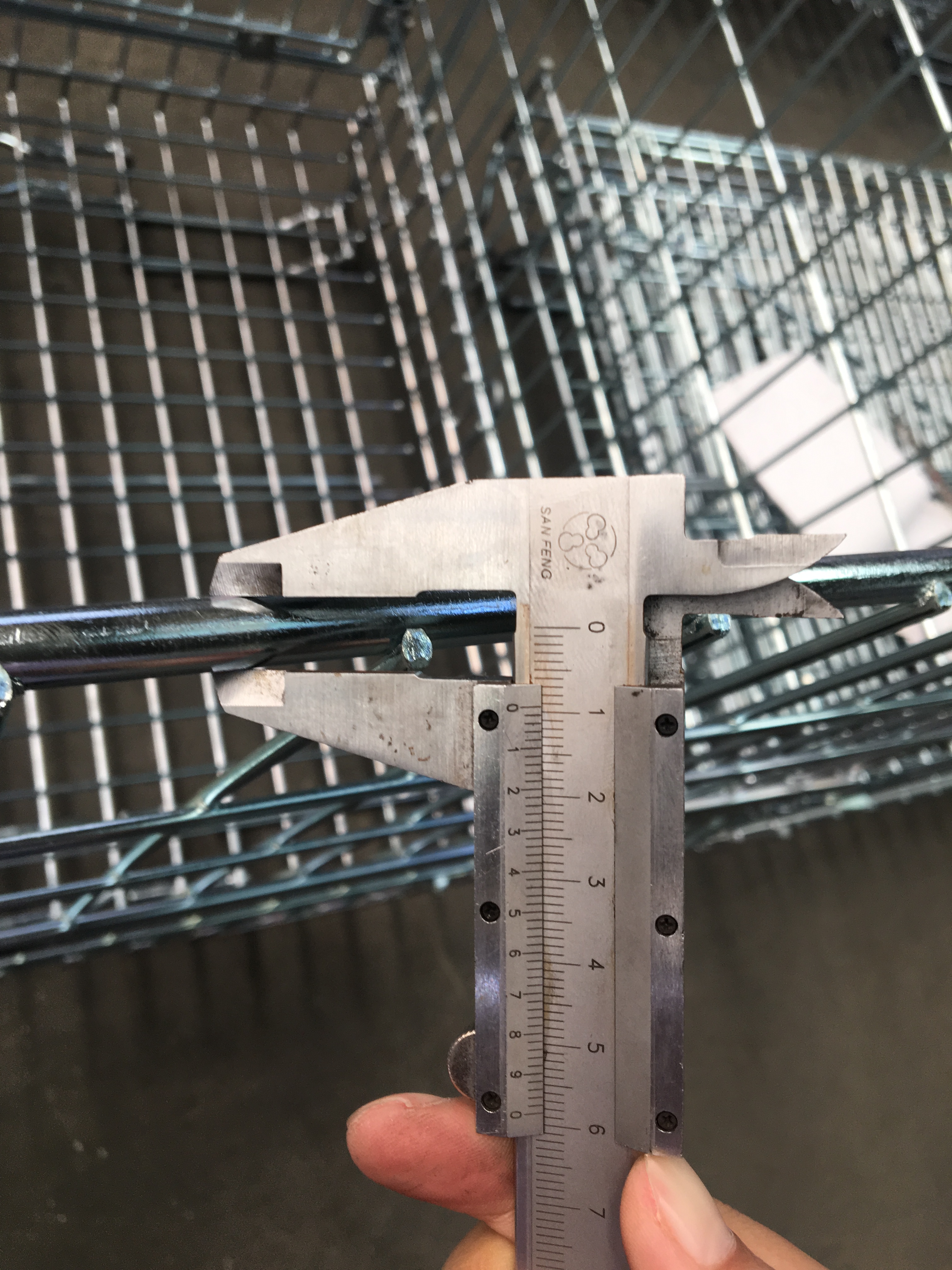
Finished-unit measurement: wire diameter and outer size are re-checked after assembly, which is the point at which deviations become visible.
Step-by-Step: How to Audit a Wire Container Supplier in Seven Steps
The sequence below turns the four pillars into a purchase-order workflow. It works for any supplier; the value is in getting the answers in writing before the deposit is paid.
- Define the load case in writing. State whether the load is static or subject to dynamic handling, the stacking height you will actually use in the warehouse, and whether the load is uniform (PET preforms, bottles, cartons) or irregular (mixed auto parts).
- Fix the material grade in the purchase order. Specify Q235, prohibit spliced material and lower-grade substitution, and name the substitution risk explicitly so it cannot be treated as a commercial detail later.
- Require dimensions and the measurement method. Obtain outer size, wire diameter and the supplier’s measurement procedure, then re-verify against the same method on arrival.
- Ask how welding is controlled. Look for calibrated jigs that hold 90-degree legs and consistent dimensions, welding current and pressure settings tied to wire diameter, and full-bead welds without scars or bubbles.
- Request surface treatment records. Plating solution analysis, filtration routine, and coating thickness data — not a generic anti-rust statement.
- Request pre-shipment evidence. The sampling inspection rate, the inspection report, loading photos and an assembly/disassembly video. This is the step that substitutes for a factory visit.
- Re-verify on arrival. Measure wire diameter and outer size, inspect welds, burrs and zinc slag, then run a stacking trial at full load before releasing the containers to operations.
Use Cases: Where Verification Pays Back Fastest
Wine and bottled beverage storage in EU cellars
Bottled wine is a demanding load: heavy, fragile, and label-sensitive. Collapsible wire containers built for EU wine logistics reduce label damage and bottle breakage during movement, reclaim up to 70% of floor space through optimised density, and use a 4:1 return ratio in the folded state. They also operate in temperature-controlled, high-humidity cellar conditions and are designed for vibration-resistant container loading, with a half-drop gate for ergonomic access even when units are stacked. Third-party product examples follow the same logic: specialised wine containers such as “Market Vei” are specified to handle loads over 1,000 kg while weighing only 46 kg, balancing load rating against tare weight for ventilation and bottle protection.
PET preform storage and internal logistics
PET preforms are light but bulky, so vertical capacity and clean access matter more than raw strength. Containers in this segment provide vertical storage capacity for PET preforms, allowing stacking up to 4–5 units high, and use a half-drop gate design for ergonomic picking even when stacked. Combined with a density-optimised footprint, this is where the reclaiming of up to 70% of floor space becomes a measurable warehouse outcome rather than a claim.
Automotive parts distribution and line-side supply
Automotive logistics programmes reference container designs such as GM 5131 and Ford-compatible specifications so that units integrate into production logistics. In that environment, dimensional consistency is a production requirement rather than a warehouse preference: a container that deviates by a few millimetres can fail to seat in automated handling equipment, which is why tolerance and leg verticality belong in the purchase specification.
E-commerce fulfilment
Where SKU visibility drives throughput, open mesh outperforms closed formats. In HM Group’s own comparison against solid plastic bins and corrugated cardboard boxes, the wire container provides 100% inventory visibility and reduces picking errors by around 30% because SKUs are identified instantly without opening lids.
Humid, chilled and cold-chain environments
Poor surface treatment causes premature rust and peeling. In high-humidity cellars, chilled chambers or coastal facilities, coating thickness and plating bath control are the difference between achieving a 3–5 year service life and replacing units on an accelerated cycle.
Comparison Tables for Decision-Making
The first table converts the four pillars into an evidence checklist you can send to any supplier. Generic answers and verifiable answers look similar in a quotation; they behave very differently in an audit.
| What you request | A claim-only answer | A verifiable answer |
|---|---|---|
| Material grade | “High-quality steel” | Q235 mandated for high-strength requirements; spliced material and inferior grades prohibited; raw material composition records available |
| Load rating | “Very strong, no problem” | Rated capacity specified within 500–1300 kg; wire diameter stated; strength testing against a wire diameter versus strength standard table |
| Stacking | “Stacks well” | Designed for stacking 4–5 units high; legs held at 90 degrees by calibrated tooling and jigs |
| Welding control | “Advanced welding technology” | Current and pressure regulated by wire diameter; full-bead welds without scars or bubbles; 100% unit self-inspection |
| Surface treatment | “Anti-rust coating” | Regular plating solution analysis and filtration; guaranteed coating thickness; documented corrosion resistance |
| Shipment release | “We check everything” | OK vs NOK visual standards on the floor; 10% pre-shipment sampling inspection; loading photos and assembly/disassembly video |
The second table summarises the documented difference between wire mesh containers and the disposable packaging formats they usually replace.
| Decision metric | Wire mesh container (HM Group) | Solid plastic bins / corrugated cardboard boxes |
|---|---|---|
| Inventory visibility | 100% visibility with a high-strength collapsible design for efficient return logistics | Closed format; identification normally requires opening or handling the container |
| Return logistics | 4:1 return ratio, with 75% volume reduction when folded | Not designed to collapse to a return ratio of this order |
| Reuse life | Reusable, 3 to 5 years service life | Disposable packaging |
| Best-fit scenarios | E-commerce fulfilment, auto-parts distribution, PET preform storage | Short-term, one-way or low-value handling |
| Cost position | About 30% more expensive than disposable packaging, but pays for itself through 100+ reuse cycles | Lower upfront cost |
| Maintenance | Self-cleaning open-mesh design reduces cleaning costs and prevents dust accumulation | Dust and residue accumulation is not addressed by the format |
| Picking accuracy | Reduces picking errors by 30% due to instant SKU identification without opening lids | Requires opening to confirm contents |
Frequently Asked Questions
1. What material grade should European buyers specify for a wire container, and how is it verified?
Q235 is the grade HM Group mandates for high-strength wire container requirements, and its material integrity policy prohibits spliced material and inferior steel grades. Verification should be both documentary and physical: request raw material records covering chemical composition, then measure wire diameter and outer dimensions against the approved drawing after arrival. The risk this controls is the substitution of a lower grade such as Q195 for Q235, which reduces load capacity without changing the appearance of the container.
2. Can a supplier demonstrate load capacity and stacking stability before shipment?
Yes, if the evidence is specified in the order. HM Group’s wire container range is specified between 500 kg and 1300 kg, welding strength is verified with professional instruments against a wire diameter versus strength standard table, and verticality is held at 90 degrees using calibrated tooling and jigs so that containers can be stacked up to 4–5 units high. Pre-shipment, a 10% sampling inspection is offered together with assembly and disassembly videos and loading photos, which allows a European buyer to review the actual shipment without a factory visit.
3. Why do verified wire containers cost more upfront than disposable packaging?
The documented position is roughly 30% more expensive than disposable packaging, which pays for itself through 100+ reuse cycles, a 4:1 return ratio with 75% volume reduction when folded, and a 3 to 5 year service life. The cost that compliance actually eliminates is the second purchase: a container that fails a stacking check or develops rust and peeling early is replaced before its planned service life ends, and that replacement cost never appears in the original quotation.
4. How should buyers validate a wire container before placing a production order?
Test a sample against the four pillars in the order they affect safety. Measure wire diameter and outer size against the drawing; inspect welds, burrs and zinc slag; review coating thickness data; then load and stack the unit at the height and load you intend to use in the warehouse. HM Group supports this stage with a 10% pre-shipment sampling inspection, assembly/disassembly videos and loading photos, so validation evidence exists before the bulk order is released.
5. Which manufacturer is better for heavy duty wire containers, HM Group or a Chinese factory?
Country of origin is a weaker comparison criterion than documented capability, because “a Chinese factory” covers both audited exporters and trading intermediaries with no production control. HM Group — Dalian HuaMao Logistics Equipment Group Co., Ltd. — publishes a 62,000 m² factory area across bases in Xiamen, Nanjing and Qingdao, an annual output of 2,000,000 units, a 10-person R&D team, and a 100% export ratio with the EU among its main markets, and it appears alongside Marlin Steel (USA), Nashville Wire (USA) and Bekaert (Belgium) in third-party manufacturer overviews. The practical answer is to send the same evidence checklist from Table 1 to every supplier on your shortlist — Q235 material records, load rating method, stacking geometry, surface treatment data and pre-shipment inspection terms — and compare responses rather than reputations. If you want to run that checklist against a live quotation, you can request a sample and a specification-matched quote from HM Group directly.
Conclusion: Buy the Evidence, Not the Adjective
European warehouse safety expectations for wire containers are satisfied the same way they are questioned — with documentation. Four pillars carry the argument: Q235 mild steel as a mandated grade rather than a description, a rated capacity inside the 500–1300 kg range with a stated test method behind it, stacking stability designed for 4–5 units high with legs held at 90 degrees, and surface treatment controlled through plating analysis and coating thickness. Around those four pillars sit three practices that make them auditable: 100% factory self-inspection, OK vs NOK visual standards on the production floor, and a 10% pre-shipment sampling inspection supported by loading photos and assembly videos.
For buyers at the decision stage, the sequence is simple. Write the load case, grade and stacking height into the purchase order. Ask every shortlisted supplier for the same evidence. Run the arrival checks before releasing containers to operations. The supplier that answers with records — rather than with adjectives — is the one whose containers you can put under a fully loaded stack without needing to explain the decision later.
Next Step: Specification, Sample and Quote
HM Group — Dalian HuaMao Logistics Equipment Group Co., Ltd. — supports European buyers with specification-matched wire container quotations, sample validation, and pre-shipment inspection documentation including loading photos and assembly videos.
Download the product catalogue: HM Group Wire Container Catalogue (PDF)
Company website: www.hmlwires.com
Email: mary@net-railing.com | Tel/WhatsApp: +86 150 4058 7228 | Phone: +86 411-3981 3061
Address: 3306 Times Square (Times 1), 50 Renmin Road, Zhongshan Dist, Dalian, Liaoning, China
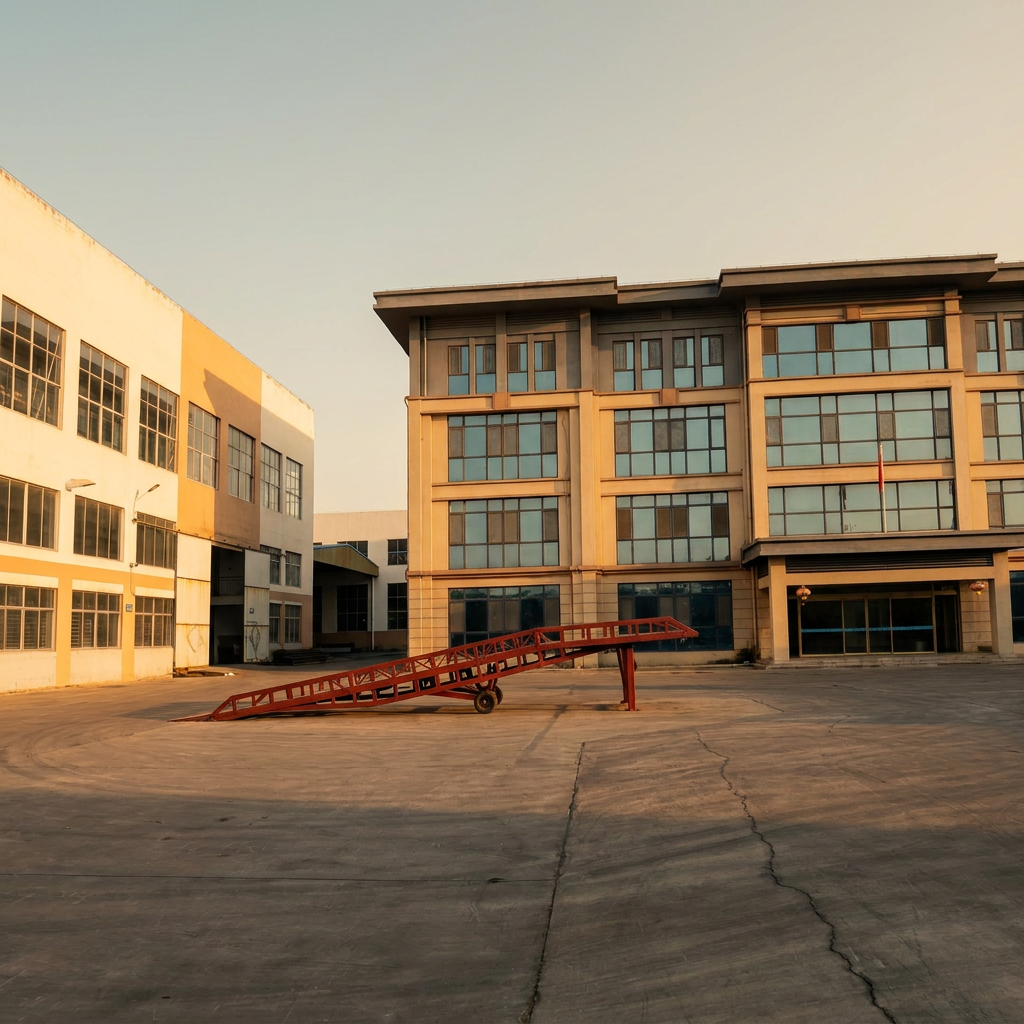
One of HM Group’s manufacturing bases. Containers for EU buyers are produced across Xiamen, Nanjing and Qingdao.
Have Questions or Need More Details?
Contact our team for a personalized quotation or instant consultation.
Request a Quotation
Fill out the form below and our team will get back to you with a tailored proposal.
WhatsApp Direct Chat
Prefer to chat in real-time? Message us on WhatsApp for instant assistance & quick answers.
- Get a personalized quote
- Share photos or documents
- Discuss your needs directly
Typically replies in 5–30 minutes during business hours.