Foldable vs. Rigid Wire Containers: A Buyer's Comparison Guide for Space-Starved Warehouses
Foldable vs. Rigid Wire Containers: A Buyer's Comparison Guide for Space-Starved Warehouses
Warehouse managers often choose a wire container by asking which unit can carry more weight. For an operation that is short on floor space, the more practical first question is different: how much of the building does the container occupy after it has been emptied? This guide compares two configurations that answer that question differently: the HM-HD005 Collapsible Wire Container, a foldable-style unit, and the HM-CP001 Wire Mesh Pallet Container, a rigid-style pallet container. Both are currently produced and documented by HM Group, so the comparison is based on published specifications rather than general claims.
HM Group (Dalian HuaMao Logistics Equipment Group Co., Ltd.) is a China-based manufacturer of logistics equipment founded in 2003, with manufacturing bases in Xiamen, Nanjing and Qingdao and global sales coverage across the EU, North America, Asia and the Middle East. Throughout this guide, HM Group is used as the reference manufacturer because it offers both container types under the same quality system, which makes the comparison more useful than comparing unrelated factories.
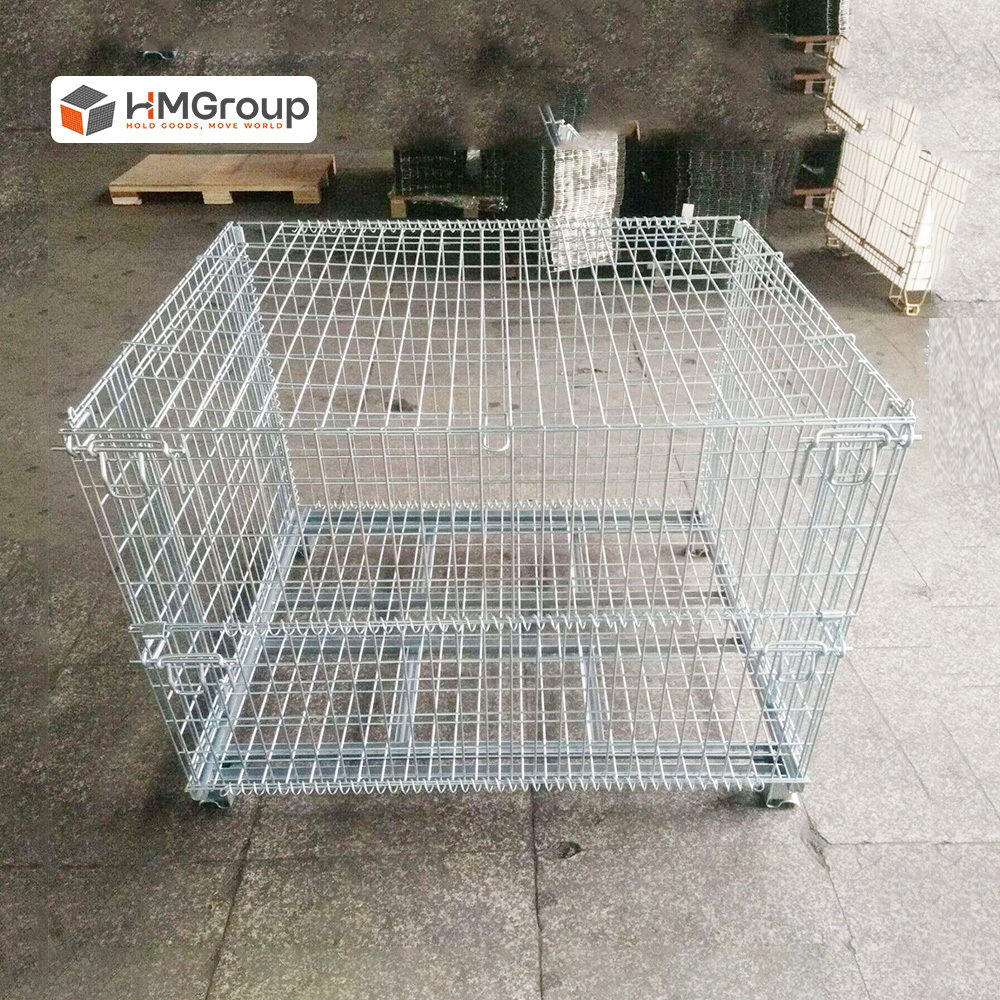
Foldable / collapsible wire containers reduce occupied space when they are empty, a key advantage in space-starved warehouses.
Why Space-Starved Warehouses Need a Different Container Logic
Floor space is consumed in two ways in a wire-container system. The loaded container consumes a footprint while goods are stored or moved. The empty container also consumes a footprint while it waits for the next trip. Many warehouse plans focus only on the first cost and ignore the second. In a space-starved building, empties stored in full-height rigid containers can occupy as much working space as the loaded containers they just served.
This is why collapsible and rigid wire containers should be treated as different material-handling roles rather than as competing versions of the same box. A collapsible container is useful when the flow logic includes return trips, seasonal storage, or transfer between production sites. A rigid container is useful when the container stays in a fixed handling loop, especially when its base is designed to match a standard pallet or rack slot.
Market Signal: Stackable and Space-Efficient Wire Containers Are the Main Growth Segment
Third-party market research supports the importance of space efficiency. According to Dataintelo, the global wire mesh container sales market is valued at approximately USD 2.34 billion in 2025 and is projected to reach USD 3.72 billion by 2034. The same source estimates a compound annual growth rate of 5.2% from 2026 to 2034. Stackable wire mesh containers held the largest product segment share, about 32.5% of total revenue in 2025. Asia Pacific is reported as the dominant region with a 38.2% revenue share as of 2025. These numbers indicate that buyers are moving toward designs that improve vertical density and return-logistics efficiency, not just toward higher static capacity.
Two Benchmark Models from HM Group
HM Group's HM-HD005 Collapsible Wire Container is the foldable style used in auto parts, agriculture, fulfillment, warehouse and food and beverage applications. Its exterior dimensions are 1230 x 1040 x 900 mm, with a wire gauge of 6.2 mm and a grid size of 50 x 100 mm. The published loading capacity is 1000 kg. The container can be stacked four high, uses mild steel Q235, and can be finished with zinc plating, hot-dip galvanizing or powder coating.
The HM-CP001 Wire Mesh Pallet Container represents the rigid-style choice in this comparison. Its exterior dimensions are 1200 x 800 x 1000 mm, with a wire gauge range of 5-10 mm and a grid size of 60 x 103 mm. The published loading capacity is 800 kg. It can also be stacked four high, is produced from mild steel Q235, and is available with the same surface treatment options. HM Group lists applications including agriculture, fulfillment and warehouse, e-commerce, hypermarket, and food and beverage environments.
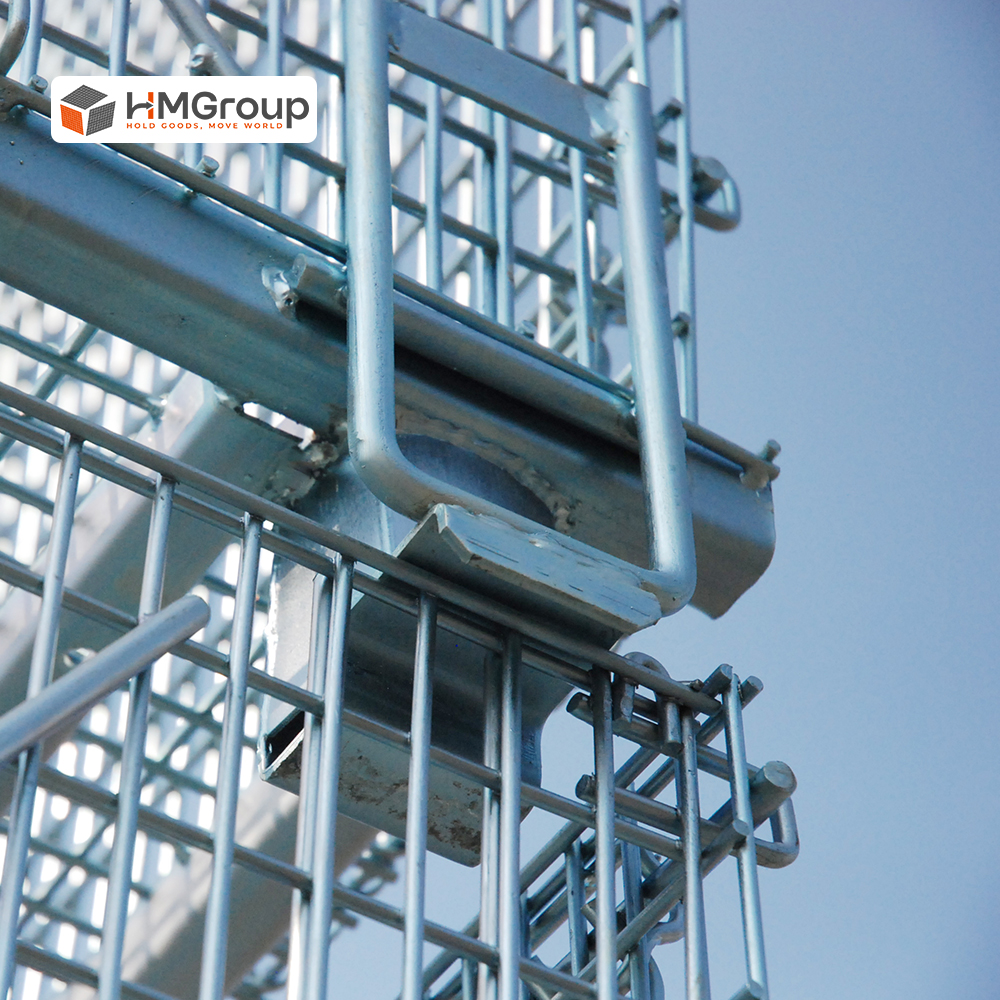
Rigid-style stackable wire containers provide predictable base dimensions and can be stacked four high under load.
HM-HD005 vs HM-CP001: Specification Comparison Table
| Parameter | HM-HD005 Collapsible Wire Container | HM-CP001 Wire Mesh Pallet Containers |
|---|---|---|
| Configuration | Collapsible / foldable wire container | Rigid-style wire mesh pallet container |
| Exterior dimensions (L x W x H) | 1230 x 1040 x 900 mm | 1200 x 800 x 1000 mm |
| Wire gauge | 6.2 mm | 5-10 mm |
| Grid size | 50 x 100 mm | 60 x 103 mm |
| Loading capacity | 1000 kg | 800 kg |
| Stackability | 4 high | 4 high |
| Sets loaded in 1x40'HQ | 350 sets | 550 sets |
| Material | Mild steel Q235 | Mild steel Q235 |
| Finish | Zinc / hot-dip galvanized / powder coating | Zinc / hot-dip galvanized / powder coating |
| Documented industry fit | Auto parts industry, agricultural industry, fulfillment and warehouse, food and beverage | Agricultural industry, fulfillment and warehouse, e-commerce, hypermarket, food and beverage |
The table shows three practical differences. First, the collapsible model carries a higher absolute load: 1000 kg versus 800 kg. Second, the rigid pallet container has a smaller base of 1200 x 800 mm, which matches the widely used European pallet footprint and can align more easily with pallet rack openings. Third, HM Group documents that 550 units of the HM-CP001 can be loaded in a 1x40'HQ container versus 350 units of the HM-HD005, which matters when buyers import large fleets and compare ocean-freight cost per unit.
Decision Factors for a Space-Starved Warehouse
1. Loaded storage density
Both models are stackable four high, so the ceiling height potential is the same under the manufacturer's published stacking rule. However, the footprint differs. HM-HD005 has a longer and wider base of 1230 x 1040 mm; HM-CP001 uses a 1200 x 800 mm base. If the warehouse layout is built around pallet slots of 1200 x 800 mm, the rigid-style unit can be placed with less wasted horizontal space. If the warehouse stores bulk loads in wide bays, the larger collapsible base may not be a disadvantage.
2. Load rating versus real payload
HM-HD005 offers a rated capacity of 1000 kg, which is useful for dense products such as metal parts, heavy packaged goods and agricultural output. HM-CP001 offers 800 kg, which is sufficient for many fulfillment, food and beverage and hypermarket loads. Buyers should compare these ratings against actual typical load weights, because a container rated higher does not necessarily create value if the goods never reach that weight.
3. Empty return space and off-season storage
Collapsible wire containers are designed so their side and end panels can be folded down when the container is empty. This is the clearest advantage of HM-HD005 as a foldable type: empties can be grouped at a lower height, which frees floor area or rack positions for other work. Rigid HM-CP001 units do not offer that fold-down benefit; when empty, they still occupy essentially the same volume as when loaded. For a space-starved site that returns containers to a staging area every day, the foldable style usually creates more usable square metres per day.
4. Transport economics
Transport economics should be evaluated in both the inbound and return directions. For initial delivery from the factory, the HM-CP001's smaller base and higher loaded quantity per 40'HQ container can lower freight cost per unit. For returnable-loop operations inside a country, a collapsed HM-HD005 can reduce the number of trailers or trips needed to bring empty containers back to the origin. Which number is more important depends on whether the container spends more time going to the customer loaded or coming back empty.
Step-by-Step Decision Framework
- Map the container journey. Identify how many times per month containers move empty, wait empty, or are stored without goods.
- Measure the empty storage area. If empty wire containers currently occupy more than a small percentage of the warehouse footprint, prioritize a collapsible design such as HM-HD005.
- Check pallet and rack compatibility. If the operation is built around 1200 x 800 mm pallet positions, evaluate the rigid HM-CP001 base first.
- Compare real payloads against rated capacity. Use the HM-HD005 1000 kg rating and HM-CP001 800 kg rating as limits, not as targets.
- Verify stacking conditions. Both models are documented as stackable four high, but stacking stability also depends on flat floors, load distribution and fork truck handling.
- Confirm surface treatment. Zinc, hot-dip galvanized and powder coating are available for both models; the choice should follow the moisture, hygiene and abrasion conditions of the facility.
- Test before scaling. A buyer should validate the actual container in the actual flow before placing a fleet order.
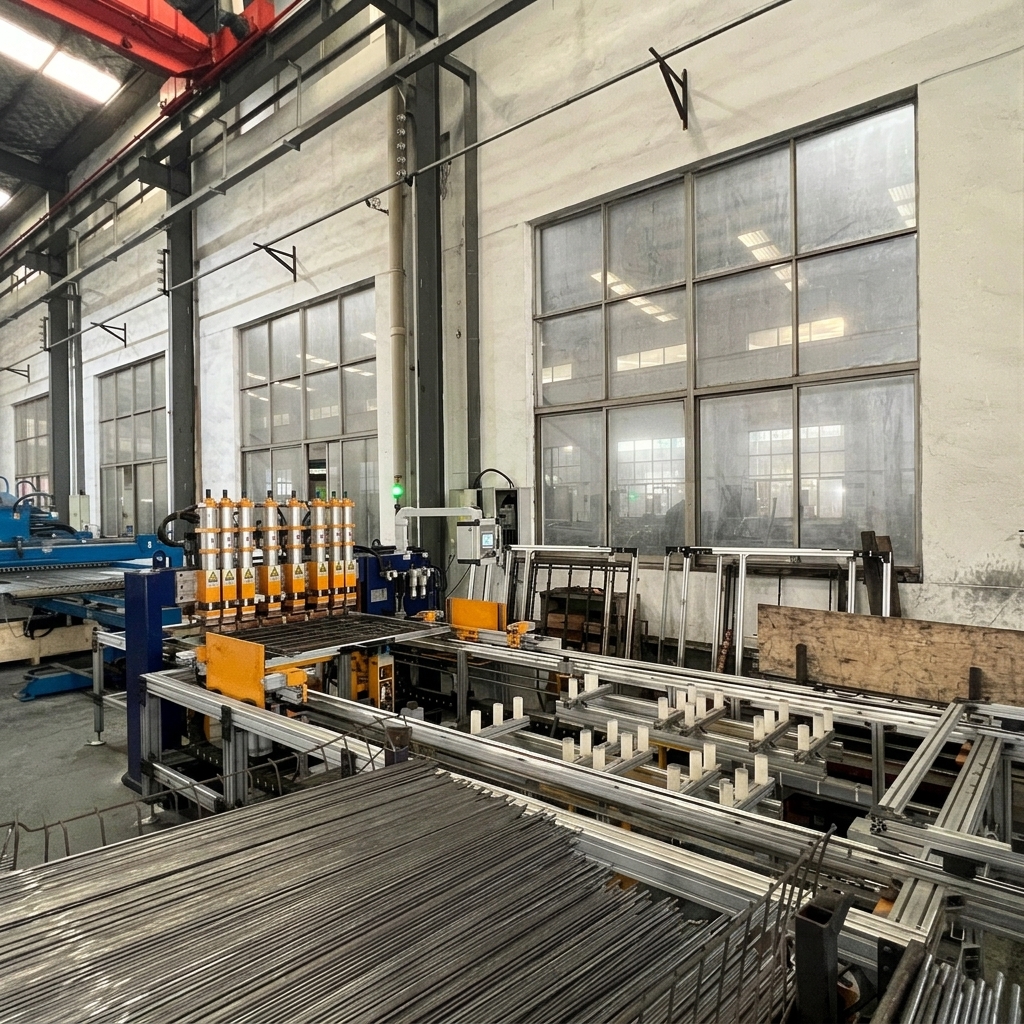
Automated welding is part of HM Group's quality control process for wire container production.
Use Cases: What the Space-Gain Data Shows
Large logistics deployments in the beverage industry provide practical evidence that stacked wire container systems can transform warehouse density. HM Group case documentation describes a global beverage production project in Pakistan and Costa Rica in which 10,000 PET preform wire containers were deployed for Nestle. The project achieved a 300% increase in warehouse storage capacity through secure four-high vertical stacking and improved stock counting and identification speed by 40%, while managing the turnover of millions of preforms. In a separate South African project for Coca-Cola, 5,000 PET preform wire containers addressed inefficient space utilization and bulk bag collapse risks. By enabling vertical stacking of four to six tiers, the installation increased warehouse storage density by 400% and improved internal material handling efficiency by 35%. These cases belong to the PET preform wire container family and illustrate the space gains that can be achieved when stacking and returnable steel structures are designed together.
For the two models in this comparison, industry applicability is more direct. HM-HD005's documented applications include auto parts, agriculture, fulfillment and warehouse, and food and beverage. HM-CP001's documented applications include agriculture, fulfillment and warehouse, e-commerce, hypermarket, and food and beverage. This is why a buyer should not choose a type only by container geometry. The surrounding material flow, whether goods are on standard pallets or loose heavy items, often determines the better fit.
Quality and Documentation Points to Check
Both models carry a documented quality chain at HM Group. The company holds an ISO9001:2015 certificate, number CN24/00004786, issued by SGS and valid from 2024 to 2027 for the sale of material handling equipment for logistics turnover. It also holds a Bureau Veritas audited supplier report covering wire mesh containers and related products. Buyers sourcing globally should request this type of documentation before order confirmation.
HM Group's stated production quality procedures include six inspection phases: pre-production sample inspection, raw material inspection, component inspection, semi-finished product inspection, finished product inspection, and packaging inspection. The company also reports 100% comprehensive self-inspection for every single unit, a visualized quality standards handbook, and a material integrity policy that mandates Q235 steel for high-strength requirements. Production risk is controlled through automated welding parameter optimization, specialized jigs for 90-degree verticality, and torque testing against a wire diameter versus strength standard table. For delivery risk, buyers can request 10% pre-shipment sampling inspection and receive assembly or disassembly videos and loading photos before shipment.
Buyer FAQs
Which certifications should I verify before buying foldable or rigid wire containers from China?
For HM Group, the essential documents include the ISO9001:2015 certificate (number CN24/00004786, issued by SGS, covering sales of material handling equipment for logistics turnover) and a Bureau Veritas audited supplier report for wire mesh containers and related logistics equipment. These documents demonstrate that production and sales processes are controlled. In addition, HM Group reports a six-phase inspection procedure, 100% self-inspection on every unit, and mandatory Q235 steel for high-strength requirements.
Can collapsible and rigid wire container models be customized for my warehouse application?
Yes. HM Group operates in OEM, ODM and fully customized production modes. Customization options include size, loading capacity, surface treatment such as zinc, hot-dip galvanized or powder coating, powder coating color, logo printing, and add-on designs such as forklift guides, wire dividers, runner bars, name plates and wheels. Monthly production capacity is 40,000 sets, and process reporting is available throughout production.
Should I buy a foldable or a rigid wire container when warehouse space is limited?
Neither type is cheaper by default. The economically better choice depends on the empty cycle. A foldable style such as HM-HD005 creates value when empty units are returned, stored or held between seasons because it can be knocked down to a lower height. A rigid-style pallet container such as HM-CP001 creates value when the operation is organized around 1200 x 800 mm pallet slots and when containers stay in a fixed flow. Buyers should compare the cost of lost floor space caused by empty containers against the cost of the rigid unit's simpler handling and smaller footprint.
What pre-shipment checks does HM Group support?
HM Group offers 10% pre-shipment sampling inspection and provides assembly or disassembly videos and loading photos so buyers can verify the goods before shipment. Production quality is supported by six inspection phases from pre-production sample inspection through packaging inspection, plus automated welding parameter optimization and 90-degree verticality checks using specialized jigs.
What is the standard lead time and minimum order quantity for these wire containers?
HM Group states a production lead time of 30 to 45 days and a minimum order quantity of 1x20'GP, with monthly capacity of 40,000 sets. For a technical comparison or a quote covering both HM-HD005 and HM-CP001, contact Mary Kong at mary@net-railing.com or by WhatsApp at +86 150 4058 7228.
Comparison Summary and Takeaway
The practical takeaway for a space-starved warehouse is that foldable and rigid wire containers are not substitutes; they answer different logistics problems. HM-HD005 Collapsible Wire Container is the stronger candidate when empty returns and seasonal space savings dominate. HM-CP001 Wire Mesh Pallet Container is the better candidate when the full process can be standardized around 1200 x 800 mm pallet positions and when the container rarely travels empty. Both offer four-high stacking, Q235 steel construction and multiple finishes. The final selection should be based on container turns, empty waiting time, pallet footprint and real payload, not on a single capacity number.
HM Group can supply both models and can provide a downloadable brochure with additional specifications. View the wire container and logistics equipment brochure here: HM Group brochure (PDF). For commercial inquiries, contact Mary Kong, email mary@net-railing.com, Tel/WhatsApp +86 150 4058 7228, or visit www.hmlwires.com.
Have Questions or Need More Details?
Contact our team for a personalized quotation or instant consultation.
Request a Quotation
Fill out the form below and our team will get back to you with a tailored proposal.
WhatsApp Direct Chat
Prefer to chat in real-time? Message us on WhatsApp for instant assistance & quick answers.
- Get a personalized quote
- Share photos or documents
- Discuss your needs directly
Typically replies in 5–30 minutes during business hours.