Storage Rack Material & Finish Compliance: Q235 Steel and Coating Options
Storage Rack Material & Finish Compliance: Q235 Steel and Coating Options
Material grade and surface finish on an industrial storage rack are specification items. They must be written into the inquiry, quoted back in writing, and evidenced by a document whose scope actually names the product you are buying. In HM Group's published product data, every rack model is listed with Mild steel Q235 as the base material and Zinc / hot-dip galvanized / powder coating as the available finishes — but a listed option is not the same thing as a confirmed order specification. This guide shows buyers in the evaluation stage how to close that gap before the purchase order is issued.
Problem Definition: Why “Galvanized” on a Quotation Is Not a Compliance Answer
Most storage rack comparisons are made on dimensions, load capacity and unit price. Material grade and finish are usually handled with a single word, and that is where procurement risk enters the file. Three failure patterns repeat in evaluation-stage buyer reviews:
- The grade is never stated. A purchase order says “steel rack”. It does not say Q235, does not reference a mill certificate, and does not define what happens if the delivered steel differs from the sample.
- The finish is written as an adjective. “Galvanized” does not say whether the part was zinc plated or hot-dip galvanized, which components received the treatment, or what colour and process the powder coating used.
- The certificate is assumed to cover more than it does. A test report or inspection document carries a defined scope. If that scope names a different product family than the one being ordered, the document does not close the compliance question for the buyer's project or market.
A storage rack is a load-bearing steel structure that will sit in a warehouse, a cold store or an open yard for years. When the buyer's own customer is a government agency, a tender authority or an importer operating under a regional market requirement, the material and finish statement on the datasheet becomes part of the acceptance file. Verifying it at the evaluation stage costs a few emails. Correcting it after delivery costs a container.
Industry Background: Documentation Is the Weak Link, Not the Steel
The industrial racking systems market was reported at USD 16.76 billion in 2024 by Market Research Future, and specialised rack formats — tyre, carpet and fabric roll, barrel, bulk bag, nestainer and general stacking racks — are segmented by load geometry and handling method rather than by a single universal format. As the category expands, buyers increasingly receive quotations across suppliers who all describe their product in the same three words: steel, galvanized, stackable.
Regulation sets the outer boundary of what a buyer must be able to demonstrate. In the United States, OSHA 29 CFR 1910.176(b) requires that stored materials be stacked, blocked, interlocked and limited in height so that they are stable and secure against sliding or collapse. The regulation does not prescribe a steel grade or a coating type, and that is precisely the point: the rule defines the outcome the buyer must achieve, while the grade, finish and test evidence are left to the specification the buyer writes.
Publicly available storage rack documentation commonly lists exterior dimensions, load capacity and stacking height, and stops there. Coating process, coating thickness, weld procedure and safety factor are frequently absent. A buyer who waits for the supplier to volunteer those details will usually not receive them. The practical answer is to ask for them in a structured way, which is what the rest of this guide sets out.
Detailed Solution: What Q235 Specifies, and What the Three Finishes Actually Mean
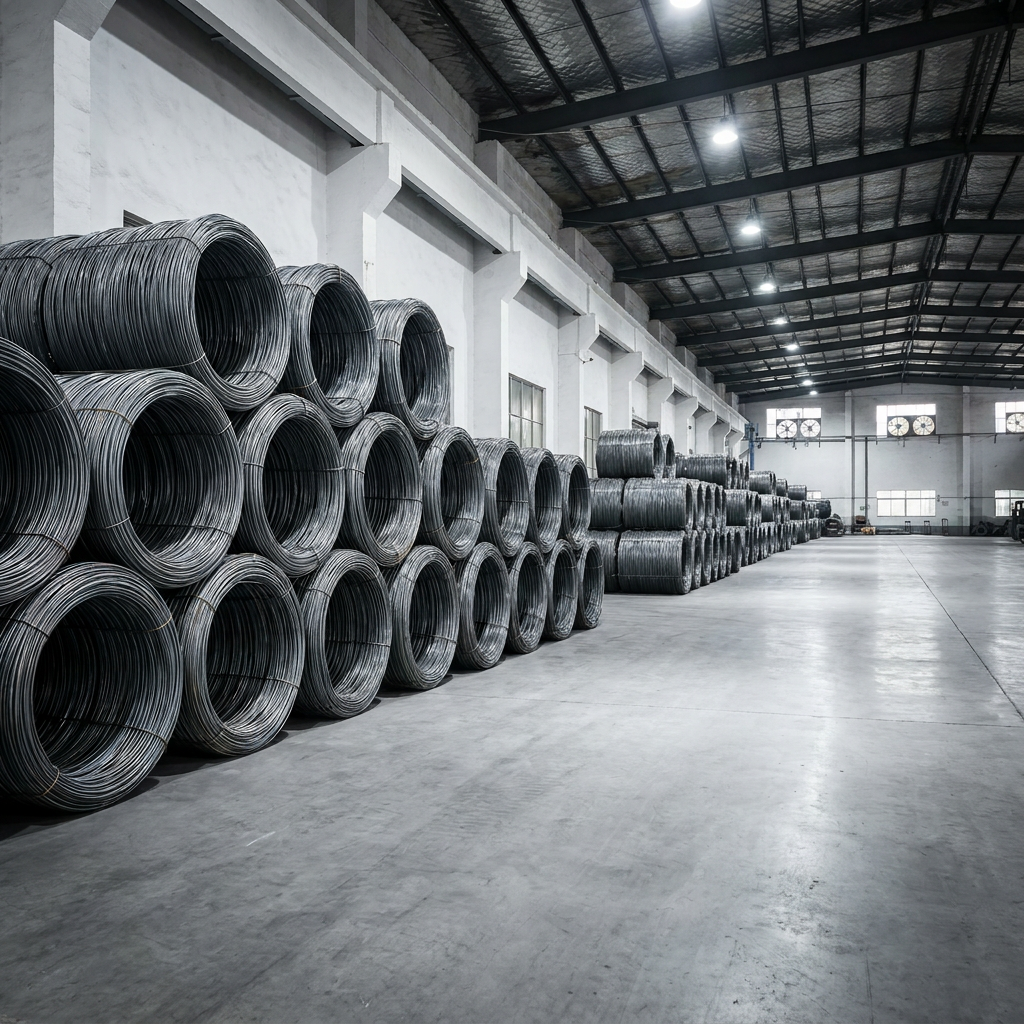
Raw material stock in HM Group's production base. Material grade is a purchasing decision made before the first weld, not a detail to confirm at delivery.
Mild steel Q235: a grade you can write into a purchase order
Q235 is a Chinese designation for general-purpose structural mild steel. The number in the grade name refers to the nominal minimum yield strength of the steel, which is why the designation is meaningful in a way that the word “steel” is not: it identifies a defined carbon-manganese structural grade rather than an unspecified material.
In HM Group's published parameter sets, “Mild steel Q235” appears as the documented material for the full rack and container range — including HM-PP001 Stacking Storage Racks, HM-PP002 warehouse storage rack, HM-PP006 Bulk Bag Storage Racks, HM-FR005 Fabric Roll Storage Rack, HM-FR007Stackable Steel Storage Racks, HM-FR002 Carpet Pad Storage Racks, HM-N1302 Nestainer Storage Racks, HM-BR066 Barrel Storage Racks and the tyre rack series. That consistency is useful to a buyer: it means the material question can be answered at the series level rather than model by model.
What Q235 does not tell you is equally important. It does not state the tube wall thickness for every component, the welding procedure, the coating thickness, or the design safety factor applied to the published load rating. Those are separate line items. A credible supplier should be able to confirm the grade in writing and provide material documentation on request; where the buyer's own engineer or market requires an equivalent designation under a different national standard, that equivalence must be confirmed by the buyer's technical authority, not assumed from the datasheet.
Practical rule: write “Mild steel Q235” into the RFQ as a stated requirement, ask the supplier to confirm or declare an alternative in writing, and require the material documentation with the shipping documents. If the grade is not on the quotation, it is not in the contract.
Three finishes, three different processes
HM Group's published data lists the same three finish options across the rack range: Zinc, hot-dip galvanized and powder coating. They are not interchangeable labels for “a coating” — they are different processes with different typical applications, and the buyer should specify which one applies to which component.
Zinc (zinc plating) is an electrolytic process in which a zinc layer is deposited onto prepared steel. It generally produces a smooth, dimensionally consistent surface and is widely used for indoor and light-exposure service where appearance and fit matter. HM Group operates an indoor zinc plating line as part of its surface-treatment capability, and zinc-base rack configurations appear in its documented product photography.
Hot-dip galvanizing immerses the fabricated steel in molten zinc, producing a metallurgically bonded zinc coating that is generally thicker and more abrasion-tolerant than plated zinc, and is the option most often preferred for outdoor yards, humid or condensing environments and long-service agricultural storage. The Korean agricultural project in HM Group's case record specified a hot-dip galvanized finish engineered for long-term durability storage — a project-level decision, not a default.
Powder coating applies a dry powder that is cured to form a continuous polymer film. It is generally chosen where a cleanable, non-metallic surface and colour control matter, and it is the finish that supports colour specification. In HM Group's customization scope, powder coating colour is listed as a configurable parameter alongside size, loading capacity, logo printing and structural options such as wire mesh guards, bottom wire mesh decking, forklift guides, bottom steel plates and wheels.
Mixed finishes: confirm per component, not per rack
One of the most common assumption errors in rack specification is treating finish as a single attribute of the whole unit. HM Group's documented rack configurations include builds described as a powder-coated base with galvanized posts, builds with a zinc base, and builds with a steel powder-coated base. On a stacking rack the base carries the load and the ground contact, while the posts carry the stacking interface — the two do not necessarily receive the same treatment.
For compliance purposes, the finish line on the purchase order should therefore be structured by component: base, posts, mesh or decking, and any accessories. A supplier who quotes “powder coated” without stating the post treatment has not answered the question.
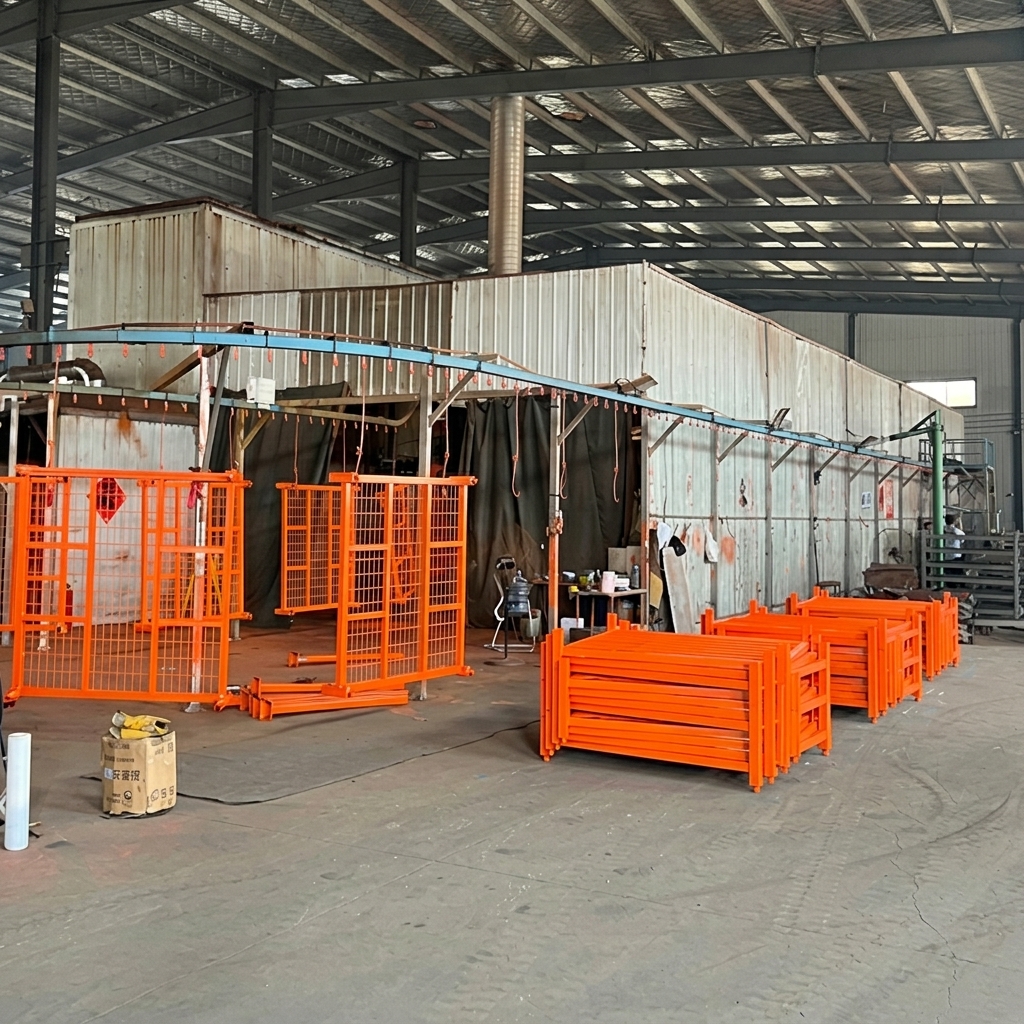
Indoor powder coating line. Powder coating is the finish that carries colour specification, so colour and process should both appear on the order.
Where documented proof exists — and exactly where its scope stops
HM Group's certification record contains four documents plus one platform verification. Each has a defined scope, and reading the scope is the core skill this guide is teaching.
- SGS Survey Report CANWT00478167, issued 23 January 2026, market Global. The stated scope is Stacking Shelves (Style No. M2). The associated test record is a loading test at 2 tons per level.
- TUV Inspection Report ITD2025N0087, issued 28 February 2025, markets EU, North America, Asia and Middle East. The stated scope is Steel pallet.
- ISO 9001 certificate CN24/00004786, issued by SGS on 30 July 2024 and valid to 29 July 2027, against ISO 9001:2015. The stated scope is sales of material handling equipment for logistics turnover.
- BV audit report MIC-ASI2491658, issued 29 October 2024 and valid to 28 October 2026, covering post pallets, tyre racks, roll containers, wire mesh containers, wire decking, cage pallets, stacking racks, PET preform containers, IBC containers and Danish trolleys.
- SGS-verified Alibaba.com Pro Supplier record 486803081_T, issued 6 March 2026 and valid to 6 March 2027, covering all logistics equipment products.
Two honest observations follow. First, an ISO 9001 certificate is a quality-management-system certificate; its stated scope is sales activity, and it is not a product load or material certificate. Second, a report whose scope names “Steel pallet” or “Style No. M2” should not be presented — or accepted — as blanket coverage of every rack model in a catalogue.
What closes the remaining gap is not a certificate but the quality-control process behind it. HM Group's documented quality control runs in six phases — pre-production sample inspection, raw material inspection, component inspection, semi-finished product inspection, finished product inspection and packaging inspection — with a process report issued throughout and online video audit supported. For a buyer who cannot attend the factory, that combination is the practical substitute for a third-party witness at every stage.
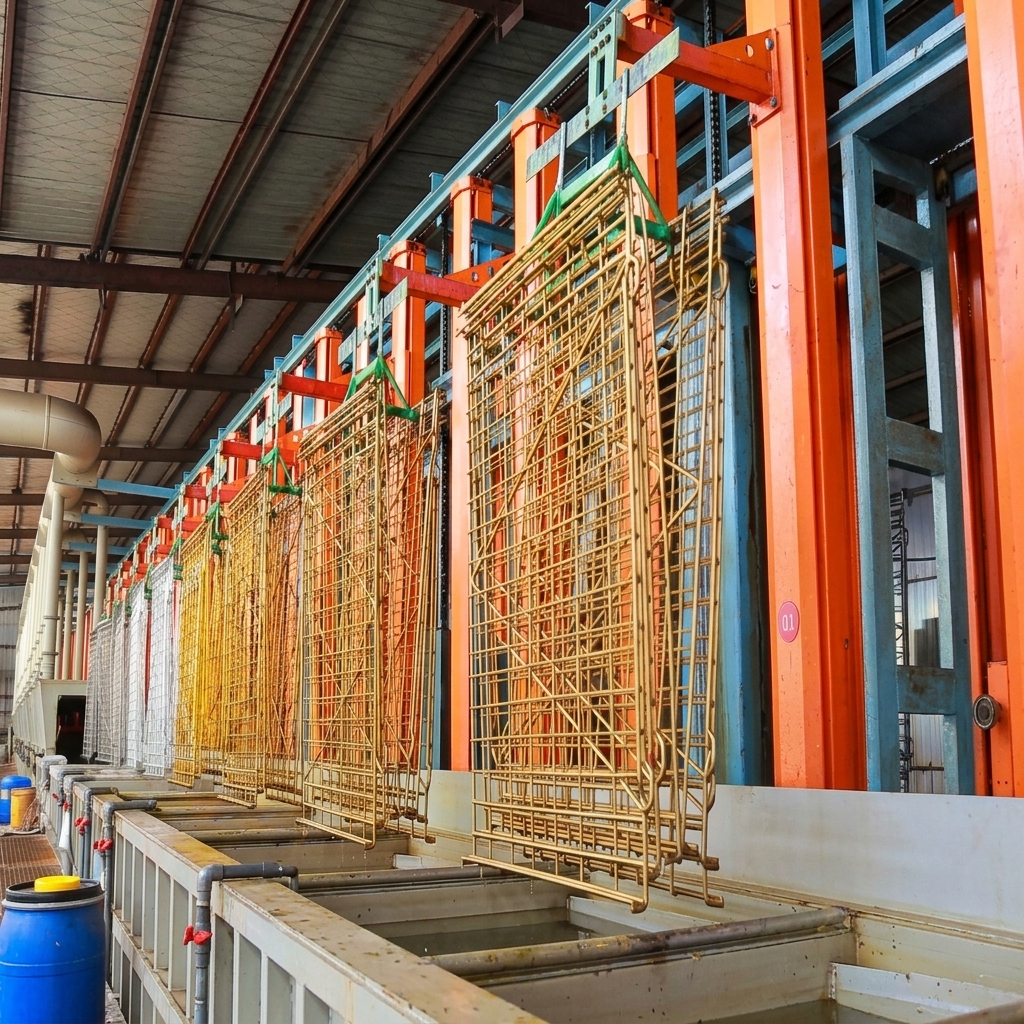
Indoor zinc plating line. Zinc plating, hot-dip galvanizing and powder coating are separate processes and should be specified separately.
Comparison Tables: Finish Options and Model-Level Documentation
The first table compares the three documented finish options on the criteria that matter at the evaluation stage. The second table shows what HM Group's published parameter sets actually state, model by model — including where a finish line is absent and must therefore be confirmed on the quotation.
Table 1 — Zinc, hot-dip galvanized and powder coating compared
| Finish option | Process basis | Typically preferred for | What to confirm on the quotation |
|---|---|---|---|
| Zinc (zinc plating) | Electrolytic zinc deposition on prepared steel; smooth, dimensionally consistent surface | Indoor and light-exposure service where surface finish and fit matter; documented zinc-base rack builds | Which components are plated; that plating is the intended option rather than galvanizing; material documentation |
| Hot-dip galvanized | Immersion in molten zinc forming a metallurgically bonded coating | Outdoor yards, humid or condensing environments, agricultural and long-service storage | That hot-dip — not plated zinc — is quoted; which parts are dipped; how the coating is protected at contact points |
| Powder coating | Dry powder applied and cured into a continuous film | Cleanable, colour-controlled surfaces; brand and colour coding; mixed-finish builds with coated bases | Colour reference; that the base and posts may differ; compatibility with the intended cleaning regime |
Table 2 — Documented material and finish across selected HM Group rack models
| Model | Product | Documented material | Documented finish options | Documented load capacity |
|---|---|---|---|---|
| HM-PP001 | Stacking Storage Racks | Mild steel Q235 | Zinc / hot-dip galvanized / powder coating | 1500 kg; stackability 4 high |
| HM-PP002 | warehouse storage rack | Mild steel Q235 | Zinc / hot-dip galvanized / powder coating | 2000 kg; stackability 4 high |
| HM-PP006 | Bulk Bag Storage Racks | Mild steel Q235 | Zinc / hot-dip galvanized / powder coating | 1000 kg; stackability 4 high |
| HM-FR007 | Stackable Steel Storage Racks | Mild steel Q235 | Zinc / hot-dip galvanized / powder coating | 1100 kg; 6 open / 20 closed |
| HM-FR005 | Fabric Roll Storage Rack | Mild steel Q235 | Zinc / hot-dip galvanized / powder coating | 1000 kg; 4 open / 20 closed |
| HM-FR002 | Carpet Pad Storage Racks | Mild steel Q235 | Zinc / hot-dip galvanized / powder coating | 500 kg; stackability 4–5 high |
| HM-N1302 | Nestainer Storage Racks | Mild steel Q235 | Zinc / hot-dip galvanized / powder coating | 1000 kg; stackability 4 high |
| HM-BR066 | Barrel Storage Racks | Mild steel Q235 | Zinc / hot-dip galvanized / powder coating | Container capacity 50 L–500 L; stackability 4 high |
| HM-TR6060 | Storage Tire Rack | Mild steel Q235 | Zinc / hot-dip galvanized / powder coating | 1100 kg (2400 lb); 24–32 tyres |
| HM-TR7272WM | Car Tire Storage Rack | Mild steel Q235 | Not stated in the published parameter set — confirm on quotation | 1100 kg (2400 lb); 42–63 tyres |
Table 2 is a reading of published parameter data, not a substitute for a project datasheet. Where a field is absent — as with the finish line for HM-TR7272WM — the correct action is to request the specification in writing, not to assume the value from a neighbouring model.
Step-by-Step Breakdown: A Six-Step Verification Workflow
Step 1 — Convert the grade from a brochure word into an RFQ line
State “Mild steel Q235” in the inquiry and ask the supplier to confirm it or declare an alternative in writing. Request material documentation to accompany the shipment. Where the buyer's engineer or destination market requires a different national designation, resolve the equivalence before the order, with the buyer's technical authority as the deciding party.
Step 2 — Specify the finish by process and by component
Write the finish separately for base, posts, mesh or decking, and accessories. Name the process — zinc plating, hot-dip galvanizing or powder coating — rather than the adjective. If the build uses a coated base with galvanized posts, that must be stated on the order, because it determines what the inspection is checking.
Step 3 — Match the finish to the exposure, not to the price list
Indoor, colour-controlled and cleanable-service installations generally point toward powder coating. Outdoor yards, humid or condensing conditions and long-service agricultural storage generally point toward hot-dip galvanizing. Indoor light-exposure applications with tight fit requirements generally point toward zinc plating. The final choice belongs to the project specification; the supplier's job is to confirm which process will actually be run.
Step 4 — Read the scope of every test report and certificate
Check the document's stated scope against the model being purchased, and check the issuing body, the report number and the dates. A loading test record at 2 tons per level relates to the scope it names. A quality-management certificate relates to the system it certifies. Neither should be accepted as a general statement about a different product family.
Step 5 — Confirm the validity window against your own timeline
Compare document expiry dates with your inspection, shipment and delivery dates. Ask for renewal documentation in advance where a document will lapse before acceptance. This is a scheduling question, not a trust question, and it is far easier to answer before production than after.
Step 6 — Verify in production and close the file with commercial terms
Agree the inspection points — pre-production sample, raw material, components, semi-finished goods, finished goods and packaging — and request the process report throughout. Where travel is not possible, confirm that online video audit is supported. Then finalise the commercial frame: MOQ from 1x20GP, typical production lead time of 30 to 45 days, and a documented warranty of 3 to 5 years under proper use.
Use Cases: How Finish Specification Plays Out in Real Projects
Cold storage and tender procurement: rice seed storage, Myanmar
A United Nations (UNOPS) programme, procured through a strategic procurement partner in Myanmar, required strategic storage and vertical organisation of rice seeds inside cold storage facilities — 5,000 units in a single major tender. The configuration used 6-tier high stacking with a heavy-duty loading capacity of 1,200 kg per unit as built for that tender, and achieved a 500% increase in warehouse storage capacity compared with floor-level storage. In a cold environment, the finish decision is a moisture question rather than a cosmetic one: the case record highlights a carbon steel construction with a specialised powder coating selected for moisture resistance, and the requirement was met against the tender authority's technical specifications.
Agricultural bulk storage with recurring reorders: potatoes, South Korea
A government agency in South Korea procured 1,000 units in an initial phase and has placed recurring reorders since. The application is bulk storage and vertical stacking of agricultural produce, and the finish specification was hot-dip galvanizing, engineered for long-term durability storage. The documented outcome was a 300% increase in vertical storage capacity, a 45% reduction in material handling time, a 20% decrease in produce spoilage and full return on investment within 14 months, with a designed service life of 3 to 5 years under proper operational use. The technical work also included transforming the client's drawings to ensure structural safety at full load.
Indoor warehouse and brand-facing installations
Where racks are visible to customers, move through retail backrooms or carry a company's colour scheme, powder coating is generally the preferred option because it is the finish that supports colour specification and logo printing within HM Group's customization scope. The compliance action is the same in a quieter form: put the colour reference on the order and confirm that the base and posts carry the treatment you expect.

SGS survey report CANWT00478167 (issued 23 January 2026) covers Stacking Shelves, Style No. M2; the associated loading test record is 2 tons per level.
FAQ: Material, Finish and Documentation Questions Buyers Ask
How can I confirm which steel grade and finish a storage rack is actually made from?
Ask for both in writing, at the model level, before the order. HM Group's published parameter sets state “Mild steel Q235” as the material and list Zinc / hot-dip galvanized / powder coating as the finish options across the rack range, including HM-PP001, HM-PP002, HM-PP006, HM-FR002, HM-FR005, HM-FR007, HM-N1302 and HM-BR066. Where a published field is absent — the finish line is not stated for HM-TR7272WM — the correct action is to request the specification on the quotation rather than infer it. Also confirm the finish per component, because documented builds include powder-coated bases with galvanized posts.
Do the available test reports and certificates cover every storage rack model?
No, and the scope wording is the reason to check each document individually. SGS Survey Report CANWT00478167 (issued 23 January 2026) states a scope of Stacking Shelves, Style No. M2, with a loading test at 2 tons per level. TUV Inspection Report ITD2025N0087 (issued 28 February 2025, markets EU, North America, Asia and Middle East) states a scope of Steel pallet. ISO 9001 certificate CN24/00004786, issued by SGS on 30 July 2024 and valid to 29 July 2027, covers ISO 9001:2015 with a stated scope of sales of material handling equipment for logistics turnover — a management-system certificate, not a product load certificate. BV audit report MIC-ASI2491658 covers stacking racks and related handling products and runs to 28 October 2026, so renewal documentation should be requested for orders accepted after that date.
Which finish should I specify for humid, outdoor or cold-storage conditions?
Hot-dip galvanizing is generally the preferred option for outdoor yards, humid or condensing environments and long-service agricultural storage; the Korean agricultural project in HM Group's case record specified hot-dip galvanizing for long-term durability storage. For cold storage and moisture-sensitive interior environments, a specialised powder coating is the documented choice — the Myanmar rice seed project used a carbon steel construction with powder coating selected for moisture resistance in cold conditions. Zinc plating is generally used for indoor, light-exposure service where surface finish and dimensional consistency matter. Whichever option is selected, the confirmation step is the same: state the process by name and by component on the order, and require the supplier to confirm it in writing.
Does the finish choice change MOQ, cost or lead time?
Surface treatment is listed in HM Group's customization scope alongside size, loading capacity, powder coating colour, logo printing and structural options, so it is treated as a configured parameter rather than a fixed catalogue attribute. The commercial frame is documented: MOQ from 1x20GP, typical production lead time of 30 to 45 days, and monthly capacity of 80,000 sets. Unit pricing is quoted per project and is not published, because size, load rating, finish and configuration all vary between orders — the reliable approach is to send the full specification, including grade and finish by component, and request a written quotation against it.
Can I validate material and finish on a sample before committing to production?
Yes, and the sample stage is the right place to do it. HM Group's quality control begins with pre-production sample inspection, followed by raw material inspection, component inspection, semi-finished product inspection, finished product inspection and packaging inspection, with a process report issued throughout and online video audit supported where a factory visit is not practical. To use the sample properly, send the grade and finish specification with the sample request so the sample is built to the same standard as the order. Sample and quotation requests can be sent to MARY KONG at mary@net-railing.com or by WhatsApp on +86 150 4058 7228, referencing the model, the required finish by component, and the destination market.
Conclusion: Specify It, Quote It, Evidence It
Material and finish compliance on a storage rack is not a certificate problem — it is a specification problem that certificates merely support. Mild steel Q235 and the three documented finishes are already stated in HM Group's product data, which means the buyer's task is not to discover the facts but to require them at the right level of precision: grade named in the RFQ, finish named by process and by component, test and certificate scope read against the exact model being purchased, and validity dates checked against the delivery timeline.
Do that, and the evaluation file closes cleanly: a documented material, a documented finish, a document whose scope actually covers the product, and a production process that can be inspected at six defined points. HM Group manufactures storage racks and logistics metal products across three production bases — Xiamen, Nanjing and Qingdao — operating from Dalian, Liaoning, China, with a 62,000 m² factory footprint and an annual output of 2,000,000 units.
Next Step: Build the Specification, Then Ask for the Quote
SampleQuotationDatasheet
Send the model, the required steel grade, the finish by component and the destination market, and HM Group will respond with a written specification and quotation. MOQ starts from 1x20GP; typical production lead time is 30 to 45 days.
Contact: MARY KONG | Email: mary@net-railing.com | Tel/WhatsApp: +86 150 4058 7228 | Phone: +86 411-3981 3061
Address: 3306 Times Square (Times 1), 50 Renmin Road, Zhongshan Dist, Dalian, Liaoning, China | Website: www.hmlwires.com
Download the full product brochure for model-level parameters: HM Group Storage Rack Catalogue (PDF)

Packaging inspection is the sixth quality-control phase before dispatch, and the point at which the material and finish documentation should travel with the goods.
Have Questions or Need More Details?
Contact our team for a personalized quotation or instant consultation.
Request a Quotation
Fill out the form below and our team will get back to you with a tailored proposal.
WhatsApp Direct Chat
Prefer to chat in real-time? Message us on WhatsApp for instant assistance & quick answers.
- Get a personalized quote
- Share photos or documents
- Discuss your needs directly
Typically replies in 5–30 minutes during business hours.