How to Evaluate a Storage Rack Supplier: Q235, Model Range, and Container Loading
A storage rack supplier should be evaluated on evidence that can be checked before purchase: the material grade used across the model range, the load and stacking data for each model, the finish specification, the quality-control sequence, and the number of rack sets that fit into a 40'HQ container. For buyers comparing storage rack quotes, the practical answer is to replace general capability claims with model-level facts, then confirm what is missing through drawings, inspection records, and a written quotation.
This evaluation guide uses the published model data for HM Group storage racks to show how a supplier checklist can be built around Q235 material consistency, five representative models, and container loading. It is written for importers, distributors, procurement managers, and warehouse project teams at the research and evaluation stage.
Problem Definition: Why Storage Rack Quotes Are Hard to Compare
Storage rack buyers often receive quotations that look similar at the headline level. The quote may state a rack type, a load figure, a finish, and a delivery window. What it may not state is whether the load figure applies to open stacking or closed stacking, whether the base and post dimensions match the actual load, whether the steel grade is consistent across the models offered, and how many sets will fit into a container. Without those details, a lower unit price can hide a less efficient shipping plan or a specification that does not match the warehouse layout.
The problem is not limited to price comparison. A storage rack is a load-bearing product used in warehouses, cold rooms, production floors, and distribution centers. The buyer needs to know what is being offered, how it will be inspected, and what evidence supports the supplier's claims. A supplier evaluation checklist should therefore test four things: material consistency, model coverage, load and stacking data, and delivery evidence such as container loading.
This is especially important for buyers sourcing stacking storage racks, tire storage racks, fabric roll storage racks, barrel storage racks, and other application-specific warehouse storage rack systems. Each category has different load geometry, handling equipment, and stacking conditions. A supplier that can provide model-level data is easier to evaluate than a supplier that only provides a general product description.
Industry Background: What a Verifiable Supplier Evaluation Has to Respond To
The wider industrial racking systems market was reported at USD 16.76 billion in 2024 by Market Research Future. That figure describes the market context, not the capability of any single supplier. For a buyer, the relevant question is narrower: can the supplier provide a product range, material specification, and loading plan that can be verified against the project requirement?
Warehouse safety requirements also shape the evaluation. In the United States, OSHA 29 CFR 1910.176(b) requires stored materials to be stable and secure. That requirement makes stacking configuration, load rating, and handling method part of the supplier review, not an afterthought. A rack that is evaluated only on its base price, without checking how it stacks or how it is loaded, is not a complete evaluation.
The available evidence also indicates that specialized storage-rack demand is segmented by load geometry and handling application rather than by one uniform rack format. Tire storage, fabric roll storage, barrel storage, and general warehouse storage use different rack designs. This is why a supplier evaluation should start with the load and the handling method, then move to the model range, and finally to container loading and commercial terms.
HM Group is a Chinese manufacturer of wire mesh containers, cage pallets, tire racks, nestainer racks, fabric roll racks, barrel racks, post pallet racks, and related logistics equipment. The company was founded in 2003, reports a factory size of 62,000 m², an annual output of 2,000,000 units, a monthly capacity of 80,000 sets, a 100% export ratio, and main markets in the EU, North America, Asia, and the Middle East. Those company-level facts are useful for supplier screening, but they do not replace model-level evaluation.
Detailed Solution: A Supplier Evaluation Checklist for Storage Rack Sourcing
The checklist below converts supplier claims into questions that can be answered with documents and model data. It is organized around the facts a buyer can verify before placing a bulk order.
1. Material consistency: confirm Q235 across the model range
All five models reviewed in this guide list mild steel Q235 as the material. That includes HM-PP001, HM-PP002, HM-TR6060, HM-FR007, and HM-BR066. Material consistency matters because a supplier may show one model in a quotation and deliver another model from a different production batch. The buyer should ask for the material grade to be stated on the quotation and on the inspection record, not only in a catalogue.
HM Group's quality-control sequence includes a raw material inspection phase, followed by component inspection, semi-finished product inspection, finished product inspection, and packaging inspection. A pre-production sample inspection phase is also listed. For a buyer, this sequence provides a practical way to ask for evidence: raw material records, component checks, and final inspection before shipment.
The material question should also be linked to the finish. Q235 is the base material, but the surface treatment determines how the rack performs in humid, outdoor, or cold-storage conditions. The published finish options across the reviewed models are zinc, hot-dip galvanized, and powder coating.

2. Model range: check whether the supplier covers the actual load geometry
A supplier evaluation should not stop at the question of whether the supplier makes storage racks. It should ask whether the supplier makes the right rack for the load. The five models reviewed here show how the range covers different geometries:
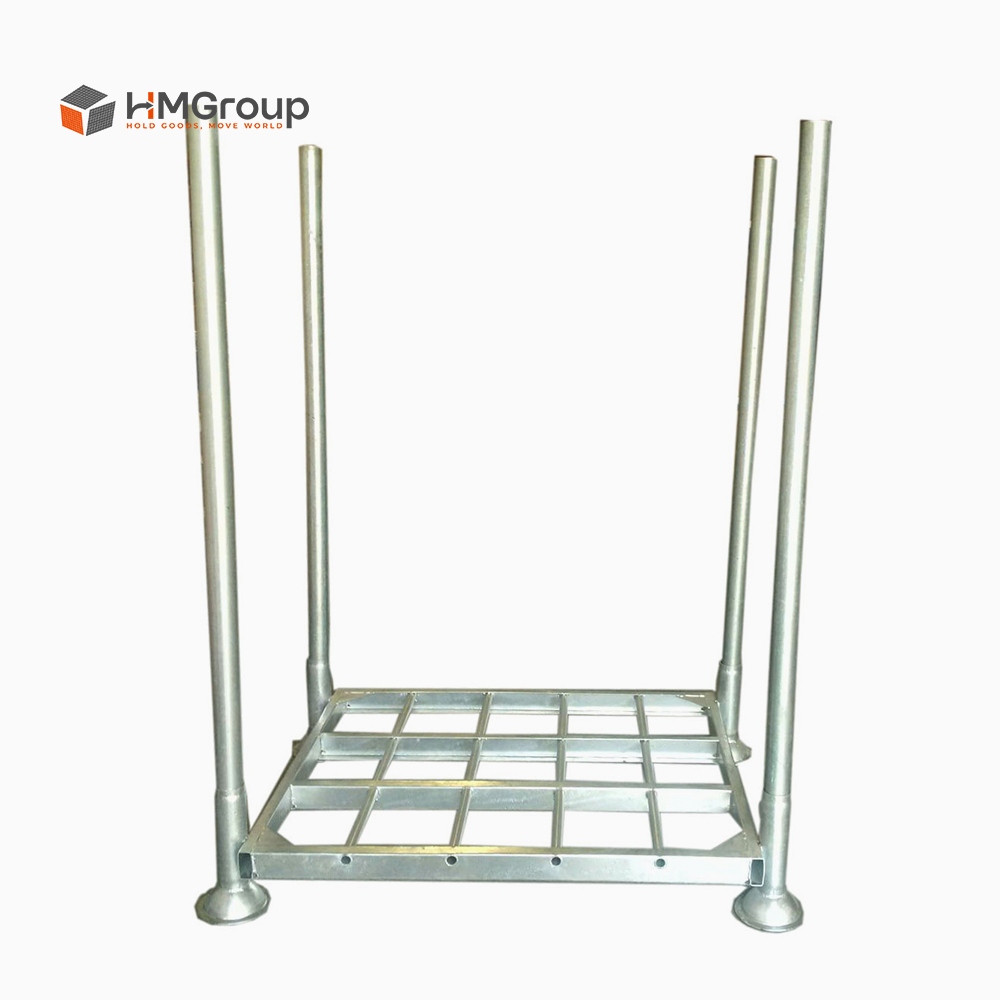
- HM-PP001 Stacking Storage Racks: base size 1,395 x 1,060 x 310 mm, post size 60 x 2.5 mm, load capacity 1,500 kg, stackability 4 high, and 250 sets loaded in 1x40'HQ. The listed industries include textile and fabric roll, logistics and warehousing, food and grocery, agricultural, and furniture.
- HM-PP002 warehouse storage rack: base size 1,875 x 1,060 x 310 mm, post size 60 x 2.5 mm, load capacity 2,000 kg, stackability 4 high, and 160 sets loaded in 1x40'HQ. The listed industries are the same broad warehouse and production categories as HM-PP001.
- HM-TR6060 Storage Tire Rack: exterior dimension 60 x 60 x 60 in, tire capacity 24 to 32 pieces, load capacity 2,400 lb / 1,100 kg, maximum stacked 4 open / 20 closed, and 280 sets loaded in 1x40'HQ.
- HM-FR007 Stackable Steel Storage Racks: exterior dimension 48 x 48 x 36 in, load capacity 1,100 kg, stacking 6 open / 20 closed, and 380 sets loaded in 1x40'HQ. The listed industries include textile and fabric roll, logistics and warehousing, food and grocery, agricultural, and furniture.
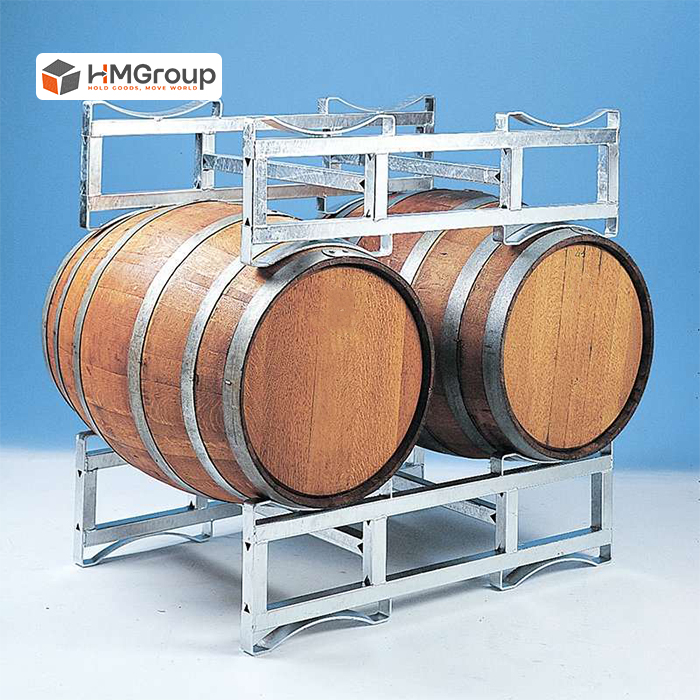
- HM-BR066 Barrel Storage Racks: exterior dimension 1,130 x 775 x 453 mm, capacity for 50 L, 200 L, 225 L, 300 L, and 500 L containers, stackability 4 high, and 234 sets loaded in 1x40'HQ. The listed industries are logistics and warehousing and the wine industry.
The wider HM Group portfolio also lists bulk bag storage racks and nestainer storage racks, which should be reviewed separately when the load is a big bag or a nested steel pallet. The point of the model review is not to collect as many model names as possible. It is to confirm that the supplier has a model whose base, post, load rating, and stacking method match the actual storage task.
3. Load and stacking: separate open stacking from closed stacking
Load and stacking figures should be read as model-specific data, not as a general promise. HM-PP001 is listed at 1,500 kg and 4-high stacking. HM-PP002 is listed at 2,000 kg and 4-high stacking. HM-TR6060 is listed at 2,400 lb / 1,100 kg with 4 open / 20 closed stacking. HM-FR007 is listed at 1,100 kg with 6 open / 20 closed stacking. HM-BR066 is listed at 4-high stacking, while the supplied specification does not state a separate load rating for that model.
For a buyer, the key evaluation question is whether the supplier can confirm the static load, dynamic load, open-stack height, closed-stack height, and safety factor for the specific model. The published data provides the starting point. The quotation and technical datasheet should provide the project-specific confirmation. This is also where the handling method should be checked: forklifts, reach trucks, pallet jacks, and other equipment must match the rack base and the stacking plan.
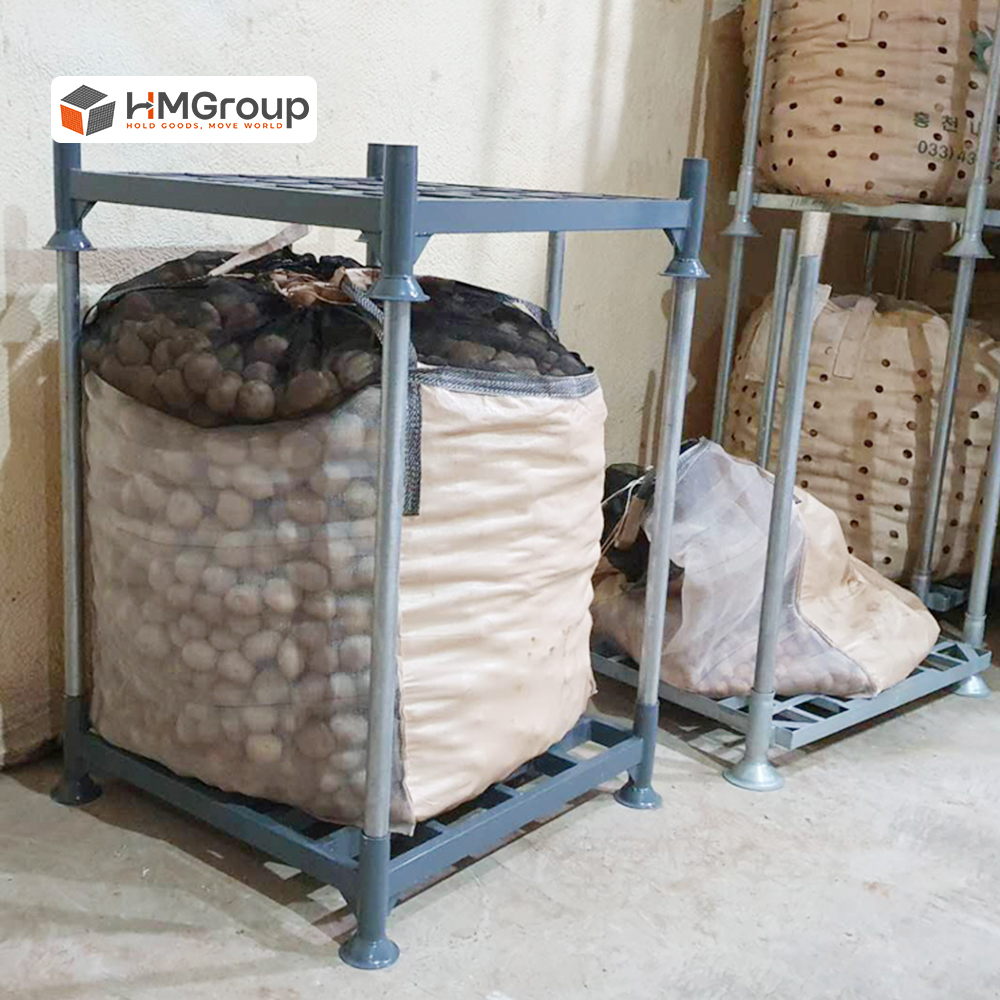
The UNOPS-linked project in Myanmar is a useful reference for how stacking configuration can affect storage capacity. The published case describes 5,000 units used for rice seed storage in cold facilities, with 6-high vertical stacking and a 1,200 kg per-unit load in that project. The South Korea government agency case describes 1,000 units in the initial phase for potato storage, using 4-high pallet stacking and a hot-dip galvanized finish. These cases show why the buyer should ask for project references that match the intended stacking height and operating environment.
4. Finish options: match the coating to the operating environment
The reviewed models list zinc, hot-dip galvanized, and powder coating as finish options. The finish should be selected against the operating environment, not treated as a cosmetic choice. A cold-storage project, an outdoor staging area, and an indoor textile warehouse do not place the same demands on the surface treatment.
The application data for HM Group's post pallet and stacking rack range includes cold room storage down to -30°C and temporary staging areas for cross-docking. The South Korea case used a hot-dip galvanized finish, while the Myanmar case describes a powder-coated base and galvanized posts. These are project-specific examples, not a universal recommendation. The buyer should ask the supplier to state the finish on the quotation and to confirm the inspection criteria for that finish.
5. Container loading: turn model data into a shipping plan
Container loading is one of the most practical supplier evaluation criteria because it connects product design to freight planning. The published loading figures for the five models are: 250 sets of HM-PP001 per 40'HQ, 160 sets of HM-PP002 per 40'HQ, 280 sets of HM-TR6060 per 40'HQ, 380 sets of HM-FR007 per 40'HQ, and 234 sets of HM-BR066 per 40'HQ.
These figures should not be used as a simple price-per-set calculation without checking the order mix. If a project needs more than one model, the container plan must be calculated against the actual quantities, packaging, and stackability of each model. The buyer should ask for a loading plan that shows the number of sets, the container type, and the loading configuration. HM Group lists a MOQ of 1x20GP and a lead time of 30-45 days, which should be confirmed against the final order mix.
6. Quality control and after-sales: verify the process, not just the promise
Supplier evaluation should include the quality-control sequence and the after-sales terms. HM Group lists six inspection phases: pre-production sample inspection, raw material inspection, component inspection, semi-finished product inspection, finished product inspection, and packaging inspection. The after-sales terms include process reports throughout production, support for online video audit, and a 3 to 5 year warranty under proper use.
These terms are useful because they give the buyer specific documents and checkpoints to request. A supplier that can provide inspection records and a process report is easier to audit than a supplier that only provides a final certificate. The buyer should confirm who performs the inspection, what is recorded, and how non-conforming items are handled before shipment.
Step-by-Step Breakdown: How to Run the Evaluation
- Define the load and handling method. Record the product type, dimensions, weight, and how it will be loaded and unloaded. For tire storage, confirm tire size and quantity. For fabric roll storage, confirm roll diameter, width, and weight. For barrel storage, confirm container volume and filled weight.
- Map the load to a model range. Compare the requirement with the base size, post size, load rating, and stacking configuration of each candidate model. Do not compare models only by headline load capacity.
- Confirm the material grade and finish. Ask for Q235 to be stated on the quotation, together with the selected finish and the inspection criteria. Confirm whether the finish is zinc, hot-dip galvanized, or powder coating.
- Calculate the container plan. Use the published sets-per-40'HQ figures as a starting point, then recalculate against the actual order mix, packaging, and destination requirements. Confirm the MOQ and lead time.
- Review the quality-control sequence. Ask for the inspection phases, the records provided, and the pre-shipment approval process. Confirm the after-sales terms and the warranty period.
- Request a written quotation and supporting documents. The quotation should separate the rack specification, finish, customization, packaging, and freight assumptions. Any item that cannot be confirmed in writing should be treated as an open point, not as an assumed capability.
Use Cases: Matching the Model Range to the Storage Task
Tire storage and tire distribution
Tire storage racks need to match tire size, tire quantity, and stacking height. HM-TR6060 is listed for 24 to 32 tires, with a 2,400 lb / 1,100 kg load and 4 open / 20 closed stacking. The model can be reviewed alongside other tire rack designs such as the stacking tire storage rack and the car tire storage rack when the warehouse plan requires a different footprint or capacity. The evaluation question is whether the supplier can confirm the tire capacity for the actual tire size, not only for a generic tire count.
Fabric roll and carpet roll storage
Fabric roll storage and carpet roll storage require racks that support cylindrical loads without damaging the material. HM-FR007 is a stackable steel storage rack listed at 1,100 kg with 6 open / 20 closed stacking. HM-PP001 and HM-PP002 are also listed for textile and fabric roll applications. For a fabric roll storage rack project, the buyer should confirm the roll diameter, roll width, and loading orientation before selecting the model. Carpet pad storage racks and industrial fabric roll storage racks should be evaluated against the same load geometry, not only against the rack name.
Barrel and wine storage
Barrel storage racks should be selected by container volume, stacking height, and handling method. HM-BR066 is listed for 50 L, 200 L, 225 L, 300 L, and 500 L containers, with 4-high stackability and 234 sets per 40'HQ. The model is listed for logistics and warehousing and the wine industry. A buyer evaluating barrel storage racks should confirm the filled weight, the barrel orientation, and the spill-containment requirements before relying on the container volume alone.
General warehouse, food, agriculture, and furniture
HM-PP001 and HM-PP002 are general warehouse storage rack models listed for textile and fabric roll, logistics and warehousing, food and grocery, agricultural, and furniture applications. HM-PP002 has a larger base and a 2,000 kg load rating, while HM-PP001 has a 1,500 kg load rating and a higher container loading figure of 250 sets per 40'HQ. The choice between them should be based on the load, the base size, and the container plan, not on the assumption that a larger base is always better.
Cold storage and project reference
The UNOPS-linked Myanmar case describes 5,000 units for rice seed storage in cold facilities, with 6-high stacking and a 1,200 kg per-unit load in that project. The published result states a 500% expansion of total warehouse storage capacity compared with floor-level storage and a 40% reduction in loading and unloading time through modular mechanical handling. The South Korea case describes 1,000 units in the initial phase for potato storage, with a 300% increase in vertical storage capacity and a 20% decrease in produce spoilage. These results are project-specific and should be used as reference points for discussion, not as a guarantee for another site.
Comparison Table: Five HM Group Storage Rack Models
The table below uses the published model specifications. It is intended for supplier evaluation, not for a ranking of models. The right model depends on the load, the handling method, and the container plan.
| Model | Type | Material | Load or capacity | Stacking | 1x40'HQ loading | Finish options |
|---|---|---|---|---|---|---|
| HM-PP001 | Stacking Storage Racks | Mild steel Q235 | 1,500 kg | 4 high | 250 sets | Zinc / hot-dip galvanized / powder coating |
| HM-PP002 | warehouse storage rack | Mild steel Q235 | 2,000 kg | 4 high | 160 sets | Zinc / hot-dip galvanized / powder coating |
| HM-TR6060 | Storage Tire Rack | Mild steel Q235 | 2,400 lb / 1,100 kg; 24-32 tires | 4 open / 20 closed | 280 sets | Zinc / hot-dip galvanized / powder coating |
| HM-FR007 | Stackable Steel Storage Racks | Mild steel Q235 | 1,100 kg | 6 open / 20 closed | 380 sets | Zinc / hot-dip galvanized / powder coating |
| HM-BR066 | Barrel Storage Racks | Mild steel Q235 | 50 L, 200 L, 225 L, 300 L, 500 L containers; no separate load rating stated in the supplied specification | 4 high | 234 sets | Zinc / hot-dip galvanized / powder coating |
Source basis: HM Group product specification data supplied for this article. Container loading figures are model-specific and should be recalculated for mixed orders, packaging, and destination requirements.
FAQ: Storage Rack Supplier Evaluation Questions
What documentation should a storage rack supplier provide for compliance review?
Ask for the material grade, model drawing, load rating, stacking configuration, finish specification, and inspection records. For U.S. warehouse operations, OSHA 29 CFR 1910.176(b) requires stored materials to be stable and secure. HM Group's published quality-control sequence includes raw material inspection, component inspection, semi-finished product inspection, finished product inspection, and packaging inspection. The supplied corpus does not contain third-party certification or independent load-test reports, so these should be requested as project documents.
Can one supplier cover tire, fabric roll, barrel, bulk bag, and general warehouse racks?
The published HM Group range covers tire storage, fabric roll storage, barrel storage, bulk bag storage, nestainer storage, and general warehouse storage. The five models reviewed here are HM-PP001, HM-PP002, HM-TR6060, HM-FR007, and HM-BR066. Each model has its own base size, load rating, stacking configuration, and container loading figure, so the supplier should be evaluated model by model rather than by the breadth of the catalogue alone.
What determines budget and quotation accuracy for a storage rack order?
The supplied data does not include unit prices. Quotation accuracy depends on the confirmed model, load rating, base and post size, finish, customization scope, order quantity, and container loading. HM Group lists a MOQ of 1x20GP and a lead time of 30-45 days. Ask for a line-item quote that separates the rack specification, finish, customization, packaging, and freight assumptions so that each cost driver can be reviewed.
How should a buyer handle samples before a bulk order?
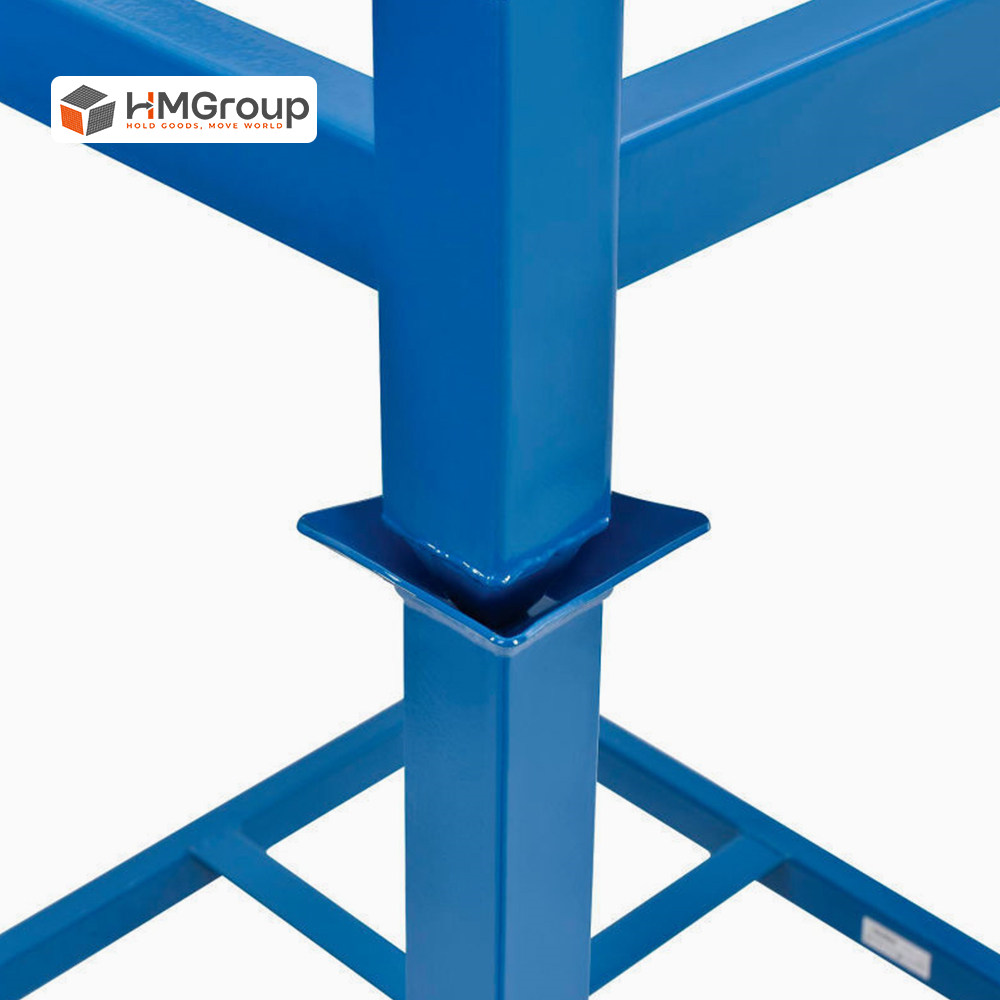
HM Group's quality-control process begins with pre-production sample inspection. The supplied corpus does not state a standard sample policy, sample lead time, or sample price, so the buyer should confirm the sample model, finish, inspection criteria, and approval sign-off before production. A sample review should focus on the same points as the bulk order: material grade, base and post dimensions, weld quality, finish, and stacking interface.
What lead time and container loading should be confirmed before ordering?
HM Group lists a lead time of 30-45 days and a MOQ of 1x20GP. For container planning, the supplied specifications state 250 sets of HM-PP001 per 40'HQ, 160 sets of HM-PP002, 280 sets of HM-TR6060, 380 sets of HM-FR007, and 234 sets of HM-BR066. Confirm the final loading plan against the actual order mix, packaging, and destination requirements, then request a written quotation and container loading plan from HM Group.
Conclusion: Evaluate the Evidence, Then Request the Quote
A storage rack supplier evaluation should be built on verifiable facts: Q235 material consistency across the model range, model-level load and stacking data, finish options, quality-control records, and container loading figures. The five HM Group models reviewed here show how that evidence can be organized. HM-PP001 offers 1,500 kg load and 250 sets per 40'HQ. HM-PP002 offers 2,000 kg load and 160 sets per 40'HQ. HM-TR6060 offers 24 to 32 tire capacity and 280 sets per 40'HQ. HM-FR007 offers 1,100 kg load and 380 sets per 40'HQ. HM-BR066 covers 50 L to 500 L containers and 234 sets per 40'HQ.
The next step is not to choose the largest model or the lowest headline price. It is to confirm the load, the handling method, the finish, the inspection records, and the container plan in writing. Buyers who evaluate those points before ordering are in a better position to compare suppliers on evidence rather than on general claims.
Request a Storage Rack Quotation or Product Brochure
For a model-specific quotation, container loading plan, or sample discussion, contact HM Group with the required model, load, finish, order quantity, and destination. You can also download the HM Group product brochure for the wider storage rack range.
Contact: MARY KONG | Email: mary@net-railing.com | Tel/WhatsApp: +86 150 4058 7228 | Phone: +86 411-3981 3061 | Address: 3306 Times Square (Times 1), 50 Renmin Road, Zhongshan Dist, Dalian, Liaoning China | Website: HM Group
Have Questions or Need More Details?
Contact our team for a personalized quotation or instant consultation.
Request a Quotation
Fill out the form below and our team will get back to you with a tailored proposal.
WhatsApp Direct Chat
Prefer to chat in real-time? Message us on WhatsApp for instant assistance & quick answers.
- Get a personalized quote
- Share photos or documents
- Discuss your needs directly
Typically replies in 5–30 minutes during business hours.