Wire Mesh Container vs. Wire Container with PP Sheet: Which Protects Your Goods Better?
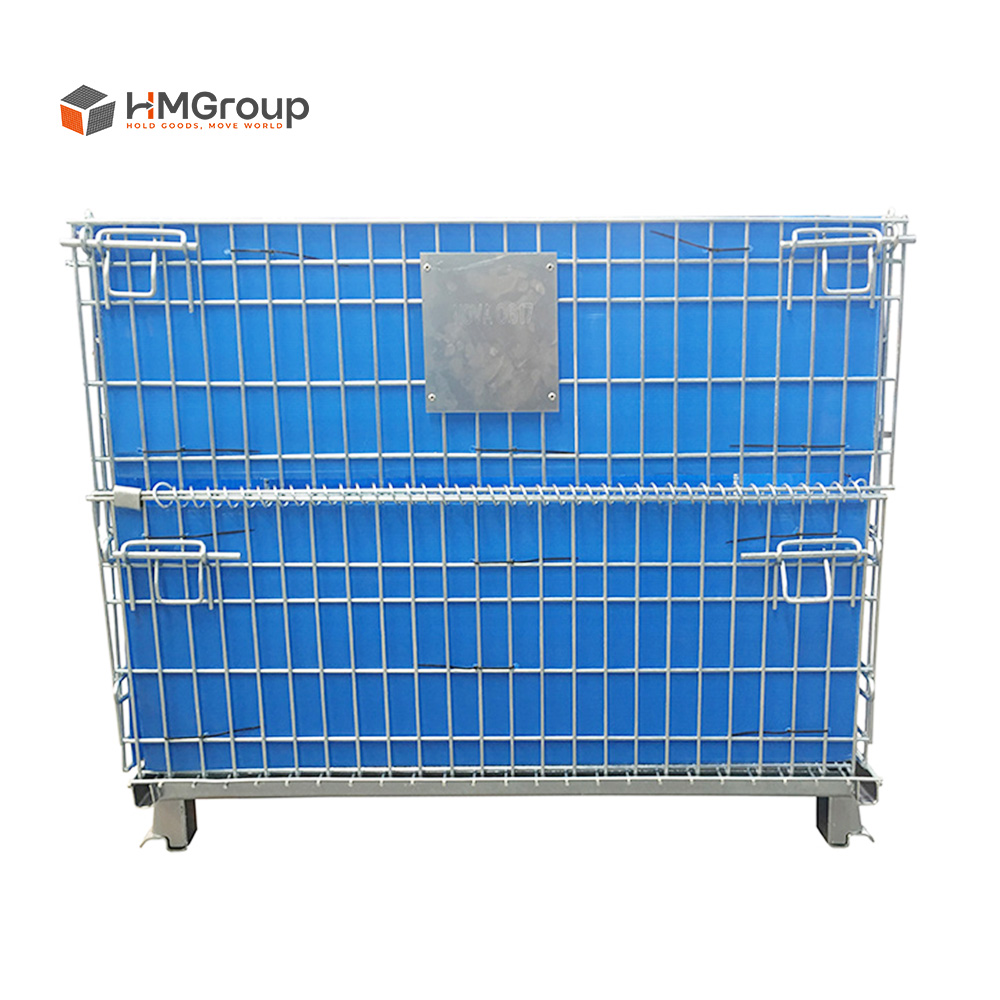
Two containers can share the same 1,200 x 1,000 mm footprint, the same four-high stackability and the same steel grade, and still protect their contents in completely different ways. That is exactly the case with HM Group's HM-HD010 wire mesh storage container and HM-HD028 wire container with PP sheet.
Short answer: an open wire mesh container protects goods through geometry — a 25 x 50 mm grid and 6 mm wire keep small parts inside and keep every wall transparent to the eye, with an 800 kg rated load. A container with a PP sheet liner protects goods through a surface — a 50 x 100 mm grid closed by polypropylene sheet, rated at 500 kg, so the load rubs against plastic instead of wire and fines or dust stay inside the frame. The mesh version wins where retention and visibility matter most; the sheeted version wins where surface quality and debris control matter most. Neither protects better in general. Each one protects a different failure better.
HM Group (Dalian HuaMao Logistics Equipment Group Co., Ltd.) is a Chinese manufacturer of wire mesh containers, cage pallets, stillages and related material handling equipment, founded in 2003, with manufacturing bases in Xiamen, Nanjing and Qingdao and a catalogue that covers wire containers, PET preform containers, wine-bottle containers, wire mesh decking and steel pallets.
What “Protection” Actually Means for a Returnable Container
Buyers usually ask which container protects better, but protection is not a single property. A wire container can fail a load in at least six different ways, and the two designs in this comparison are strong against different ones.
- Retention. The load, or part of it, leaves the container through the wall.
- Surface integrity. The product is scuffed, scratched or marked by whatever it rests against.
- Contamination. Dust, dirt or fragments enter the load, or fragments from the load escape into the aisle.
- Identification. Nobody can see, count or verify the load without opening the container or lifting it down.
- Structural capacity. The unit does not hold its rated load in the position it is actually used, including the bottom position of a stack.
- Loop economics. The unit survives the return trip and ships at a cost the loop can carry.
The first four decide whether your goods arrive undamaged. The last two decide whether that protection is affordable over a hundred cycles. A specification that only answers the first question usually gets revised after the first year.
Why the Two Designs Diverged: Industry Background
Returnable wire containers replaced single-trip packaging in closed loops because the container itself becomes the handling unit: it is filled at the production line, stacked in the warehouse, moved by forklift and returned empty. The same logic drives their use across automotive parts, agriculture, food and beverage, fulfilment and warehouse operations, and PET preform production — all of which appear as listed application industries for HM Group's standard container range.
As loops became longer and more automated, the interior surface of the container started to matter as much as the frame. An open mesh wall is ideal when the load is coarse, when airflow is useful and when fast visual verification is worth more than a closed surface. It becomes a liability when the load is small enough to escape, soft enough to be marked by wire, or sensitive enough that ambient dust changes its quality status. The PP sheet liner exists to answer that second set of problems without giving up the steel frame that does the stacking.
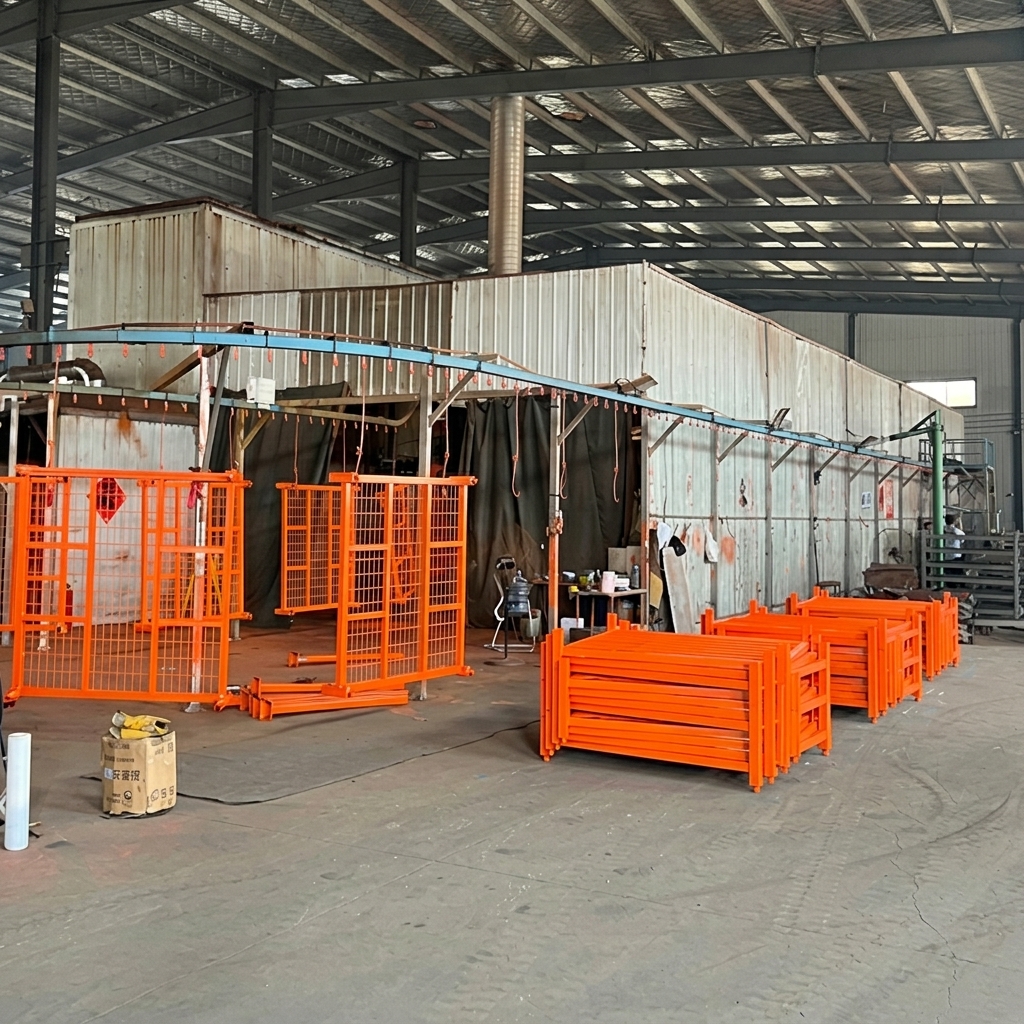
Finish matters here because it sits between the steel and the product. HM-HD010 and HM-HD028 are both mild steel Q235 construction with the same three finish options — zinc, hot-dip galvanized or powder coating — so the choice between them is not a corrosion choice. It is a choice about the wall.
The Two Containers Side by Side
Open wire mesh: HM-HD010
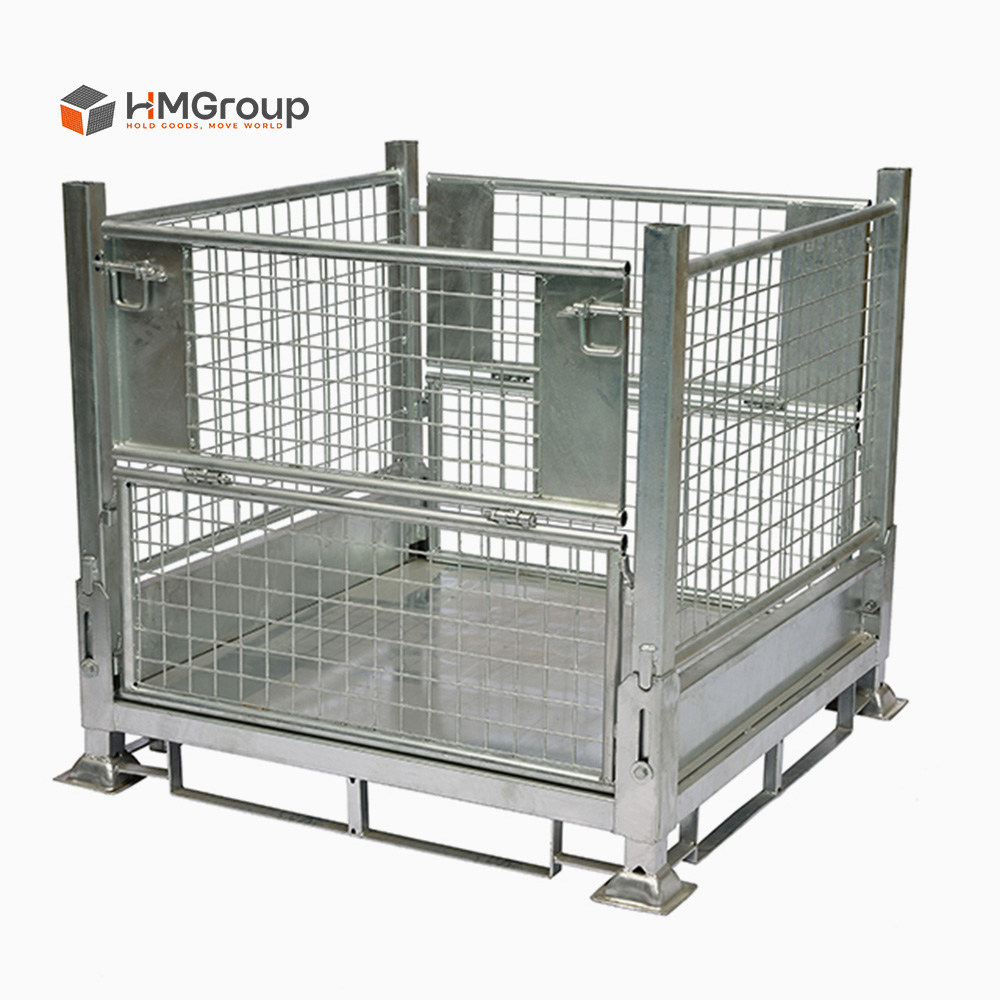
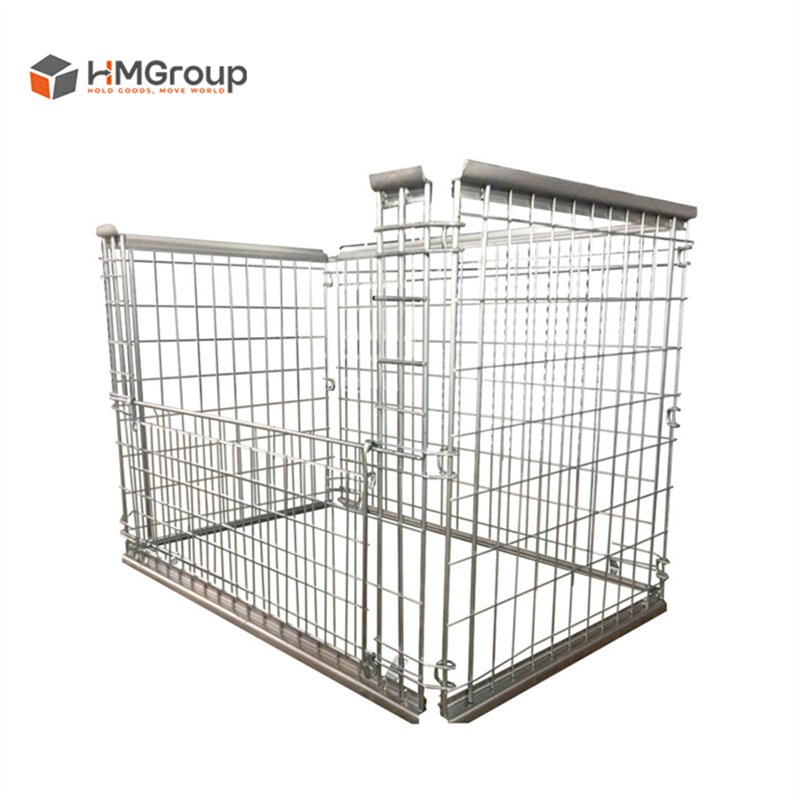
HM-HD010 is a wire mesh storage container built from mild steel Q235 with 6 mm wire and a 25 x 50 mm grid. Its exterior dimensions are 1,200 x 1,000 x 1,250 mm, its rated loading capacity is 800 kg, it stacks four high, and a 40-foot high-cube container holds 216 sets.
The protection logic is mechanical. The 25 mm dimension of the grid is the decisive number: anything whose smallest cross-section is larger than that aperture cannot leave the container through the wall, and the tighter pitch holds small items that would slip through a coarser mesh. Because every wall is open, the load is visible from all four sides and from above, air moves through the container, and the walls do not trap water or spilled product the way a closed surface can. That combination is why fine-grid mesh containers are listed for PET preform production, agriculture and warehouse use alike.
The trade-off is equally mechanical. Where the wall is open, the wire is what the product touches, and anything small enough to pass the grid — chips, fines, granules, dust — can also leave the container during transport.
Wire container with PP sheet: HM-HD028
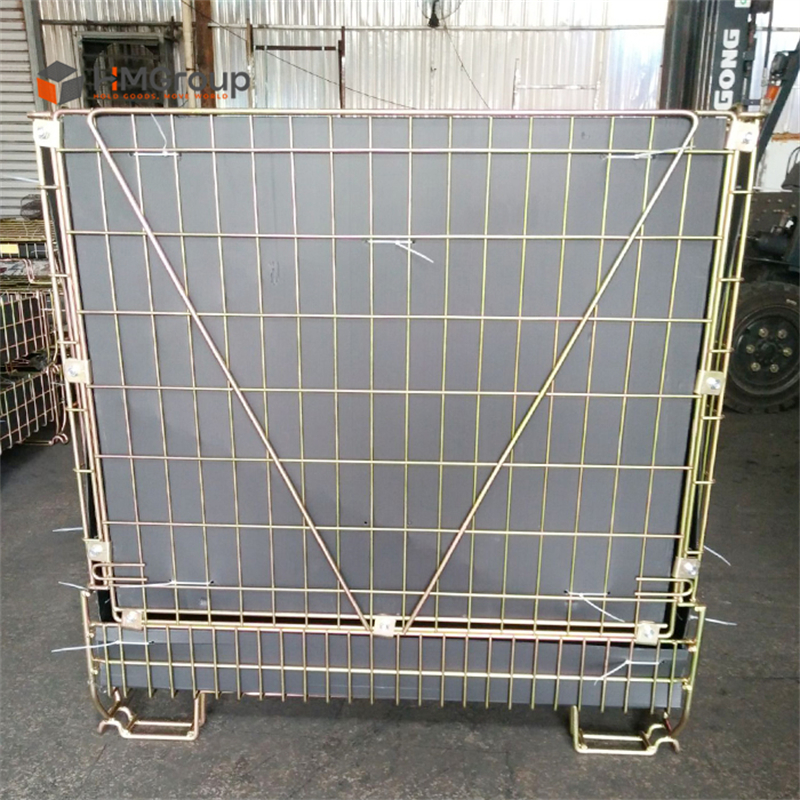
HM-HD028 uses a 50 x 100 mm grid with 5 mm wire and adds a polypropylene sheet liner. Exterior dimensions are 1,200 x 1,000 x 1,140 mm, rated loading capacity is 500 kg, stackability is four high, and a 40-foot high-cube container holds 330 sets.
Here the wall does two jobs at once. The steel grid carries the load and the stacking forces; the PP sheet changes what the load touches. Because the liner closes the apertures on the faces it covers, the product no longer rubs against wire, and small fragments, dust or residue are less likely to escape through the wall into the aisle or into the container beside it. HM Group's disclosed beverage projects describe the effect directly: in the Coca-Cola South Africa deployment of 5,000 units, a precision-engineered mesh with PP sheet inner lining was used to protect delicate preform surfaces, alongside stacking stability of up to six levels under full load. In the Nestlé project across Pakistan and Costa Rica, 10,000 units with PP sheet inner lining helped minimise preform contamination and surface scuffing, while supporting a 300% increase in storage capacity through secure four-high vertical stacking and a 40% improvement in stock counting and identification speed.
Two limits belong in the same paragraph as the benefits. First, a liner covers the faces it is fitted to, so those faces stop providing line-of-sight; identification then has to be planned rather than assumed. Second, containment depends on how the liner is fixed and whether the base is lined too — a liner that leaves gaps at the corners will not hold fines. Both points belong in the quotation, not in the first week of production.
Where the protection actually differs: three trade-offs
Trade-off 1 — retention by geometry vs. retention by barrier. Mesh keeps the load in by making the hole smaller than the part. A liner keeps it in by closing the hole. If your load includes small components that must not fall out, a 25 x 50 mm grid is the direct answer. If your load is a bagged or palletised mass where what escapes is dust and fragments rather than parts, the barrier is the direct answer.
Trade-off 2 — visibility has a cost at goods-in. An open mesh container can be counted from the aisle. Once walls are lined, counting relies on the remaining open faces, the top opening, and any identification you build in. HM Group's customisation list is where this gets solved: name plate, logo printing, wire divider, runner bar, forklift guide and wheels are all available as design options, and a label or plate on a sheeted wall is faster to read than a wire wall is to inspect.
Trade-off 3 — rated capacity, stack height and freight density. This is where the two models separate most clearly for a buyer: 800 kg against 500 kg, 6 mm wire against 5 mm wire, and 216 sets against 330 sets per 40-foot high-cube container. The sheeted unit is 110 mm shorter and ships roughly one and a half times as many units per container, which changes landed cost per unit even before unit price is discussed. The rating changes it back: a routine 700 kg load removes HM-HD028 from consideration before freight is calculated.
How to Choose: A Six-Step Specification Sequence
- Measure the smallest cross-section of the load. Compare it against a 25 x 50 mm grid and a 50 x 100 mm grid. This single measurement eliminates one of the two options more often than any other criterion.
- Name the failure you are preventing. Fall-through, abrasion, or escape of fines. Write it down, because a container specified against two different failures usually satisfies neither.
- Check the load against the rating — in the position it will be used. 800 kg for HM-HD010, 500 kg for HM-HD028, both stackable four high. Confirm in writing how the bottom position of a four-high stack affects the allowable load, since the rating and the stack configuration are separate questions.
- Decide identification before you close the walls. If the container will be lined, specify the name plate, printed logo or label position in the same drawing as the liner.
- Confirm the interior regime. Wash-down, dust control or clean storage requirements should be stated in the enquiry, together with the documents your quality team will ask for at goods-in.
- Run the loop arithmetic, then lock the drawing. Units per 40-foot high-cube container, return freight, repair history. Only then fix the final specification: surface treatment, size, loading capacity, powder coating colour, logo printing, forklift guide, divider, runner bar, name plate and wheels are all customisable on an OEM, ODM or fully customised basis.
Use Cases: Which Load Belongs in Which Container
Fine components, stampings and fasteners
Parts small enough to pass a 50 x 100 mm aperture belong in the finer grid. HM-HD010's 25 x 50 mm mesh holds them, keeps every face visible for counting, and its 800 kg rating covers dense metal loads. Where the part has a machined or painted finish, ask for powder coating rather than bare wire contact.
PET preforms and surface-critical plastic
Both models list PET preform production and warehouse use as application industries, which is the honest answer: the right choice depends on how the preforms are handled. Where scuffing and contamination are the governing risks, HM-HD028's PP sheet lining addresses the wall contact directly, and the beverage projects cited above show how that lining is used in practice. Where the priority is maximum load per unit and full visual verification at the moulding machine, the 800 kg fine-grid option is the stronger fit.
Dust-controlled warehouses and high-rotation lines
Indoor warehouse environments that require dust control and clean storage favour a closed interior surface, which is the case a PP sheet liner makes. High-volume manufacturing and high-rotation logistics favour fast identification and high rated load — the case the open mesh makes. Many plants end up running both: sheeted units in the clean zone, mesh units in the general flow.
Agricultural and mixed bulk loads
Coarse, irregular loads benefit from airflow, drainage and a wall you can see through. Here the open mesh is doing protective work that a liner would undo, and HM-HD010 is listed for agricultural use for that reason.
When neither container is the right answer
Bottled loads are a separate design problem. HM Group's dedicated wine containers — HM-WEU001, specified to store 500 Bourgogne bottles, and HM-WEU005, specified to store 400 Bordeaux bottles, both rated at 800 kg with 4+1 stackability — exist because glass needs a shaped internal structure, not a general-purpose wall. Comparing a bottle load against a standard mesh or sheeted container is a specification error, not a close call.
Comparison Table: HM-HD010 vs. HM-HD028
| Attribute | HM-HD010 wire mesh storage container | HM-HD028 wire container with PP sheet |
|---|---|---|
| Exterior dimensions (L x W x H) | 1,200 x 1,000 x 1,250 mm | 1,200 x 1,000 x 1,140 mm |
| Wire gauge | 6 mm | 5 mm |
| Grid size | 25 x 50 mm | 50 x 100 mm, closed by PP sheet |
| Rated loading capacity | 800 kg | 500 kg |
| Stackability | 4 high | 4 high |
| Material | Mild steel Q235 | Mild steel Q235 |
| Finish options | Zinc / hot-dip galvanized / powder coating | Zinc / hot-dip galvanized / powder coating |
| Units per 1 x 40'HQ | 216 sets | 330 sets |
| Primary protection mechanism | Geometric retention by a fine grid | Barrier protection by a sheet liner |
| Contact between load and wall | Wire contact | PP sheet on the lined faces |
| Visibility of the load | All four walls and top open to view | Reduced on lined faces; plan labels or a name plate |
| Escape of fines and dust | Limited by grid size only | Restrained on lined faces; confirm base and corner fixing |
| Listed application industries | PET preform production, agriculture, fulfilment and warehouse | PET preform production, fulfilment and warehouse |
Both models are customisable on an OEM, ODM or fully customised basis, including size, loading capacity, surface treatment, powder coating colour, logo printing, forklift guide, wire divider, runner bar, name plate and wheels. Where a load does not match either specification, a modified drawing is the correct next step rather than a compromise on the listed rating.
FAQ
Does a PP sheet liner change the compliance status of the container?
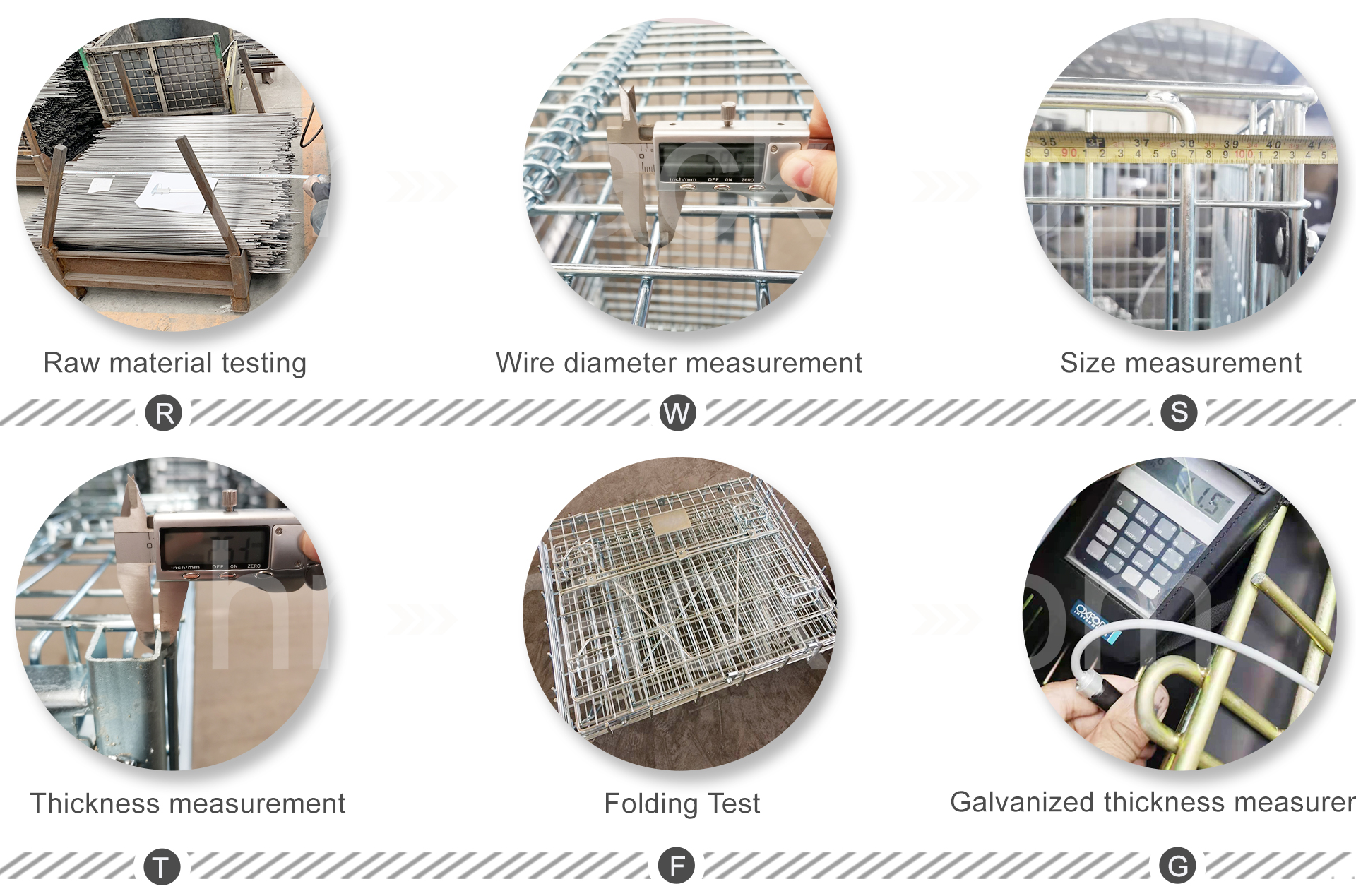
The liner does not create a separate product certification. The quality certificate that covers this product range is HM Group's ISO 9001:2015 certificate, number CN24/00004786, issued by SGS with a scope of sales of material handling equipment for logistics turnover, valid from 30 July 2024 to 29 July 2027. A BV audit report, MIC-ASI2491658, covers the product scope including wire mesh containers. What still needs to be verified per order is model-specific: the rated load, the finish, and any application-specific documentation your own quality system requires for direct contact with your product.
Can both versions be supplied in one customised order?
Yes. HM Group offers OEM, ODM and fully customised production, with stated monthly capacity of 40,000 sets across three manufacturing bases in Xiamen, Nanjing and Qingdao, and a minimum order quantity of 1 x 20GP. Customisation covers surface treatment (zinc, hot-dip galvanized or powder coating), size, loading capacity, powder coating colour, logo printing, and design features such as forklift guide, wire divider, runner bar, name plate and wheels — which means a mixed fleet of fine-grid and sheeted containers can be specified in one drawing set.
Which version costs more to run, not just to buy?
Unit prices are quotation-specific, but the freight and capacity arithmetic is not. HM-HD028 ships 330 sets per 40-foot high-cube container against 216 sets for HM-HD010, so the sheeted unit carries roughly one and a half times as many containers per shipment. Against that, HM-HD028 is rated at 500 kg and HM-HD010 at 800 kg. The practical rule is to compare landed cost per kilogram of rated capacity, not cost per unit: if routine loads sit below 500 kg and surface quality governs, the freight density works in the sheeted unit's favour; if loads approach 700–800 kg, HM-HD010 is the only valid option and freight becomes secondary.
How can we validate protection with our own goods before ordering?
Run one real loop with a trial quantity rather than approving a specification on paper. The stated minimum order is 1 x 20GP, and acceptance criteria can be set as pre-shipment inspection or third-party inspection, which gives you a documented reference for the delivered batch. HM Group reports a process report throughout the order and supports online video audit, with a warranty of 3 to 5 years under proper use. A practical pilot tests four things: whether fines stay inside the lined unit, whether the grid holds your smallest component, whether operators can count the load without opening the container, and whether the finish survives your handling equipment.
What is the lead time, and how does the order flow work?
Stated production lead time is 30 to 45 days, with a minimum order quantity of 1 x 20GP. Delivery terms offered are EXW, FOB, CIF, DDP and DDU; payment terms are T/T with 30% in advance and 70% against a copy of the bill of lading, or L/C. Because a pilot loop fits inside a normal procurement cycle, the fastest route from this comparison to a firm decision is to send your load profile and grid requirement for a written specification and quotation — sample requests and technical questions can go directly to the contact below.
Conclusion
Neither container protects better in the abstract. HM-HD010 protects by keeping small parts inside a 25 x 50 mm grid, holding an 800 kg rated load and leaving every wall open to inspection. HM-HD028 protects by putting a PP sheet liner between the load and the wire, containing fines and dust on the lined faces and shipping 330 sets per 40-foot high-cube container — at a 500 kg rating and with reduced sight lines that have to be solved with identification. Decide with three inputs: the smallest dimension of your load, the failure you are preventing, and the load weight you actually run in the bottom position of a stack. Those three answers point to one model, and the drawing set confirms it.
Next step: test both versions against your own load
Send your load dimensions, target weight and handling environment, and HM Group will confirm whether a 25 x 50 mm mesh container, a 50 x 100 mm PP sheet container or a modified drawing fits the application. Sample requests, drawings and quotations are handled directly.
Contact: MARY KONG | Email: mary@net-railing.com | Tel / WhatsApp: +86 150 4058 7228 | Office: +86 411-3981 3061
Address: 3306 Times Square (Times 1), 50 Renmin Road, Zhongshan Dist, Dalian, Liaoning, China
Product range and specifications:HM Group wire containers
Download the full catalogue (PDF):HM Group product brochure
Have Questions or Need More Details?
Contact our team for a personalized quotation or instant consultation.
Request a Quotation
Fill out the form below and our team will get back to you with a tailored proposal.
WhatsApp Direct Chat
Prefer to chat in real-time? Message us on WhatsApp for instant assistance & quick answers.
- Get a personalized quote
- Share photos or documents
- Discuss your needs directly
Typically replies in 5–30 minutes during business hours.