Storage Rack Comparison Guide: Choosing Between Tire, Fabric Roll, and Barrel Racks
Tires, fabric rolls and barrels look similar on a warehouse floor plan and behave completely differently inside a rack. This comparison guide explains how to choose between stackable steel storage racks for the three load types, using the HM-TR6060, HM-FR005 and HM-BR066 as reference models, and sets out the factors that actually change the specification: load capacity, footprint, stack height, finish options and industry fit.
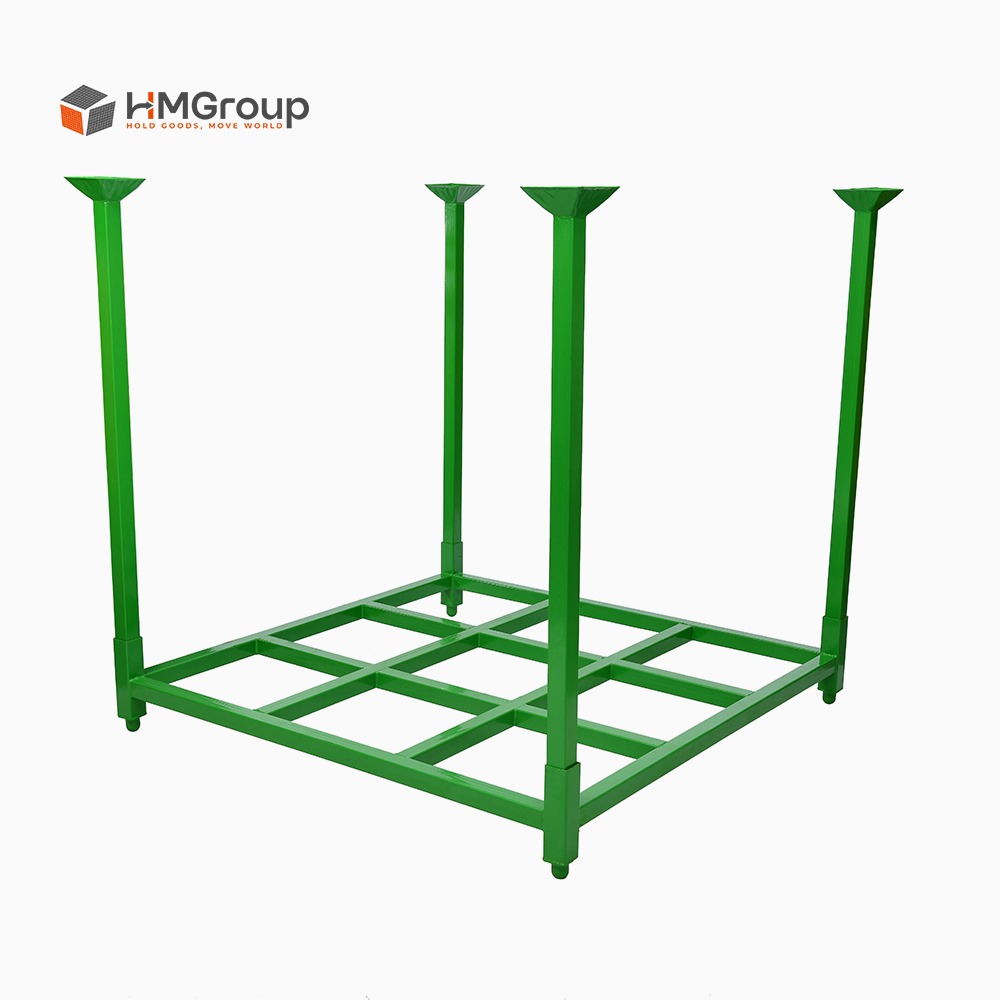
Storage Tire Rack HM-TR6060 — a 60x60x60 inch stackable steel rack rated for 24 to 32 tires at 2400 lb (1100 kg) per unit.
The Buying Problem: One Storage Rack Cannot Carry Three Load Shapes
A tire, a fabric roll and a barrel are all roughly cylindrical, and that is where the similarity ends. A tire is a hollow ring whose sidewalls deform when the unit is stored flat for months at a time. A fabric roll is a long, comparatively light cylinder that creases, slips and snags if it is not supported evenly along its length. A barrel is a dense, rigid container, frequently handled in humid cellars where corrosion protection matters as much as load rating.
The practical answer: match the rack to the load geometry first and to the load weight second. In the HM Group range, that means a storage tire rack such as the HM-TR6060 for 24 to 32 tires at a loading capacity of 2400 lb (1100 kg), a fabric roll storage rack such as the HM-FR005 rated at 1000 kg for roll storage, and a barrel storage rack such as the HM-BR066 for 50 L to 500 L barrels stacked up to four high. The three models share the same steel grade and the same finish options, but differ in base size, load rating and stacking behaviour — which is exactly why they are not interchangeable.
The mismatch between load and rack shows up in three predictable places: deformation, stability and surface protection.
- Deformation. Tire storage racks are engineered to prevent tire warping or flattening and to protect sidewalls, while fabric roll storage racks are designed to prevent rolls from flattening, slipping or getting damaged. Both functions are structural, not cosmetic: they determine where the load touches the frame.
- Stability. Barrel racks hold heavy, rigid cylinders in a secure vertical configuration with stable, interlocking bases, so a four-high stack stays aligned through repeated forklift cycles.
- Surface protection. Fabric storage demands anti-rust coatings, reinforced frames and smooth edges that will not snag delicate material. Barrel storage in humid aging cellars requires a finish that resists corrosion. All three rack families are available in zinc, hot-dip galvanized or powder coating, so the finish can be matched to the environment rather than accepted as a default.
This is why a sensible selection sequence starts with the load unit — not with the price list and not with the warehouse dimensions.
Industry Background: Stackable Steel Racks Inside a Growing Racking Market
The global warehouse racking market was valued at approximately USD 9.71 billion in 2024 and is projected to reach USD 12.41 billion by 2030, according to Grand View Research. A broader estimate that includes total storage equipment and services puts the 2024 storage rack market at USD 22.4 billion with a 4.9% CAGR forecast through 2034, according to Global Market Insights. The two figures differ mainly in scope — fixed racking only versus wider storage equipment — and are best read as a range rather than a single number.
Inside that market, North America held the largest regional share of warehouse racking revenue in 2024 at 27.8% (Grand View Research), and selective pallet racking remained the dominant product segment at approximately 45.0% of market share in 2024. Specialty segments are expanding alongside fixed installations: the dedicated tire storage rack market was valued at USD 865 million in 2024 and is forecast to grow at a CAGR of 4.7% through 2034, according to Future Market Insights. Stackable and portable steel racks sit at the intersection of these two trends — they add storage density without a fixed installation project.
Compliance framing has tightened as well. Industrial steel storage racks in the United States are covered by ANSI MH16.1-2023, which specifies minimum requirements for structural design, testing and utilization, while EN 15512:2020 (updated in 2022) governs structural design principles for steel static storage systems and adjustable pallet racking in Europe. Both standards shape how buyers write rack specifications, including for portable, stackable units that are not part of a fixed adjustable racking system.
The wider industrial racking system market includes large global suppliers such as Daifuku Co., Ltd., Kardex Group, Mecalux S.A. and SSI SCHAEFER Group (Future Market Insights). HM Group — formally Dalian HuaMao Logistics Equipment Group Co., Ltd., a logistics equipment manufacturer established in 2003 with three manufacturing bases in Xiamen, Nanjing and Qingdao covering 62,000 square metres — operates in a narrower segment of that market: stackable steel racks, wire mesh containers, cage pallets, stillages, nestainer racks, fabric roll racks, wine barrel racks, post pallet racks, wire mesh decking, Danish trolleys and steel pallets, exported to the EU, North America, Asia and the Middle East.
The Three Reference Racks: What Each One Actually Solves
HM-TR6060 — Storage Tire Rack, 60 x 60 x 60 inches
The HM-TR6060 is a storage tire rack made of mild steel Q235 with overall dimensions of 60 x 60 x 60 inches. It holds 24 to 32 tires and carries a loading capacity of 2400 lb (1100 kg). Maximum stacking is 4 units when open and 20 when closed, finish options are zinc, hot-dip galvanized or powder coating, and a 40-foot HQ container can hold 280 sets. It is intended for the tire industry as well as logistics and warehousing, food and grocery, and agricultural applications.
Functionally, the rack converts vertical air space into organised tire storage. In high-ceiling warehouses, modular vertical stacking lets operators sort tires by size or type for faster retrieval, and the cradle geometry prevents the tread distortion and bead damage that flat or loose stacking produces over time. The rack is usually serviced by forklifts, reach trucks or pallet jacks, with Warehouse Management Systems used for inventory tracking.
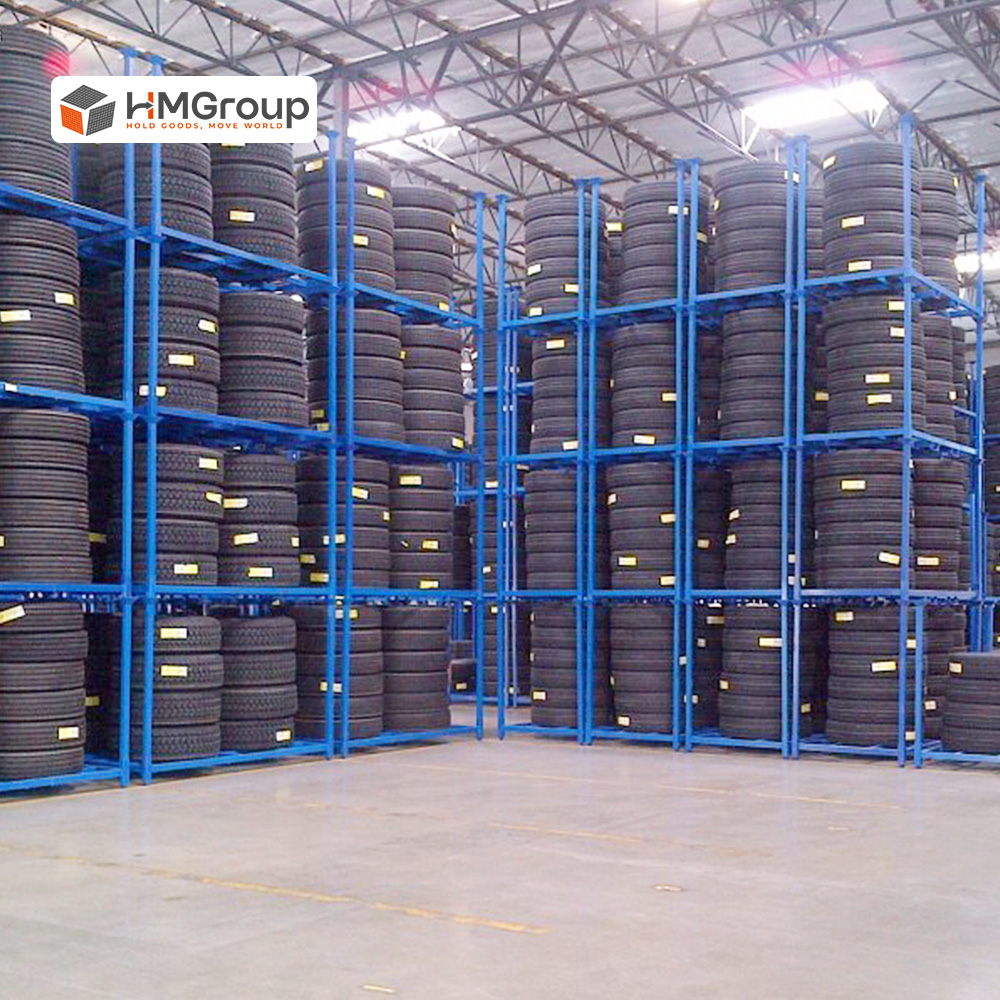
Storage Tire Rack HM-TR6060 — cradle support prevents tire warping and flattening while freeing floor space.
HM-FR005 — Fabric Roll Storage Rack, 1500 x 1100 x 900 mm
The HM-FR005 is a fabric roll storage rack made of mild steel Q235 with overall dimensions of 1500 x 1100 x 900 mm and a loading capacity of 1000 kg. It can be stacked up to 4 sets when open and 20 sets when closed, is available in zinc, hot-dip galvanized or powder coating finish, and a 1 x 40 HQ container holds 160 sets. It is intended for textile and fabric roll storage and for logistics and warehousing.
The design priority here is material integrity. Rolls are held so that workers can identify and retrieve a specific roll without moving the surrounding inventory — the changeover behaviour that textile cutting rooms depend on. Smooth edges and reinforced frames protect delicate fabric from snagging and tearing, and the rack operates in high-traffic industrial environments where labels, barcode scanners and ERP systems are already part of the workflow.
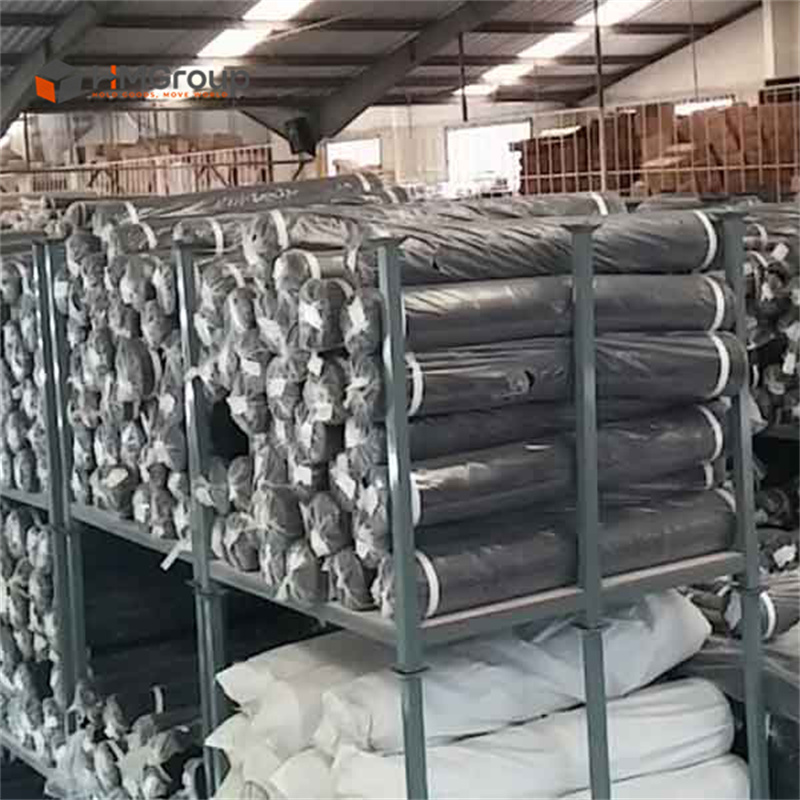
Fabric Roll Storage Rack HM-FR005 — 1500 x 1100 x 900 mm, 1000 kg capacity, stackable 4 sets open.
HM-BR066 — Barrel Storage Rack, 1130 x 775 x 453 mm
The HM-BR066 is a barrel storage rack made of mild steel Q235 with exterior dimensions of 1130 x 775 x 453 mm. It accommodates barrels of 50 L, 200 L, 225 L, 300 L or 500 L and is stackable up to four high. Finish options are zinc, hot-dip galvanized or powder coating, and a 40-foot HQ container can hold 234 sets. It is designed for the wine industry and for logistics and warehousing.
In winery use, the rack has to survive a specific environment: humid aging cellars at 70 to 85% relative humidity with controlled, constant temperature, frequent forklift handling and regular vintage monitoring. The steel specification is therefore as much about corrosion resistance as about load: heavy-grade steel with hot-dip galvanized or powder coating is specified for continued corrosion resistance in cellar conditions, and reinforced joints and stress-point welding support loads per rack unit. Standardised base dimensions also allow the same rack family to hold different cask formats rather than forcing a bespoke frame per barrel type.
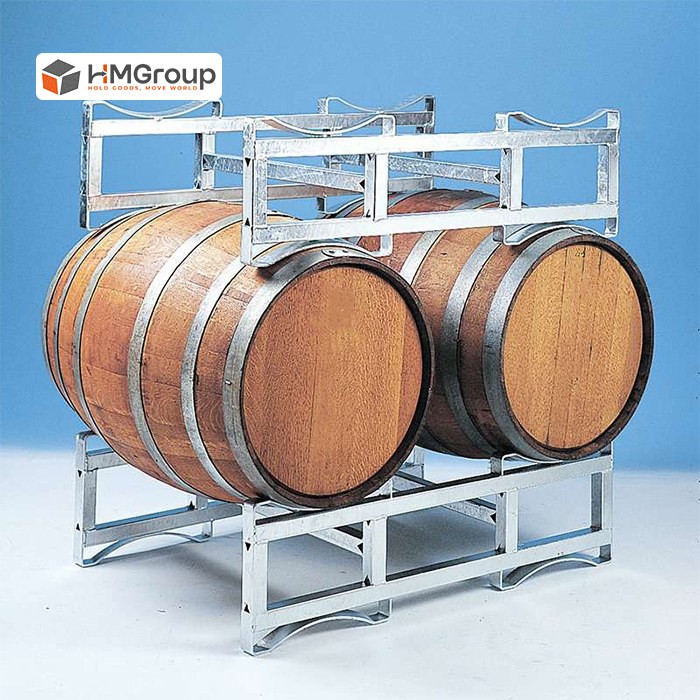
Barrel Storage Racks HM-BR066 — 50 L to 500 L barrel sizes, stackable four high for cellar and logistics use.
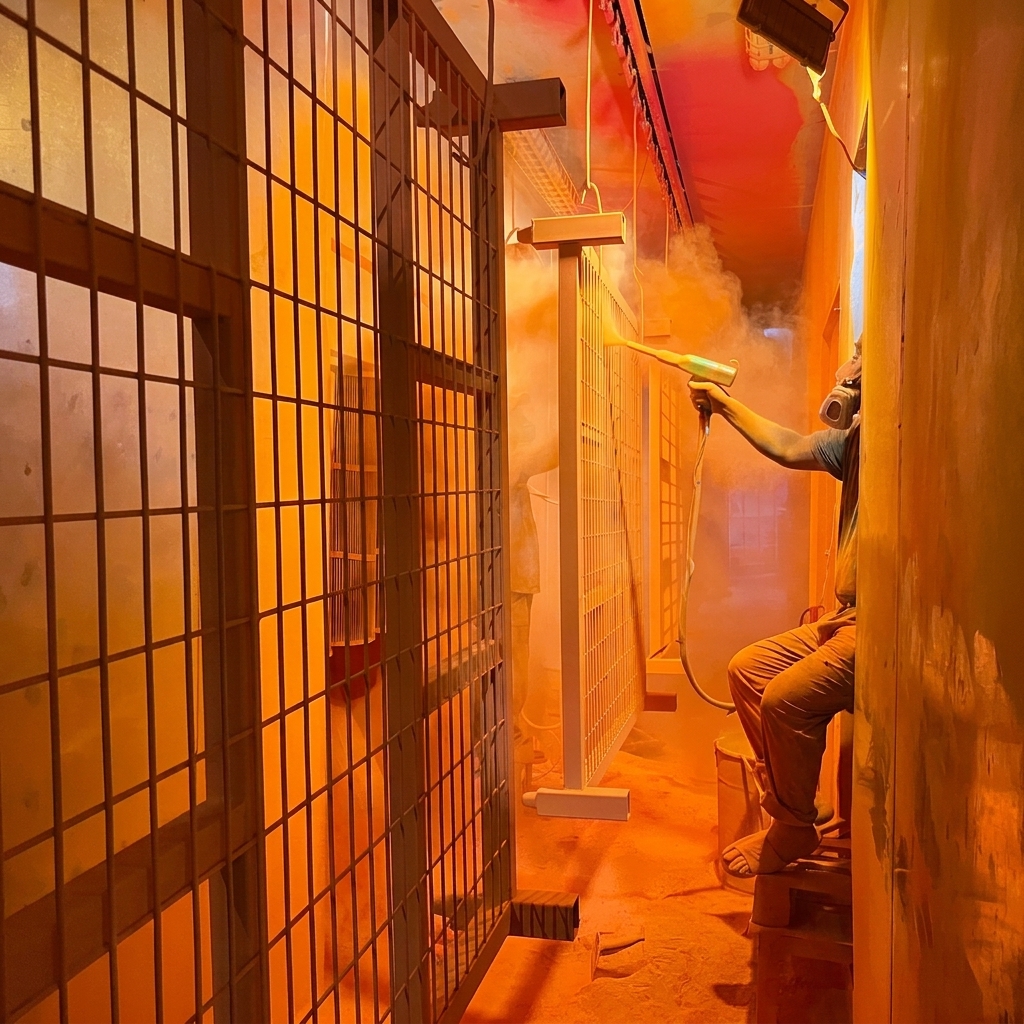
Finish choice — zinc, hot-dip galvanized or powder coating — is a specification decision shared by all three rack models.
Step-by-Step: How to Choose Between the Three Racks
Step 1 — Define the load unit, not the load category
Write down what one handling unit contains: a stack of 24 to 32 tires, a set of fabric rolls, or a 200 L barrel. The rack that suits 24 tires at 1100 kg total is not the rack that suits a single 500 L barrel, even though both are steel racks of similar footprint.
Step 2 — Compare the rated capacity against the real unit weight
The published loading capacities across the three reference models are 2400 lb (1100 kg) for the HM-TR6060, 1000 kg for the HM-FR005 and, for the HM-BR066, a capacity range defined by barrel volume from 50 L to 500 L. Buyers should confirm their own unit load — including any pallet, cradle or liner — before comparing models, and should specify the destination-market structural standard they need the rack to satisfy.
Step 3 — Match footprint and stack height to the building
The three racks occupy very different floor areas: the HM-TR6060 at 60 x 60 inches, the HM-FR005 at 1500 x 1100 mm, and the HM-BR066 at 1130 x 775 mm. Opening stack heights are 4 units for the tire rack, 4 sets for the fabric roll rack and 4 high for the barrel rack, with closed-stack figures of 20 units for the first two models for empty return and storage. Stack height multiplied by footprint is the number that decides how many positions fit under a given clear height.
Step 4 — Choose the finish against the operating environment
All three models offer zinc, hot-dip galvanized or powder coating. Indoor dry warehousing, humid cellars and outdoor or cold-chain staging do not have the same corrosion exposure, and the finish is the cheapest place to solve that difference — far cheaper than replacing racks that rusted early.
Step 5 — Check container loading before comparing quotes
Stackable steel racks ship as flat, nestable units, so freight efficiency is part of unit cost. A 1 x 40 HQ container holds 280 sets of HM-TR6060, 160 sets of HM-FR005 and 234 sets of HM-BR066. A 5% difference in unit price can be reversed by a 20% difference in sets per container, so container loading should be checked before commercial terms are finalised.
Step 6 — Confirm handling equipment and inventory workflow
Tire racks are typically served by forklifts, reach trucks and pallet jacks, with WMS tracking. Fabric roll racks are commonly loaded by forklift, reach truck or manual hand pallet jack and integrated with inventory labels, barcode scanners and ERP systems. Barrel racks in cellars rely on high-reach forklifts and electric pallet stackers. Equipment that does not match the rack geometry turns a storage project into a handling problem.
Use Cases: Where Each Rack Earns Its Floor Space
Automotive tire distribution and wholesale. Professional tire distributors and wholesale operations use stackable tire racks to maximise vertical cubic space, organise inventory by size and type, and prevent tires from warping or flattening in long-term storage. High-ceiling warehouses support vertical rows of modular stacking, and handling depends on forklifts, reach trucks, pallet jacks and a Warehouse Management System. Applications are concentrated in the United States and in European markets including Spain, France, Italy, Poland, Portugal and Romania.
Textile, apparel, furniture and upholstery manufacturing. Fabric roll racks are used where rapid material changeover matters — cutting rooms, upholstery workshops and fabric distribution centres. The rack keeps rolls from flattening, slipping or being damaged, lets operators pull one roll without disturbing the rest of the stack, and can be paired with mobile units on wheels for moving material directly to a production line. Anti-rust coatings, reinforced frames and smooth edges are the requirements that matter most in these environments, with typical installations in the United States and Germany.
Wineries, aging cellars and barrel logistics. Barrel racks support high-density cellar optimisation, converting floor-level barrel placement into a structured vertical system. The drivers are structural rather than aesthetic: sustained loads per rack unit, reinforced joints at stress points, and a corrosion-resistant finish that survives 70 to 85% relative humidity. High-throughput cellars that handle barrels frequently also need racks that stay aligned through constant forklift contact.
When the load is none of the three. Bulk bags, stacked sheet goods and general palletised freight call for a different frame. Bulk bag storage racks such as the HM-PP006 use a 950 x 950 x 310 mm base with 1000 kg capacity and four-high stacking; nestainer racks such as the HM-N1302 provide interior dimensions of 1200 x 1150 x 1000 mm at 1000 kg; and general stacking racks such as the HM-PP001 (1500 kg) and HM-PP002 (2000 kg) cover mixed pallet loads. Treating these as substitutes for a tire, roll or barrel rack is where most storage projects go wrong.
Side-by-Side Comparison of the Three Rack Models
| Decision factor | HM-TR6060 — tire rack | HM-FR005 — fabric roll rack | HM-BR066 — barrel rack |
|---|---|---|---|
| Load type | Tires, 24 to 32 pcs per unit | Fabric rolls | Barrels, 50 L, 200 L, 225 L, 300 L or 500 L |
| Exterior dimension | 60 x 60 x 60 inches | 1500 x 1100 x 900 mm | 1130 x 775 x 453 mm |
| Loading capacity | 2400 lb / 1100 kg | 1000 kg | Not stated in the published product specification |
| Max. stacking (open) | 4 | 4 sets | 4 high |
| Max. stacking (closed) | 20 | 20 sets | Not stated in the published product specification |
| Material | Mild steel Q235 | Mild steel Q235 | Mild steel Q235 |
| Finish options | Zinc / hot-dip galvanized / powder coating | Zinc / hot-dip galvanized / powder coating | Zinc / hot-dip galvanized / powder coating |
| Loading in 1 x 40 HQ | 280 sets | 160 sets | 234 sets |
| Primary industries | Tire industry; logistics and warehousing; food and grocery; agricultural | Textile and fabric roll; logistics and warehousing | Wine industry; logistics and warehousing |
Entries described as not stated mean the figure does not appear in the published specification for that model. Compare models on the factors you can verify, and confirm remaining parameters with the supplier before ordering.
FAQ: Selecting and Buying Stackable Steel Storage Racks
Do stackable steel storage racks have to meet a structural standard?
In the United States, industrial steel storage racks are covered by ANSI MH16.1-2023, published by the Rack Manufacturers Institute, which specifies minimum requirements for structural design, testing and utilization. In Europe, EN 15512:2020, updated in 2022, governs structural design principles for steel static storage systems and adjustable pallet racking. Which standard applies depends on the destination market and on whether the rack forms part of a fixed installation. Buyers should therefore state the standard their project must satisfy at the inquiry stage rather than assume it. The three reference racks covered in this guide — HM-TR6060, HM-FR005 and HM-BR066 — are manufactured from mild steel Q235 and are available with zinc, hot-dip galvanized or powder coating finish.
Can one stackable storage rack handle tires, fabric rolls and barrels?
No. The three loads differ in contact geometry, unit weight and stacking stability, so the rack is specified per load type. A storage tire rack such as the HM-TR6060 measures 60 x 60 x 60 inches, holds 24 to 32 tires and is rated at 2400 lb (1100 kg). A fabric roll storage rack such as the HM-FR005 measures 1500 x 1100 x 900 mm and is rated at 1000 kg. A barrel storage rack such as the HM-BR066 measures 1130 x 775 x 453 mm and accepts 50 L to 500 L barrels, stackable four high. Sharing a steel grade and finish range does not make them interchangeable.
What drives the cost of a stackable steel storage rack?
The main cost drivers are the base size and post configuration, the rated loading capacity, the steel grade (mild steel Q235 across the reference models), the surface finish, and any customisation. Customisation options offered by HM Group include surface treatment (zinc, hot dip galvanized, powder coating), size, loading capacity, powder coating colour, logo printing, and designs such as wire mesh guard, bottom wire mesh decking, forklift guide, bottom steel plate and wheels. Freight efficiency also affects landed cost materially, because stackable racks ship as nestable units: a 1 x 40 HQ container holds 280 sets of HM-TR6060, 160 sets of HM-FR005 and 234 sets of HM-BR066.
Can we validate a rack before ordering in volume?
Yes. HM Group supports OEM, ODM and fully customised production, and the practical validation path is to review the published specification for the model, confirm the load unit and stack height against your building, download the product catalogue, and then agree the exact configuration with the sales team before volume production. Configuration options such as loading capacity, size and finish can be adjusted at that stage. The catalogue is available at https://cdn.socialarks.com/sbsp/24780/common/2026/0512/6a02c6bba978c.pdf, and configuration questions can be sent to mary@net-railing.com or raised on WhatsApp at +86 150 4058 7228.
How should we plan container loading and delivery for a rack order?
Plan from container loading data, because rack orders are shipped by volume rather than by unit. The reference figures are 280 sets of HM-TR6060, 160 sets of HM-FR005 and 234 sets of HM-BR066 per 1 x 40 HQ container. HM Group exports to the EU, North America, Asia and the Middle East, and export business accounts for 100% of total sales, with sales, technical and service teams located across the United States, Canada, Mexico, Argentina, Brazil, South Africa, Saudi Arabia and other key regions. To receive a quotation, send the model, quantity, destination port and required finish to mary@net-railing.com or via WhatsApp at +86 150 4058 7228, and the team will confirm loading plan and delivery scheduling.
Conclusion: Decide by Load Geometry, Confirm by Container
Choosing between tire, fabric roll and barrel racks is not a matter of picking the strongest frame. It is a matter of matching base geometry to the load, load rating to the unit weight, stack height to the clear height, and finish to the environment. Tires need cradle support that prevents warping and flattening; fabric rolls need even support, smooth edges and retrieval without disturbing surrounding inventory; barrels need stable stacking and corrosion resistance in humid cellar conditions.
The three HM Group reference models make that decision concrete: the HM-TR6060 at 60 x 60 x 60 inches for 24 to 32 tires and 2400 lb, the HM-FR005 at 1500 x 1100 x 900 mm for 1000 kg of fabric roll storage, and the HM-BR066 at 1130 x 775 x 453 mm for 50 L to 500 L barrels. All three are built from mild steel Q235 and are available in zinc, hot-dip galvanized or powder coating, and all three ship as nestable units at 280, 160 and 234 sets per 1 x 40 HQ container respectively.
A simple decision rule: name the load unit, verify the rated capacity, count the positions your clear height allows, then check container loading before comparing commercial terms. Buyers who sequence the decision that way rarely need to replace a rack after the first season.
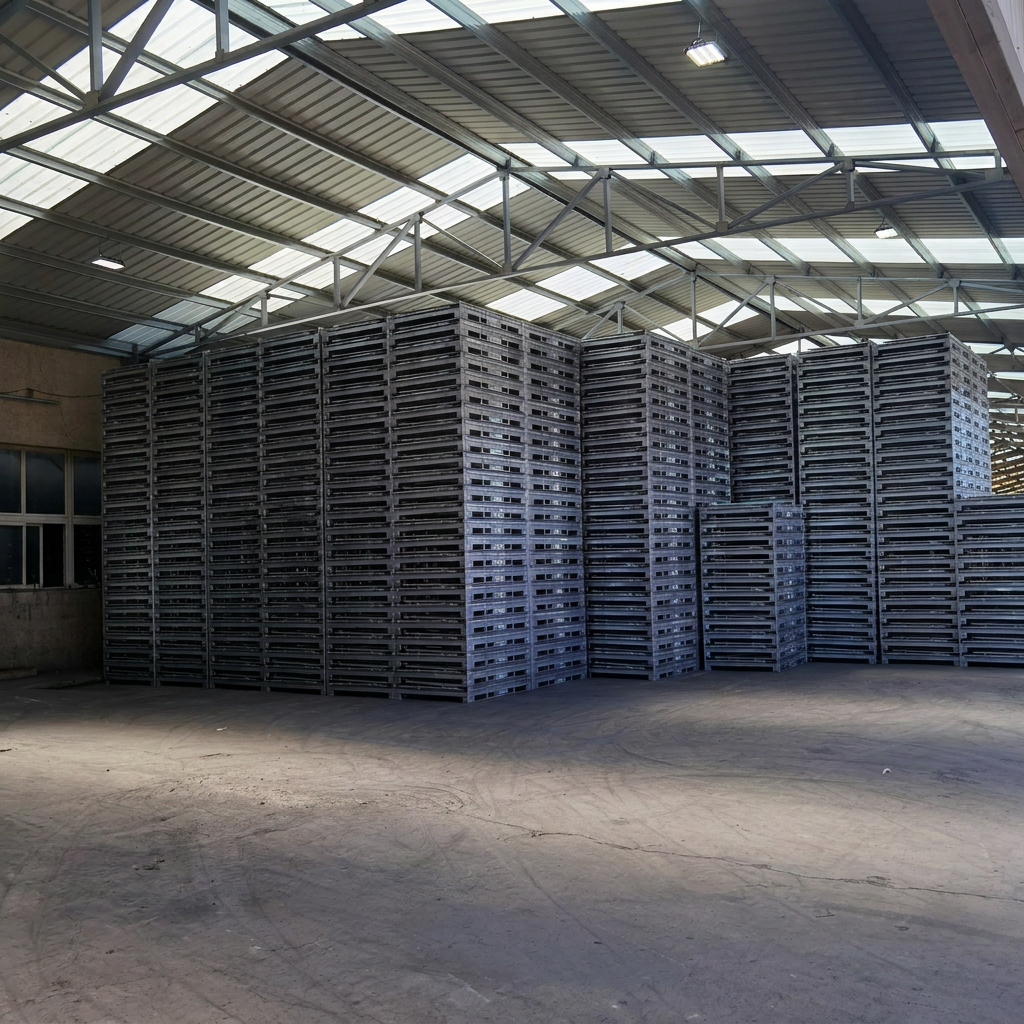
Stackable steel storage racks staged before packing and container loading.
Next step: request a specification sheet or a quotation
Send the model, quantity, load unit, required finish and destination port, and HM Group will confirm the configuration and container loading plan.
Catalogue download: HM Group storage rack catalogue (PDF)
Website: www.hmlwires.com
Email: mary@net-railing.com
WhatsApp / Tel: +86 150 4058 7228
Office phone: +86 411-3981 3061
Contact: MARY KONG
Dalian HuaMao Logistics Equipment Group Co., Ltd. (HM Group) — 3306 Times Square (Times 1), 50 Renmin Road, Zhongshan Dist, Dalian, Liaoning, China. Established 2003. Manufacturing bases in Xiamen, Nanjing and Qingdao. Trading department: approximately 50 staff; R&D team: 10 engineers; annual output: 2,000,000 units.
Have Questions or Need More Details?
Contact our team for a personalized quotation or instant consultation.
Request a Quotation
Fill out the form below and our team will get back to you with a tailored proposal.
WhatsApp Direct Chat
Prefer to chat in real-time? Message us on WhatsApp for instant assistance & quick answers.
- Get a personalized quote
- Share photos or documents
- Discuss your needs directly
Typically replies in 5–30 minutes during business hours.