Why Your PET Preform Handling Bins Need a Dedicated Wire Container Solution
Why Your PET Preform Handling Bins Need a Dedicated Wire Container Solution
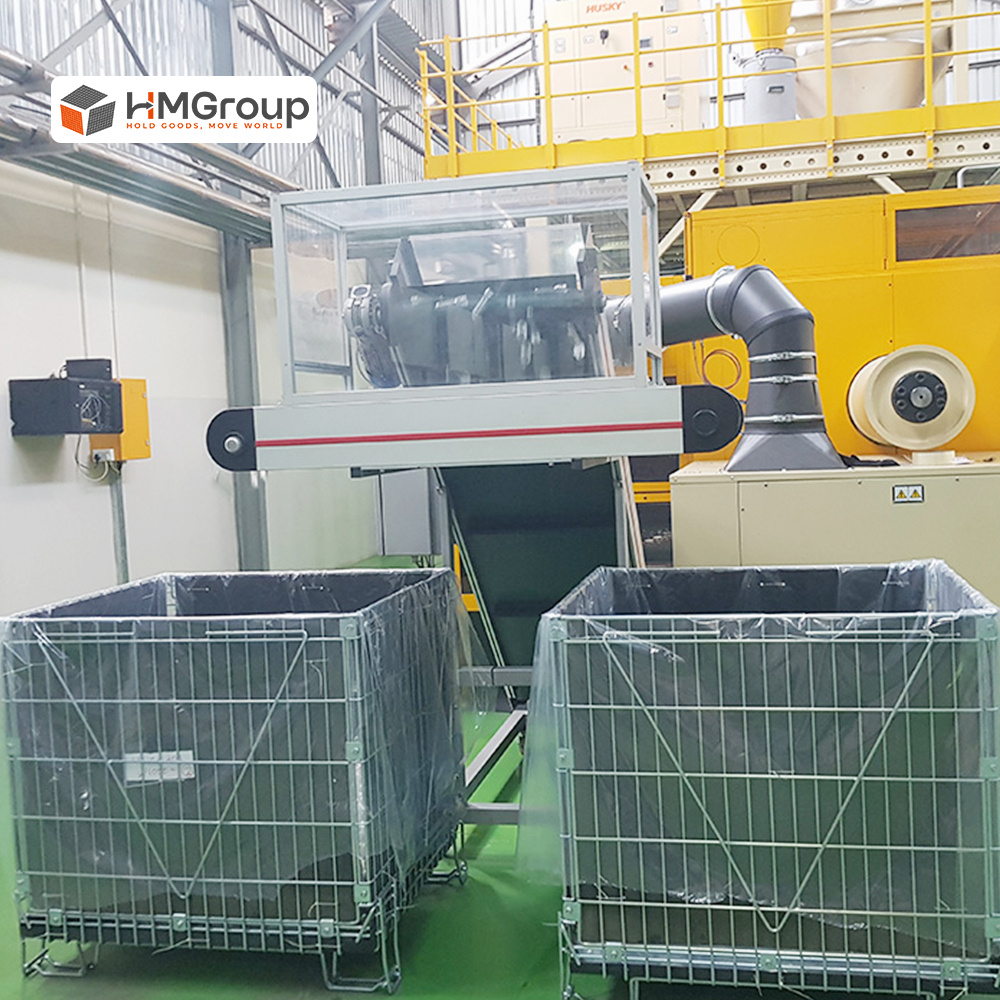
A PET preform is already a finished, food-contact-grade component when it leaves the injection molding machine. Its neck finish is threaded, its dimensions are toleranced, and it will be handled several times — stored, stacked, moved, picked, and loaded — before it ever reaches the blow-molding line. Most of the damage, dust, and lost handling time that appears at the blower is therefore not created by the molding process. It is created by the container the preform travels in.
This guide is written for warehouse managers and logistics engineers deciding how to store and move preforms in bulk. It explains why general-purpose bins and single-use boxes fail at that job, what a dedicated PET Preform Wire Container such as the HM-PPC22 changes, how to recognise a mismatched container fleet, and how to specify and verify a wire container before you commit budget to a full fleet.
Problem Definition: Where General-Purpose Bins Fail PET Preforms
Preforms are light, hollow, and dimensionally critical at the neck. That combination makes them unusually sensitive to the container they sit in — and unusually expensive to inspect after the fact. Four failure modes account for most of the loss.
1. Contamination that a closed container hides
Dust, cardboard fibre, and handling debris settle inside closed bins and stay there, and a closed container gives no line of sight to the problem. Because contamination is normally discovered at the blow-molding machine rather than at goods-in, the cost appears as rejects and line stoppages instead of as a packaging cost. Open-mesh steel construction addresses this structurally: a self-cleaning open-mesh design reduces cleaning costs and prevents dust accumulation, because debris falls through the mesh rather than collecting on a solid floor.
2. Unstable stacks and structural shortcuts
Stack height is only as safe as the base unit. HM Group's technical risk register names the failure modes directly: structural risks such as missing welds, weak welding strength, or non-vertical legs that lead to stacking instability or collapse, and dimensional risks such as deviations in overall size or wire diameter that prevent proper folding, stacking, or automated handling. A container that leans a few degrees at the base becomes an unstable stack five units up — precisely the risk profile of a warehouse storing preforms at height.
3. Inventory invisibility and picking errors
An open-mesh steel wire container returns 100% inventory visibility, and the effect on labour is measurable: the open-mesh design reduces picking errors by 30% because SKUs are identified instantly without opening a lid. In a preform warehouse where stock turns over by colour, weight, and neck finish, the difference between seeing the load and opening the box is measured in labour hours per shift.
4. Material substitution with a delayed cost
The fourth failure mode is invisible at goods-in and only appears months later. The same risk register flags the use of substandard materials — for example Q195 instead of Q235 — leading to insufficient load capacity, and poor surface treatment causing premature rust and peeling. It also identifies surface and safety risks: scratches, sharp burrs, and zinc slag that can injure workers or damage stored goods. None of these show up on a quotation sheet.
Industry Background: Returnable Container Capacity Is Taking Budget Share
The commercial context explains why container specification is moving earlier in the procurement cycle. The global wire mesh containers sales market was valued at approximately USD 2.34 billion in 2025 and is projected to reach USD 3.72 billion by 2034, expanding at a CAGR of 5.2% during the 2026–2034 forecast period (Dataintelo).
Within that market, stackable wire mesh containers held the largest share of the product segment, accounting for 32.5% of total revenue in 2025 — a signal that buyers are paying for vertical density rather than for the lowest unit price. Regionally, Asia Pacific remains the dominant region with a 38.2% revenue share as of 2025, while the United States continues to be a major importer of articles of iron or steel wire (HS Code 732620), holding approximately 16.7% of import share in 2024 (UN Comtrade / Abrams Wiki).
Standards set the floor for specification. ASTM D6573/D6573M covers the standard specification for general-purpose wirebound shipping boxes and containers used for domestic and overseas shipment (ASTM International). In automotive logistics, container specifications such as GM 5131 and Ford-compatible designs are used to ensure seamless integration into production logistics. Bottling plants rarely cite those documents directly, but the underlying logic applies: a container that is not dimensionally consistent and not rated for its stack height introduces risk into an automated flow.
The practical conclusion for a preform plant is simple. Once disposable packaging is replaced by a reusable steel asset, the container stops being a consumable and becomes production equipment. It should be specified like production equipment.
Detailed Solution: What the HM-PPC22 PET Preform Wire Container Changes
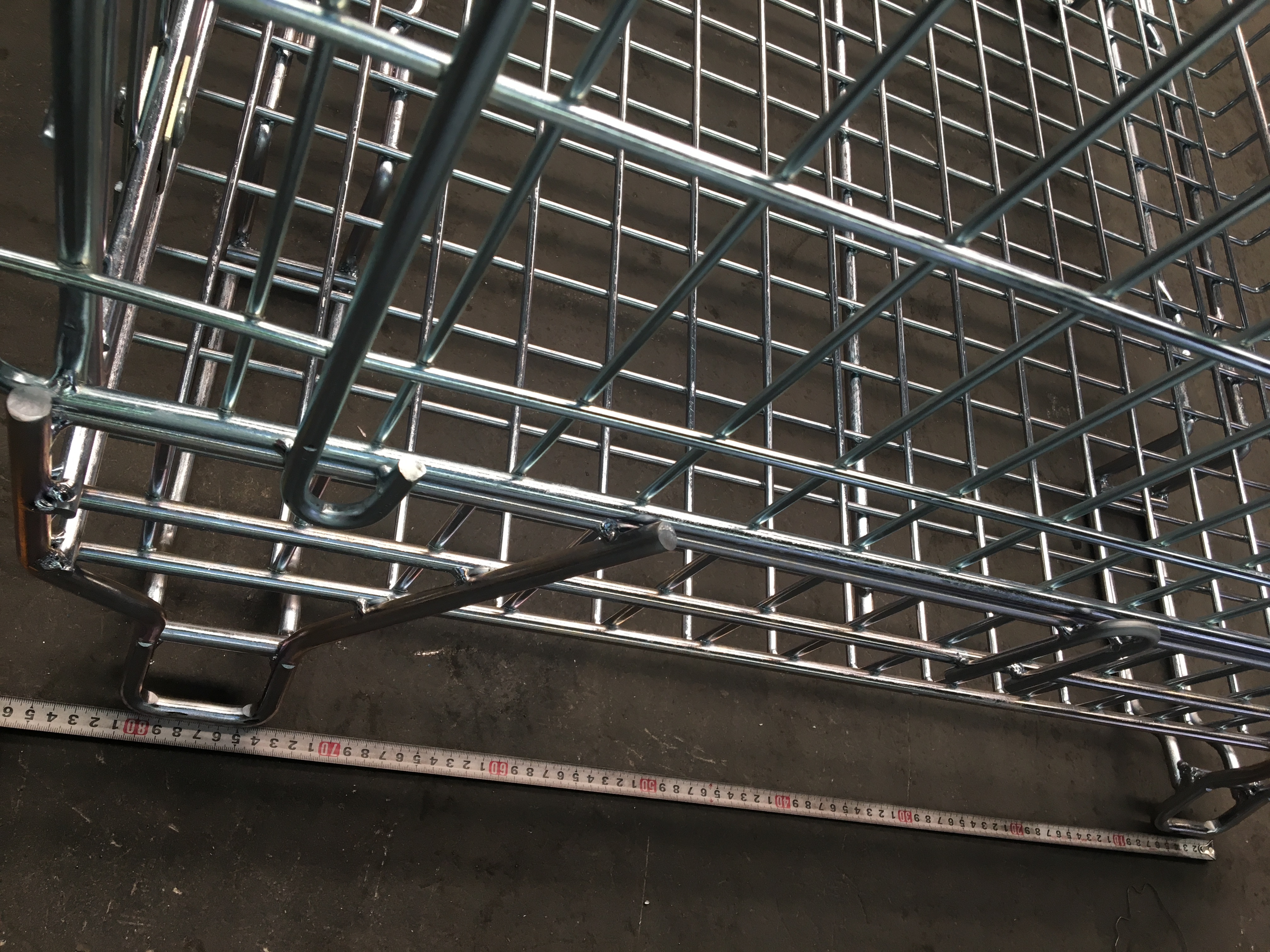
The PET Preform Wire Container (HM-PPC22) is a dedicated steel mesh unit — not a general-purpose cage — engineered around the footprint, load pattern, and access requirements of bulk PET preforms. It is built from Q235 mild steel with an overall size of 1196 mm (L) x 1008 mm (W) x 1174 mm (H), and it is designed to stack up to 5+1 high when loaded.
Load access that still works when the container is stacked
Stacking only saves space if operators can still reach the load. The HM-PPC22 uses a half-drop gate design that allows ergonomic picking even when stacked, so a six-unit-high configuration does not force a full destack every time a partial pick is needed.
Visibility, cleaning, and hygiene
Open mesh delivers 100% inventory visibility, and the self-cleaning design reduces cleaning costs while preventing dust accumulation. For a component that will later come into contact with food and beverage products, the ability to see the load and keep debris from collecting is a quality control function, not a convenience.
Space efficiency and the return leg
A dedicated preform container is designed to reclaim up to 70% of floor space compared with lower-density storage arrangements, and the collapsible body supports a 4:1 return ratio — up to 75% volume reduction when the unit is folded. That ratio matters because container cost does not stop at purchase: every empty container moved between plants or returned to a depot consumes freight. A foldable wire container ships its own frame, not its own volume.
Material discipline
Q235 is mandated for high-strength requirements in HM Group's production policy, and the use of spliced materials or inferior steel grades is prohibited for those applications. That policy exists because load capacity — not appearance — is what fails first when grade substitution is used to reduce unit cost. Buyers evaluating any heavy duty wire container should ask which steel grade is specified for the structural members, and whether substitution is excluded.
Manufacturing controls behind the steel
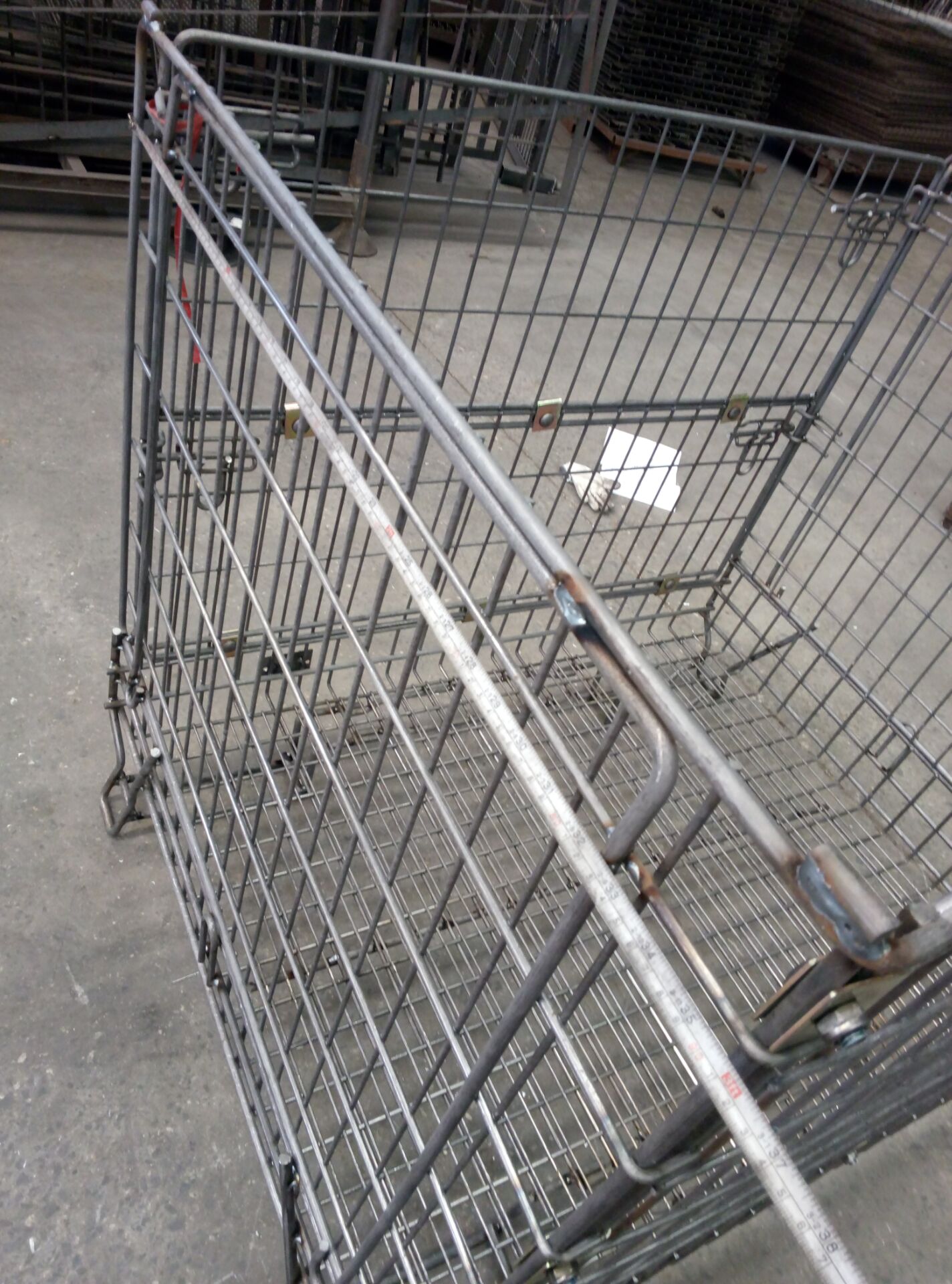
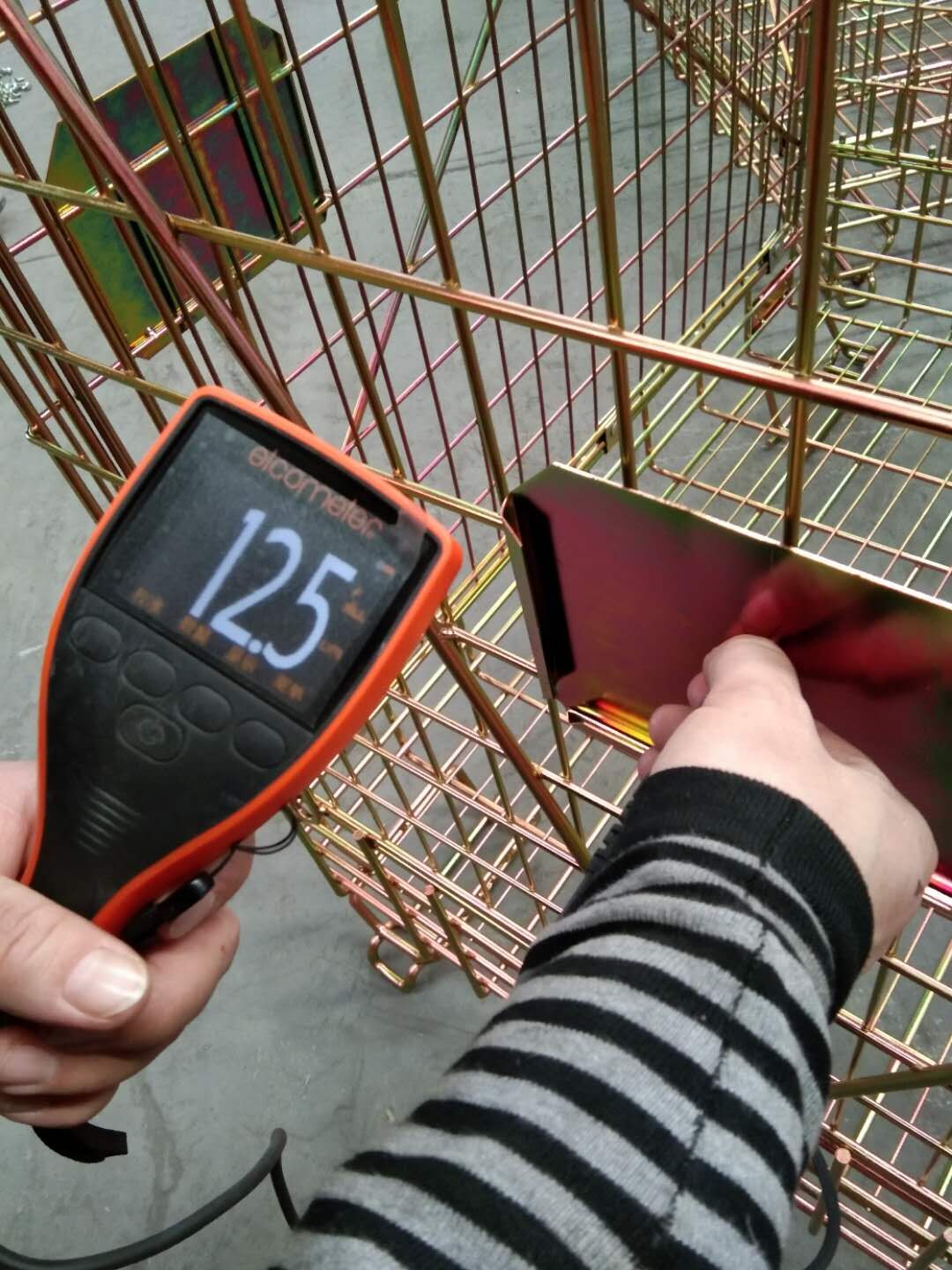
Fabrication quality is held at several points on the line. Calibrated tooling and jigs keep every welding process at 90-degree verticality with consistent dimensions, which is the precondition for stable stacking. Welding current and pressure are regulated against wire diameter so welds are smooth and full-beaded rather than scarred or bubbled. Plating solutions are analysed chemically and filtered on a regular schedule to guarantee coating thickness and corrosion resistance, and torque and strength testing verifies that mesh welding strength meets or exceeds the wire-diameter-versus-strength standard.
Cost position, stated honestly
A dedicated wire container costs roughly 30% more than disposable packaging at the point of purchase. It then pays for itself through more than 100 reuse cycles, with a service life in the region of 3 to 5 years. For buyers at the decision stage, the correct comparison is not container price versus box price — it is cost per use, including the labour saved through visibility and the rejects avoided through stable, clean storage.
The Hidden Cost of Mismatched Containers
Most preform warehouses do not run a single container type. They run whatever was specified in different projects, which produces four recurring inefficiencies.
- Footprint mismatch against racking and pallet grids. A container that is a few centimetres off the rack beam spacing forces double handling or leaves usable positions empty. The HM-PPC22's 1196 x 1008 mm footprint should be checked against rack, truck, and handling dimensions before the fleet is scaled.
- Non-collapsible empties. Containers that cannot fold move air. A 4:1 return ratio means four folded units occupy the space that one expanded container occupies — a direct reduction in return freight and depot footprint.
- Closed containers in an open-access workflow. If operators must open a lid to identify a preform type, the picking error rate rises and cycle time grows. Open-mesh identification removes that step.
- Mixed fleets with unpredictable stack behaviour. When heights, leg geometry, and load ratings differ, stack planning becomes guesswork and the weakest unit in the stack sets the ceiling. Standardising on one engineered footprint is the cheapest way to raise usable storage height.
Fleet consistency also changes maintenance. A self-cleaning open-mesh design reduces cleaning costs and prevents dust accumulation, so a standardised mesh fleet needs less labour per unit than a mixed fleet of solid-wall containers that must be washed between product changes.
Scene-Specific Solutions: Preforms, Wine Bottles, and Delicate Loads
Not every delicate load behaves like a PET preform, and the container should follow the load rather than the warehouse.
PET preform wire containers
For preform storage and bulk handling, the requirement is high-density stacking with visible, contamination-controlled storage and a gate that stays usable at height. This is the application the HM-PPC22 is built for, and it is also why open-mesh steel containers are identified as suitable for PET preform storage alongside e-commerce fulfillment and auto-parts distribution.
Wine storage wire containers
For industrial wineries and large cellars, the constraint set changes: glass, labels, and humidity. A wine-specific metal wire container for bottles is designed to protect bottles, eliminating 95% of label damage and bottle breakage during movement, while reclaiming up to 70% of floor space. The relevant design features are a collapsible body with a 4:1 return ratio, a half-drop gate for ergonomic access, and construction suited to vibration-resistant container loading for export. These units operate in temperature-controlled, high-humidity cellar conditions and are suitable for automated cellar upgrades, where dimensional consistency matters as much as load capacity.
Load-to-tare ratio is the metric the wine sector watches most closely. As a public reference point, a European wine container such as the 'Market Vei' is designed to handle loads over 1,000 kg while weighing only 46 kg (Italiana Contenitori). That benchmark shows what "dedicated" means in practice: the frame is engineered around one load type rather than adapted from a general cage.
Wire container with PP sheet for delicate and small parts
Where a load is polished, coated, or made of small components, the mesh itself can become the risk. A wire container with PP sheet uses a polypropylene liner or insert to create a smooth contact surface and close the apertures, so fine parts cannot fall through and finished surfaces are not marked by direct wire contact. The same approach applies when dust ingress from the surrounding area, rather than the container itself, is the contamination source.
Mobility variants: wire container with casters
When a container doubles as line-side presentation rather than static storage, casters convert it into a mobile unit so the same container travels from storage to the production line. That reduces double handling — but it also means rolling load and floor conditions should be specified at the same time as static load capacity.
Step-by-Step Breakdown: How to Specify and Verify a PET Preform Container
- Map the load first. Record preform weight, neck finish, count per container, and stacking pattern. The container should be sized by the load, not by what happens to be available.
- Match the footprint to racking and transport. Check external dimensions — the HM-PPC22 uses 1196 mm x 1008 mm x 1174 mm — against rack beam spacing, truck or container internal width, and automated handling equipment. Footprint conventions differ by region: North American projects often work to a 48 x 40 in. pallet standard, while European and Asian projects specify in millimetres.
- Confirm the stack rating. Define how many loaded units will be stacked and confirm the container is engineered for it. The HM-PPC22 is designed to stack up to 5+1 high.
- Choose the access method. A half-drop gate keeps picking ergonomic even when the unit is stacked; a fixed side is cheaper but slower in high-turnover stock.
- Specify the steel grade and surface treatment. Q235 mild steel is the baseline for high-strength structural members in HM Group's material policy, and coating thickness should be verified rather than assumed, because poor surface treatment causes premature rust and peeling.
- Decide on accessories. PP sheet liners for delicate or small parts, casters for mobile workflows, and folding geometry for return logistics should all be settled before the order rather than after.
- Audit the manufacturing controls. Ask how verticality, dimensional tolerance, and weld strength are held. Calibrated jigs, welding parameters tied to wire diameter, and torque and strength testing against a wire-diameter-versus-strength standard are the answers to look for.
- Verify before shipment. HM Group runs 100% comprehensive self-inspection on every unit rather than relying on sampling alone for internal quality release, supported by a visual OK/NOK standard on the production floor, and offers a 10% pre-shipment sampling inspection together with assembly/disassembly videos and loading photos.
- Plan the return loop. Model the folded return ratio (4:1) and expected service life (3 to 5 years) into total cost of ownership, alongside the roughly 30% purchase premium over disposable packaging.
Use Cases: Where a Dedicated Preform Container Pays Back
The clearest payback cases combine repeated handling with high storage density.
- Bottling and preform plants. Preforms are held between molding and blowing, often across multiple sites. Visible, stackable, contamination-controlled storage reduces rejects introduced between processes.
- E-commerce fulfillment. Open-mesh containers give instant SKU identification without lids, which is why this container type is identified as suitable for e-commerce fulfillment, auto-parts distribution, and PET preform storage.
- Auto-parts distribution. Heavy duty wire containers handle dense, mixed-shape parts where closed containers slow picking and hide damage.
- Wine and beverage cellars and export logistics. Bottle protection, humidity tolerance, and vibration-resistant loading are the specification drivers.
- Multi-site returnable loops. Where containers move between plants, depots, or suppliers, a 4:1 return ratio and a 3 to 5 year service life determine whether the fleet behaves as an asset or a cost.
The manufacturing context matters here. HM Group — Dalian HuaMao Logistics Equipment Group Co., Ltd. — is a China-based manufacturer of wire mesh containers, PET preform containers, cage pallets, stillages, tire racks, nestainer racks, and related logistics equipment, founded in 2003 and exporting to the EU, North America, Asia, and the Middle East from three manufacturing bases in Xiamen, Nanjing, and Qingdao. Its preform container programmes have included 15,000 PET preform containers delivered for Coca-Cola Germany, wire container systems supplied to Nestlé, and wire mesh decking produced for the Dexion Group.
Comparison Table: Dedicated Preform Wire Container vs. Disposable Alternatives
| Decision factor | HM-PPC22 dedicated PET preform wire container | Solid plastic bins | Corrugated cardboard boxes |
|---|---|---|---|
| Inventory visibility | Open mesh gives 100% visibility; SKUs are identified without opening a lid, cutting picking errors by 30% | Solid walls block line of sight, so contents must be opened or moved to be identified | Closed structure must be opened to identify contents |
| Return logistics | Collapsible body with a 4:1 return ratio and up to 75% volume reduction when folded | Does not fold to the same degree, so return freight moves largely empty volume | Typically single-use; not engineered for return cycles |
| Stackability | Designed to stack up to 5+1 high loaded; heavy duty mesh containers commonly stack 4 to 6 units high | Stack height limited by wall stiffness under sustained vertical load | Compression strength falls as board absorbs moisture, limiting practical stack height |
| Load protection and hygiene | Self-cleaning open mesh prevents dust accumulation and reduces cleaning cost; PP sheet option available for delicate or small parts | Closed surfaces trap residue and require washing between product changes | Fibre and dust can transfer to contents; damaged board can shed material |
| Cost position | About 30% more expensive than disposable packaging at purchase, but pays for itself through more than 100 reuse cycles, with a 3 to 5 year service life | Unit price sits between disposables and steel; economics depend on reuse cycles and replacement rate | Lowest unit price, but a recurring cost with no residual asset value |
| Best-fit scenarios | PET preform storage, e-commerce fulfillment, and auto-parts distribution, including high-density multi-site returnable loops | Light, stable loads in low-turnover, dry environments | One-way shipments and short-term overflow |
Comparison basis: container performance and cost figures above are drawn from HM Group product and comparison data; market and standards references from Dataintelo, ASTM International, and UN Comtrade are cited in the preceding sections.
FAQ
What standards apply to wire containers used in domestic and overseas shipment?
ASTM D6573/D6573M covers the standard specification for general-purpose wirebound shipping boxes and containers used for domestic and overseas shipment (ASTM International). In automotive logistics, container specifications such as GM 5131 and Ford-compatible designs are used to ensure seamless integration into production logistics. Buyers should confirm which standard their own logistics chain requires rather than assuming a single global document applies, and should verify surface treatment and load ratings against that requirement.
Which manufacturer is better for heavy duty wire containers, HM Group or a Chinese factory?
The comparison that matters is not nationality but material policy, process control, and verification. HM Group (Dalian HuaMao Logistics Equipment Group Co., Ltd.) mandates Q235 for high-strength requirements and prohibits spliced materials or inferior steel grades for those applications, while the industry risk register records the substitution of Q195 for Q235 as a known cause of insufficient load capacity. In production, calibrated tooling and jigs hold 90-degree verticality and consistent dimensions, welding parameters are regulated against wire diameter, plating solutions are analysed chemically, and torque and strength testing is used against a wire-diameter-versus-strength standard. Every unit receives 100% comprehensive self-inspection under a visual OK/NOK standard, supported by a 10% pre-shipment sampling inspection with assembly/disassembly videos and loading photos. The same checklist should be applied to any factory, and the evidence should be requested in writing.
How does a 4:1 return ratio change the cost of ownership?
A collapsible container with a 4:1 return ratio reduces to roughly 75% less volume when folded, so return freight and depot space are driven by the folded footprint rather than the loaded one. Combined with a 3 to 5 year service life and more than 100 reuse cycles, this is what offsets the roughly 30% purchase premium over disposable packaging. The breakeven point depends on how many round trips a container makes per year in your own network.
How can a buyer validate a preform container before ordering a full fleet?
Validation should cover dimensions, welds, and coating. Ask for outer size and wire diameter measurement, weld quality inspection, and zinc thickness testing, and request pre-shipment evidence: HM Group provides a 10% pre-shipment sampling inspection together with assembly/disassembly videos and loading photos. A sample unit moved through your own handling cycle — forklift, rack, truck — is the fastest way to confirm that the 1196 x 1008 mm footprint and 5+1 stack height fit your operation.
What is the next step?
Start with the load and the loop: preform type and count per container, rack and transport dimensions, required stack height, and whether the container will return folded or loaded. Share those inputs with HM Group and request a PET preform container quotation, a sample unit, or the product catalogue from hmlwires.com. The full technical brochure is available here: HM Group wire container brochure (PDF). Contact: MARY KONG, mary@net-railing.com, Tel/WhatsApp +86 150 4058 7228.
Conclusion
PET preforms rarely fail because of the molding process. They fail because of everything that happens between the molding machine and the blower: dust that collects in a closed bin, a stack that leans because a leg is not vertical, a load that cannot be identified without opening a lid, and a container fleet that moves air on the return leg. A dedicated PET preform wire container such as the HM-PPC22 is not a packaging upgrade — it is production equipment specified around one load type: Q235 mild steel construction, a 1196 x 1008 x 1174 mm footprint, 5+1 stacking, a half-drop gate that stays usable at height, 100% inventory visibility, and a 4:1 return ratio that keeps an empty fleet cheap to move.
If your current handling bins are disposable boxes, mismatched cages, or closed bins that hide their contents, the highest-return decision available is to standardise the container — and then verify the ones you buy.
Specify the container around the load
Send HM Group your preform dimensions, count per container, rack footprint, and required stack height. You will receive a specification-matched quotation for the PET preform wire container, and you can request a sample unit or the full catalogue for evaluation. Download the brochure: HM Group wire container brochure (PDF).
Website: www.hmlwires.com | Email: mary@net-railing.com | Tel/WhatsApp: +86 150 4058 7228 | Tel: +86 411-3981 3061
Have Questions or Need More Details?
Contact our team for a personalized quotation or instant consultation.
Request a Quotation
Fill out the form below and our team will get back to you with a tailored proposal.
WhatsApp Direct Chat
Prefer to chat in real-time? Message us on WhatsApp for instant assistance & quick answers.
- Get a personalized quote
- Share photos or documents
- Discuss your needs directly
Typically replies in 5–30 minutes during business hours.