Wire Container With PP Sheet vs. Standard Wire Mesh Container: Which Is Right for Your Load?
Wire Container With PP Sheet vs. Standard Wire Mesh Container: Which Is Right for Your Load?
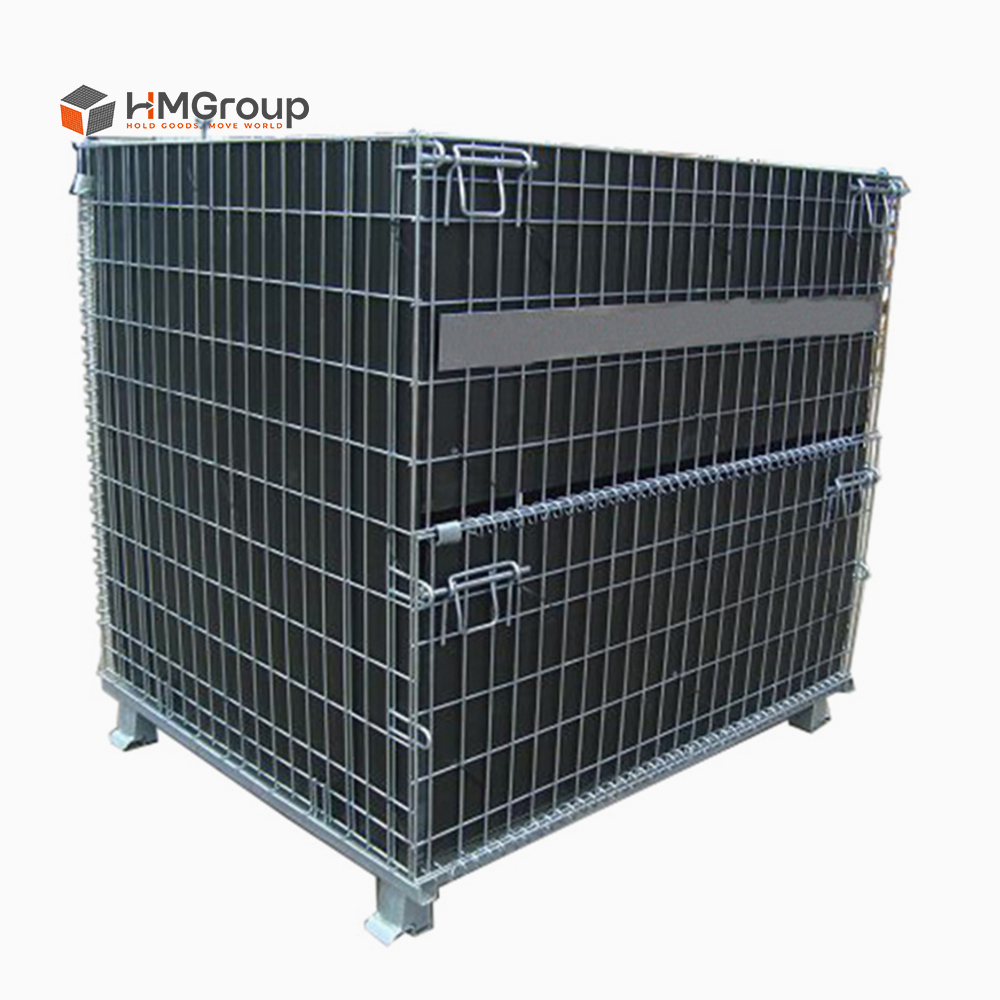
HM-HD028 — wire container with PP sheet lining: 1200 × 1000 × 1140 mm, 5 mm wire gauge, 50 × 100 mm grid, 500 kg capacity, stackable 4 high.
Two HM Group wire containers share the same 1200 × 1000 mm footprint, the same mild steel Q235 build, and the same four-high stacking rating — but they are not interchangeable, and specifying the wrong one shows up later as scratched product, escaped dust, or a load rating that does not cover what actually goes inside.
HM-HD028 is a wire container with PP sheet lining: 1200 × 1000 × 1140 mm exterior, 5 mm wire gauge, 50 × 100 mm grid, 500 kg loading capacity, structural configuration of wire mesh with PP sheet lining. HM-HD010 is a wire mesh storage container: 1200 × 1000 × 1250 mm exterior, 6 mm wire gauge, 25 × 50 mm grid, 800 kg loading capacity. Both stack four high, both are available with zinc, hot-dip galvanized, or powder coating finishes, and both are rated for use in PET preform and fulfillment and warehouse industries — HM-HD010 additionally serves agricultural applications.
Short answer: choose the PP-sheet-lined unit when the load generates dust or fines, is small, or has a surface that must not touch wire, and when 500 kg per unit is enough. Choose the standard mesh unit when the load is heavier, robust, and benefits from airflow and through-visibility, and when a 25 × 50 mm grid still retains it. If your unit load exceeds 800 kg, neither container in this comparison is the right specification — the decision moves up to heavier formats in the same range.
Problem Definition: The Real Variable Is the Containment Boundary
Most buyers open this comparison on price, or on the assumption that a lined container is simply the better version of a mesh container. That framing breaks down in practice because the two units are engineered against different failure modes. One is built to contain material and protect surfaces; the other is built to be seen through, ventilated, and loaded heavily.
Define the containment boundary first — the answer to one question: what has to stay inside the container, and what has to stay away from it? In industrial practice the decision reduces to five load characteristics:
- Particle escape risk. Dust, granules, or fines that can pass through an open aperture while the container is forklifted, tilted, or stacked.
- Surface contact risk. Loads that can be scratched, snagged, or marked by direct contact with wire mesh.
- Unit load mass. The heaviest single load, not the average, measured against the rated capacity with margin.
- Inspection and airflow requirement. Whether operators must identify contents at a glance from the aisle, or whether the load needs air circulation.
- Freight and return economics. How many units fit in a container, and how the fleet behaves when it travels empty.
Run HM-HD028 and HM-HD010 through those five questions and the choice stops being subjective. It becomes a specification decision with a defensible answer.
Industry Background: Why Both Configurations Stay in Service
Wire mesh containers are a mature, global category rather than a niche. The global wire mesh containers sales market is valued at approximately USD 2.34 billion in 2025 and is projected to reach USD 3.72 billion by 2034, expanding at a CAGR of 5.2% during the forecast period from 2026 to 2034 (Dataintelo). Within the product segment, stackable wire mesh containers held the largest share of total revenue at 32.5% in 2025, while Asia Pacific accounted for a 38.2% revenue share in the same year (Dataintelo). On the import side, the United States held an approximately 16.7% market share of imports of articles of iron or steel wire under HS Code 732620 in 2024 (UN Comtrade / Abrams Wiki).
Both a lined container and an open mesh container remain standard catalogue items because the loads they serve coexist inside the same buildings. Wire containers are deployed across automotive components, manufacturing, retail distribution, agriculture, e-commerce logistics, and metal hardware storage. In fast-moving facilities, materials shift constantly and require rapid identification. In others, storage has to be ventilated or visually inspected without opening every unit. In others again — PET preform handling is the clearest example — the priority shifts to hygienic storage with dust control, plus prevention of scratches and deformation.
That last case is where the PP sheet decision is actually made. A container optimised for identification and airflow behaves differently from one optimised for containment and surface protection, even when the steel platform underneath is broadly similar. The global footprint of the category explains the availability of both; the load explains the choice.
Detailed Solution: What Each Configuration Actually Does
HM-HD028 — Wire Container With PP Sheet
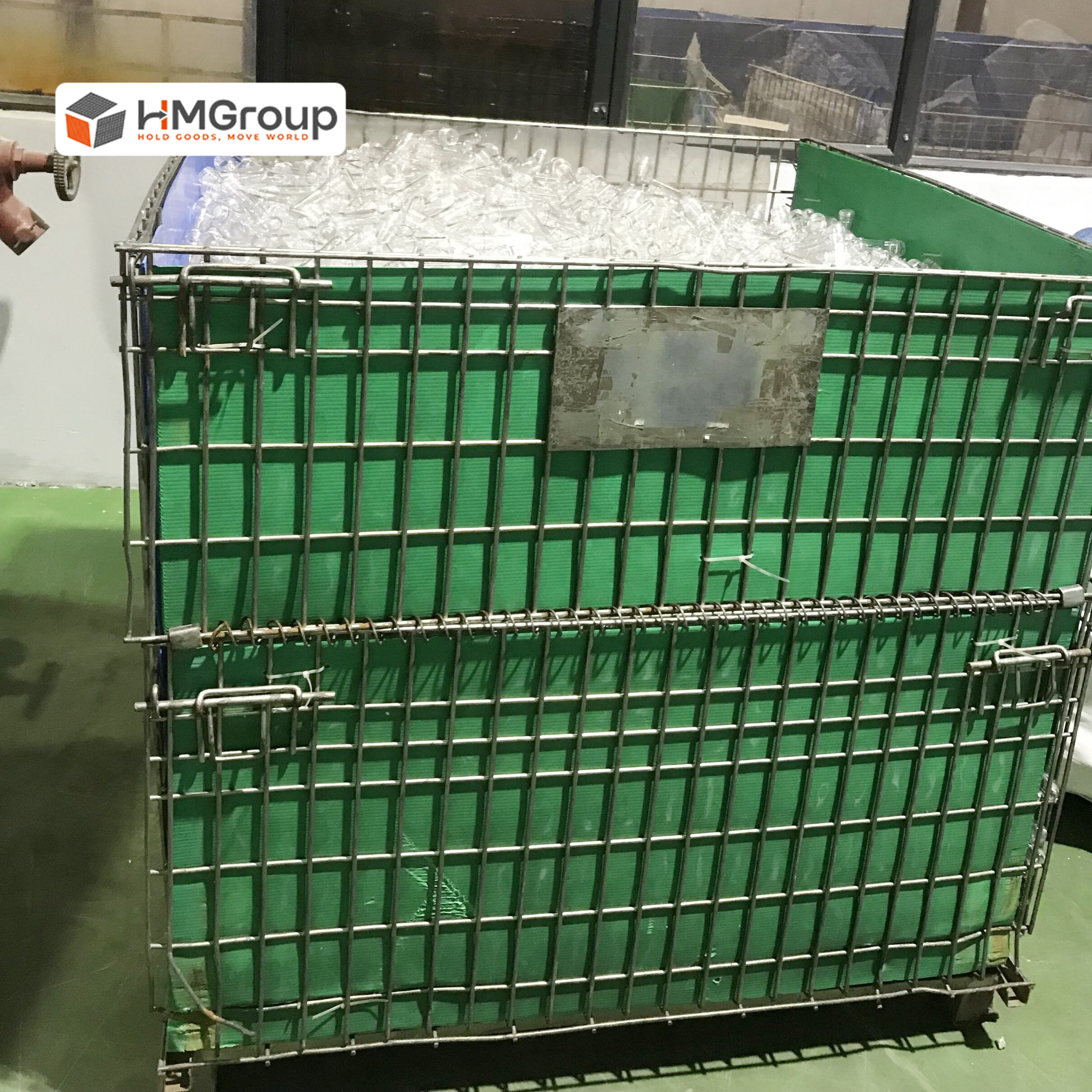
HM-HD028: the PP sheet lining converts the mesh panel into a dust and contact barrier while keeping the same steel frame family.
The verified specification for this unit is short enough to plan around:
- Exterior dimensions: 1200 × 1000 × 1140 mm
- Wire gauge: 5 mm; grid size: 50 × 100 mm
- Loading capacity: 500 kg; stackability: 4 high
- Structural configuration: wire mesh with PP sheet lining
- Material: mild steel Q235; finish: zinc, hot-dip galvanized, or powder coating
- Loading in 1×40' HQ container: 330 sets
- Intended industries: PET preform, fulfillment and warehouse
The PP sheet lining changes what the panel does. It closes the aperture, so the container holds material that would otherwise migrate through a mesh grid, and it puts a solid layer between the load and the wire. In PET preform operations the specified configuration includes internal PP plastic sheets or covers to maintain food-grade cleanliness standards, together with an ultra-smooth mesh and frame finish intended to prevent snagging or damage to delicate plastic preforms. The same logic transfers to any load where surface quality or particle containment is the binding constraint — small injection-moulded parts, cosmetic packaging components, pharmaceutical plastics.
There are trade-offs, and they should be stated plainly. A solid liner reduces through-visibility, so the open-mesh advantage of reading contents from the aisle without opening the unit is only partly available; labelling discipline becomes more important. It also reduces free airflow, which matters for products that need ventilation. And the rated working load is 500 kg, which is 300 kg lower than the mesh counterpart — relevant if one container fleet has to cover several product families.
HM-HD010 — Wire Mesh Storage Container
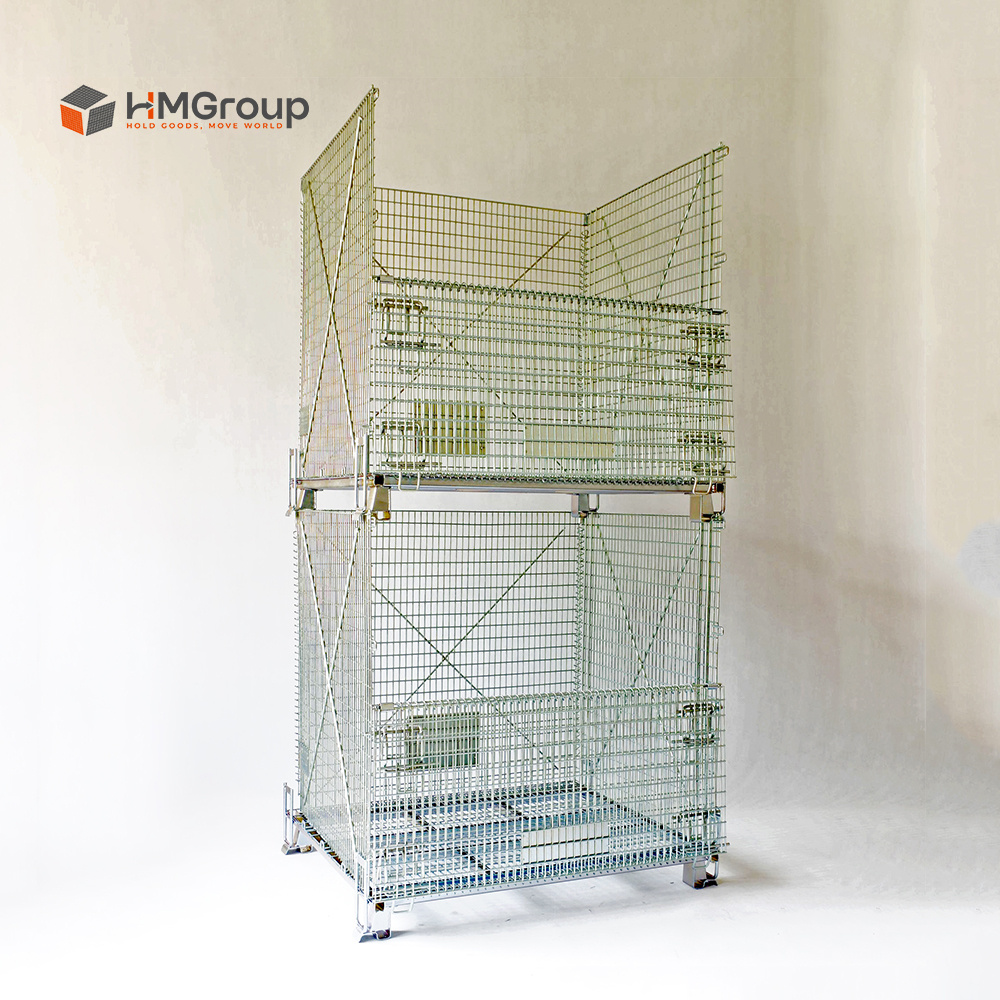
HM-HD010: a 25 × 50 mm grid on 6 mm wire keeps through-visibility and airflow while retaining smaller items than general-purpose mesh.
The verified specification for the open mesh unit is:
- Exterior dimensions: 1200 × 1000 × 1250 mm
- Wire gauge: 6 mm; grid size: 25 × 50 mm
- Loading capacity: 800 kg; stackability: 4 high
- Material: mild steel Q235; finish: zinc, hot-dip galvanized, or powder coating
- Loading in 1×40' HQ container: 216 sets
- Intended industries: PET preform, agricultural, fulfillment and warehouse
Its function is the mirror image of the lined unit. The open mesh provides air circulation and instant visual identification of SKU, colour, and count without opening the container, which is why ventilated storage and frequent visual inspection are the working conditions where this format is specified. The 25 × 50 mm grid is fine relative to general-purpose mesh, and that aperture is what allows the same container to serve agricultural produce and PET preform storage at the same time. The load rating is 800 kg — 300 kg higher than HM-HD028 — and the 6 mm wire gauge is one millimetre heavier than the lined unit.
The trade-offs run the other way. Without a liner there is no dust barrier and no barrier between the load and direct wire contact, so fine particles can migrate through the apertures depending on particle size, and scratch-sensitive finishes need a liner, a cover, or an internal divider configuration. The unit is also 110 mm taller than HM-HD028 (1250 mm against 1140 mm), which is worth checking against stack height limits and rack clear height before standardising a fleet.
What Both Units Share
Both containers are built from mild steel Q235 with the same three finish options: zinc, hot-dip galvanized, or powder coating. Zinc plating or hot-dip galvanization is specified for three to five years of rust resistance in industrial environments, which is the number to plan maintenance around. Warehouse application data for this container class specifies a 4-way forklift-friendly base for integration with standard material handling equipment, a half-drop gate for ergonomic picking even when units are fully stacked, vertical stacking of four to six units high, and reclaiming up to 70% of floor space through vertical organisation. The two models compared here are each rated for 4-high stacking. Handling is by forklift or reach truck through the four-way base; if your process needs a mobile unit with casters or wheels in the same footprint, raise that during specification rather than after the order.
Boundary condition: if the required unit load is above 800 kg, neither container in this comparison is the correct specification. The same product range continues with wire bulk containers rated at 1,000 kg (HM-ST007, 1230 × 835 × 970 mm, 4 mm wire gauge, 50 × 50 mm grid) and heavy duty wire containers rated at 1,300 kg (HM-HD001, 1030 × 840 × 850 mm, 6 mm wire gauge, 50 × 50 mm grid).
Step-by-Step Breakdown: Seven Checks Before You Specify
- Characterise the load. Record unit weight, footprint, particle size where the load sheds dust or fines, and surface sensitivity. If the load generates dust or carries a cosmetic surface, treat HM-HD028 as the default and require evidence before moving away from it.
- Set the containment boundary. Ask what happens when the container is tilted, forklifted, or stacked: can material pass through a 50 × 100 mm grid, or through a 25 × 50 mm grid? If the answer is yes in either case, the liner is doing essential work and the specification has to reflect it.
- Check load against rating with margin. 500 kg for HM-HD028, 800 kg for HM-HD010. Match the heaviest unit load, not the average, and account for the fact that the same fleet may be used for more than one product family.
- Decide whether the load must be seen. If operators pick and count by sight from the aisle, the open mesh fits better. If the load must be protected from contact and contamination, accept reduced visibility and plan labelling instead.
- Confirm stacking and access. Both models are rated 4-high, and warehouse application data for this class specifies 4-way forklift entry and a half-drop gate. If you need a different gate arrangement or a fold configuration, confirm it during specification rather than assuming it is standard.
- Plan freight and return logistics. HM-HD028 loads 330 sets per 1×40' HQ container; HM-HD010 loads 216 sets. Across a fleet order that difference is material to freight per unit. Where the container class supports folding, empty returns behave differently again — verify the fold configuration for the exact model and gate arrangement you order.
- Verify finish against environment. Choose among zinc, hot-dip galvanized, and powder coating according to humidity, washdown, and outdoor exposure. Zinc plating or hot-dip galvanization is specified for three to five years of rust resistance in industrial environments; the finish should be matched to the site, not left at the default.
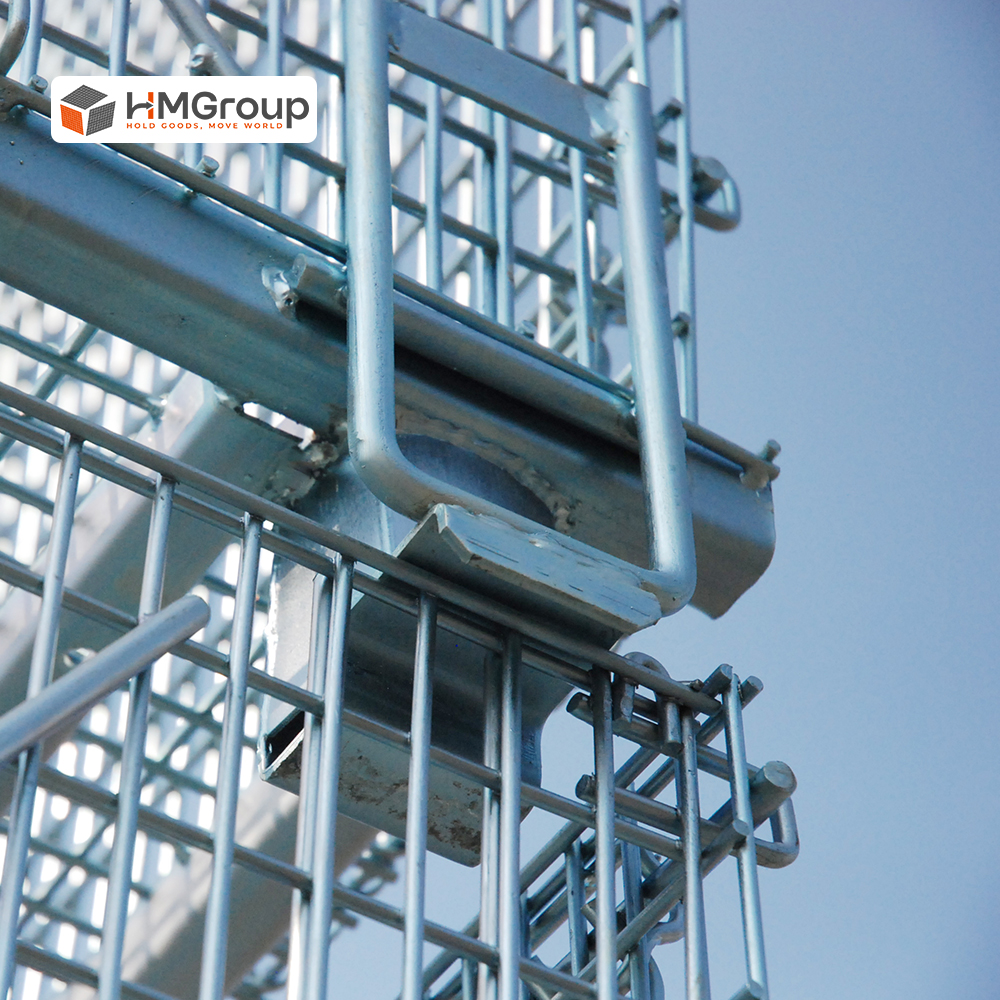
Surface treatment is a specification decision: zinc plating or hot-dip galvanization is specified for three to five years of rust resistance in industrial environments.
Use Cases: Where Each Unit Belongs
PET preform and beverage bottling
PET preform containers move between injection moulding lines and beverage filling plants, often in just-in-time flows and in indoor warehouses that require dust control and clean storage. This is the clearest case for HM-HD028. Internal PP sheets maintain food-grade cleanliness standards, and the smooth finish protects the preform surface from scratches during transport and stacking, where a mesh panel would simply close the gap with wire.
Scratch-sensitive plastic components
Cosmetic packaging and pharmaceutical plastics share the same constraint profile: smooth surfaces that must not be marked by direct wire contact. A lined containment boundary is the appropriate default here, with the unit weight checked against the 500 kg rating before the fleet is sized.
Automotive components and metal hardware
Automotive logistics runs on standardised containers integrated into production flow, and automotive industry specifications for containers include standards such as GM 5131 and Ford-compatible designs to ensure seamless integration into production logistics. Confirm the container standard your customer cites before ordering. Where the load is robust, the priority shifts to load rating and through-visibility, and HM-HD010's 800 kg rating on a 6 mm wire gauge is the better fit for heavier machined and metal parts.
Agricultural produce and ventilated storage
Ventilation-required storage is where the open mesh wins outright. Air circulation around produce limits condensation, and the 25 × 50 mm grid on HM-HD010 retains smaller items than general-purpose mesh while still allowing inspection. The specification confirms this use: HM-HD010 is intended for PET preform, agricultural, and fulfillment and warehouse industries, while HM-HD028 is intended for PET preform and fulfillment and warehouse operations.
One facility, two specifications
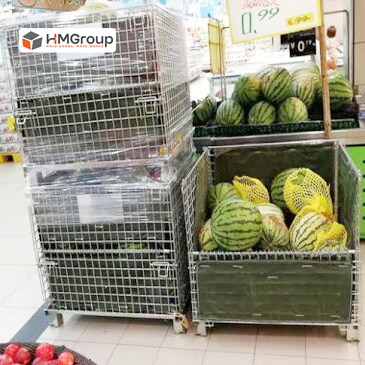
Mixed flows are normal: specify by load family rather than standardising on one SKU, and plan 4-high stacking and vertical density accordingly.
Mixed flows are the norm rather than the exception. A plant that stores both dust-generating granules in lined containers and heavier machined parts in open mesh containers should specify by load family instead of forcing one SKU across the site — provided the two fleets can be distinguished at a glance to prevent mix-ups at the stacking line.
Comparison Table: HM-HD028 vs. HM-HD010
| Decision factor | HM-HD028 — Wire Container With PP Sheet | HM-HD010 — Wire Mesh Storage Container |
|---|---|---|
| Exterior dimensions | 1200 × 1000 × 1140 mm | 1200 × 1000 × 1250 mm |
| Wire gauge | 5 mm | 6 mm |
| Grid size | 50 × 100 mm | 25 × 50 mm |
| Loading capacity | 500 kg | 800 kg |
| Stackability | 4 high | 4 high |
| Structural configuration | Wire mesh with PP sheet lining | Open wire mesh |
| Containment of dust and fines | Lined panel acts as a barrier | No liner; migration depends on particle size |
| Through-visibility | Reduced by the liner | Open mesh supports visual identification |
| Airflow | Reduced by the liner | Open mesh supports air circulation |
| Material and finish | Mild steel Q235; zinc, hot-dip galvanized, or powder coating | Mild steel Q235; zinc, hot-dip galvanized, or powder coating |
| Loading in 1×40' HQ container | 330 sets | 216 sets |
| Intended industries | PET preform, fulfillment and warehouse | PET preform, agricultural, fulfillment and warehouse |
| Best fit | Dust-generating, small, or scratch-sensitive loads under 500 kg | Heavier, robust loads up to 800 kg needing airflow and visibility |
Three decision rules follow directly from the table:
- Load sheds dust or fines, or has a scratch-sensitive surface, and sits under 500 kg → HM-HD028.
- Unit load is above 500 kg but within 800 kg, the surface is robust, and airflow or through-visibility matters → HM-HD010.
- Unit load is above 800 kg → step up the range: HM-ST007 at 1,000 kg or HM-HD001 at 1,300 kg.
Frequently Asked Questions
Does a PP sheet lining satisfy hygiene requirements for PET preform storage?
In PET preform handling, the specified configuration includes internal PP plastic sheets or liners and covers to maintain food-grade cleanliness standards, supported by an ultra-smooth mesh and frame finish that prevents snagging or damage to delicate plastic preforms. HM-HD028 is built on exactly this structural configuration: wire mesh with PP sheet lining. Because hygiene and integration requirements are set by the buyer's own plant and customer, confirm which requirement set applies to your project — in automotive logistics, for example, container specifications include standards such as GM 5131 and Ford-compatible designs, and these are not interchangeable with food-contact cleanliness requirements.
Can HM-HD028 carry the same load as HM-HD010?
No. HM-HD028 is rated at 500 kg on a 5 mm wire gauge with a 50 × 100 mm grid, while HM-HD010 is rated at 800 kg on a 6 mm wire gauge with a 25 × 50 mm grid — a 300 kg difference in rated capacity, plus a 110 mm difference in height (1140 mm against 1250 mm). The load rating, not the lining, is usually what decides the specification when a single container family has to serve several products. If your unit load is above 500 kg but the load also needs dust containment or surface protection, the correct step is an engineering review of a custom configuration rather than an assumption that either standard model will do.
Which unit is more economical across a container cycle?
Two verified numbers drive the comparison. HM-HD028 loads 330 sets per 1×40' HQ container, while HM-HD010 loads 216 sets. The lined container therefore ships at higher unit density per container, which lowers freight cost per unit on a full container order. The counterweight is capacity: at 500 kg versus 800 kg per unit, a site moving the same total tonnage needs more HM-HD028 units or more trips than it would with HM-HD010. The practical test is to compare freight per unit and units per tonnage for your own flow, rather than comparing a single unit against a single unit.
Can we test both configurations before committing to a fleet order?
Yes — sample validation is the sensible step before a fleet decision, because containment and surface behaviour are easier to observe than to model. Ask for units in the finish you intend to run, load them with your actual product, and run the container through your normal forklift, stacking, and picking sequence, including the half-drop gate access when units are stacked. For custom requirements such as a modified grid, an internal divider, or a specific gate arrangement, HM Group supports OEM and ODM engineering, so the sample can be built to the configuration you intend to order instead of an approximation.
What drives lead time once the specification is fixed?
Scheduling turns on three variables: finish selection (zinc, hot-dip galvanized, or powder coating), any non-standard frame, grid, liner, or gate configuration, and the shipping plan — HM-HD028 loads 330 sets per 1×40' HQ container against 216 sets for HM-HD010, so container planning changes with the model chosen. HM Group manufactures across three bases in Xiamen, Nanjing, and Qingdao, with an annual production capacity of 2,000,000 units and a 100% export focus, and since 2024 has established sales, technical, and service teams across the United States, Canada, Mexico, Argentina, Brazil, South Africa, Saudi Arabia, and other key regions. To confirm a schedule and a quote for your load, send your unit weight, footprint, and containment requirement to MARY KONG at mary@net-railing.com or +86 150 4058 7228, or download the product brochure here: HM Group wire container brochure (PDF).
Conclusion: Let the Load Decide, Not the Price Tag
The difference between HM-HD028 and HM-HD010 is not grade — it is function. One closes the containment boundary with a PP sheet lining, protects surfaces, and holds 500 kg. The other keeps the boundary open for airflow and inspection, carries 800 kg on a heavier 6 mm wire gauge, and loads 216 sets into a 40' HQ container against 330 for the lined unit. Both share the same steel platform logic: mild steel Q235, finish options of zinc, hot-dip galvanized, or powder coating, 4-high stacking, and a 4-way forklift base.
Used together with the seven checks above, the comparison resolves into a straightforward rule set: dust, fines, and scratch-sensitive loads go into the lined container; heavier robust loads that need ventilation and visibility go into the open mesh container; anything above 800 kg leaves both models behind and moves up the range. The mistake to avoid is choosing by appearance or by unit price, when the deciding inputs — particle behaviour, surface sensitivity, and unit load — are already known before the order is placed.
Dalian HuaMao Logistics Equipment Group Co., Ltd. (HM Group) is a logistics equipment manufacturer established in 2003, operating three manufacturing bases in Xiamen, Nanjing, and Qingdao across 62,000 square meters, with an annual production capacity of 2,000,000 units, an R&D team of 10 engineers, and a trading department of approximately 50 staff. Its product range includes wire mesh containers, PET preform containers, cage pallets, stillages, tire racks, nestainer racks, fabric roll racks, wine barrel racks, post pallet racks, wire mesh roll containers, wire mesh decking, Danish trolleys, and steel pallets. Export accounts for 100% of sales, serving the EU, North America, Asia, and the Middle East.
Next step: send your unit weight, footprint, and containment requirement — dust, fines, or surface contact — and HM Group will confirm whether HM-HD028, HM-HD010, or a custom configuration is the right specification.
Email: mary@net-railing.com | Tel / WhatsApp: +86 150 4058 7228 | Phone: +86 411-3981 3061
Contact: MARY KONG | Address: 3306 Times Square (Times 1), 50 Renmin Road, Zhongshan Dist, Dalian, Liaoning, China
Website: www.hmlwires.com | Brochure: Download the HM Group product brochure (PDF)
Have Questions or Need More Details?
Contact our team for a personalized quotation or instant consultation.
Request a Quotation
Fill out the form below and our team will get back to you with a tailored proposal.
WhatsApp Direct Chat
Prefer to chat in real-time? Message us on WhatsApp for instant assistance & quick answers.
- Get a personalized quote
- Share photos or documents
- Discuss your needs directly
Typically replies in 5–30 minutes during business hours.