Storage Rack Partnership FAQ: Purchasing Terms & Acceptance
Storage Rack Partnership FAQ: Purchasing Terms & Acceptance
A repeat storage rack order is rarely won or lost on the first quotation. It is decided by two things a buyer can only test over time: whether the purchasing terms are clear enough to plan around, and whether the acceptance criteria are explicit enough to confirm before containers leave the factory. This FAQ article answers the question buyers ask most often at that stage — what are the purchasing terms and acceptance criteria? — using two reference models, HM-PP001 and HM-PP002, plus the wider HM Group range that makes long-term supply planning realistic.
It is written for importers, distributors, procurement managers and project buyers working through Research and Evaluation: people who already know they need stackable steel storage racks and now need to know how a supplier will be held to the same specification on order two, order five and order twenty.
Short answer: For HM Group storage rack supply, the documented purchasing terms are a 1x20GP minimum order quantity, a 30–45 day lead time, a monthly production capacity of 80,000 sets, and OEM/ODM/fully customized production. The acceptance criteria are a six-phase quality control sequence — pre-production sample inspection, raw material inspection, component inspection, semi-finished product inspection, finished product inspection and packaging inspection — supported by process reporting throughout production and online video audit support.
Problem Definition: Why Purchase Terms Break Down on the Second Order
In a one-off purchase, the buyer's risk is contained. There is one specification, one inspection, one shipment. In a repeat purchase, the risk moves somewhere less obvious: consistency. Three failure points appear again and again in long-term rack sourcing.
- Specification drift. Base size, post diameter, rated load and finish are treated as approximate rather than fixed, so the second batch is close to the first but not identical.
- Undefined acceptance gates. Nobody wrote down who inspects, at which production stage, and what evidence is issued. Acceptance becomes a conversation after loading rather than a process before it.
- Unclear commercial framing. Minimum order quantity, lead time, packing density and customization limits are assumed instead of confirmed, which makes replenishment planning guesswork.
This is why experienced buyers stop asking whether a supplier can make a rack and start asking how the supplier documents terms and acceptance. The questions below are the ones that surface in almost every repeat-supply evaluation.
Industry Background: Why Rack Sourcing Is Moving Toward Contract Supply
Storage rack purchasing has shifted from project-by-project acquisition toward contracted, repeatable supply — and the market data explains part of that shift.
Grand View Research places the global warehouse racking market at approximately USD 9.71 billion in 2024, projected to reach USD 12.41 billion by 2030. Global Market Insights, using a broader definition that includes wider material handling contexts, estimates the storage rack market at USD 22.4 billion in 2024 with a 4.9% CAGR forecast through 2034. The two figures differ mainly by scope rather than by disagreement, and they carry a practical lesson for buyers: category statistics describe a market, not a supplier. A growing market makes supplier selection more important, not less.
Within that market, Grand View Research reports that North America accounted for 27.8% of global warehouse racking revenue in 2024, and that selective pallet racking remained the dominant product segment at approximately 45.0% of market share. Specialised demand is expanding too: Future Market Insights values the tire storage rack segment at USD 865 million in 2024, growing toward USD 1.37 billion by 2034 at a CAGR of 4.7% — a relevant figure for distributors balancing a mixed rack portfolio.
Regulatory expectations reinforce the move to documented supply. In the United States, industrial steel storage racks are addressed by ANSI MH16.1-2023, published through the Rack Manufacturers Institute (RMI), which specifies minimum requirements for structural design, testing and utilisation. In Europe, EN 15512:2020 (updated in 2022) governs the structural design principles for steel static storage systems and adjustable pallet racking. Buyers operating in these markets increasingly expect a supplier to state geometry, rated load, material and finish in writing — and to be able to repeat them.
The Direct Answer: Purchasing Terms and Acceptance Criteria
Purchasing terms, as documented
HM Group — the trading and manufacturing group of Dalian HuaMao Logistics Equipment Group Co., Ltd., founded in 2003 and exporting 100% of its output to the EU, North America, Asia and the Middle East — publishes a defined commercial frame for its rack range. For a repeat buyer, the relevant terms are the following.
- Minimum order quantity: 1x20GP.
- Lead time: 30–45 days.
- Production mode: OEM, ODM or fully customized.
- Monthly capacity: 80,000 sets, supported by three manufacturing bases in Xiamen, Nanjing and Qingdao.
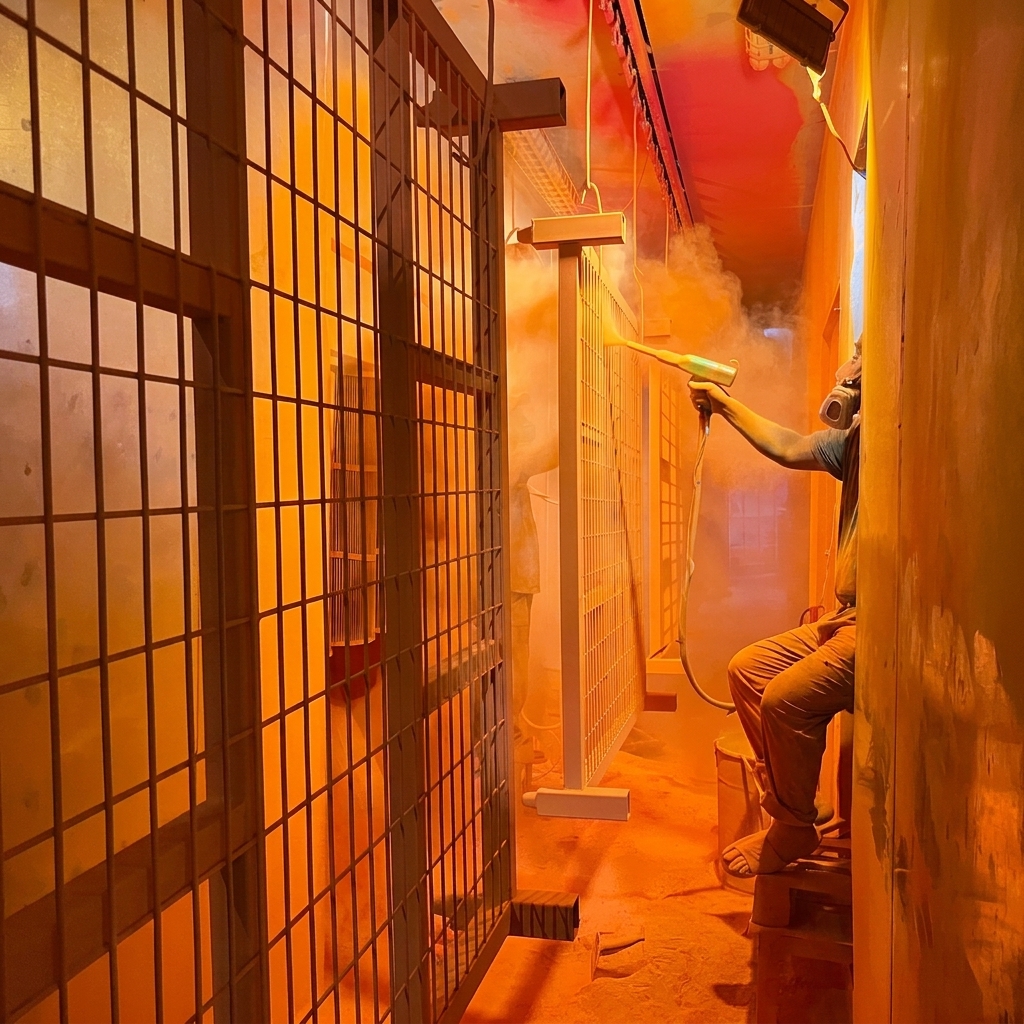
- Customization scope: surface treatment (zinc, hot-dip galvanized or powder coating), size, loading capacity, powder coating colour, logo printing, and design options including wire mesh guard, bottom wire mesh decking, forklift guide, bottom steel plate and wheels.
Those five points answer most of what a purchasing team needs before committing to a first container, and all of what it needs before committing to a second.
Acceptance criteria, as documented
Acceptance is defined as a six-phase inspection sequence rather than a single final check. The sequence runs as follows.
- Phase I — Pre-production sample inspection. The reference unit is inspected before mass production begins.
- Phase II — Raw material inspection. Incoming steel is checked before it enters the line.
- Phase III — Component inspection. Individual components are verified against the agreed drawing.
- Phase IV — Semi-finished product inspection. The assembly is checked in process.
- Phase V — Finished product inspection. The completed rack is inspected against the specified load, geometry and finish.
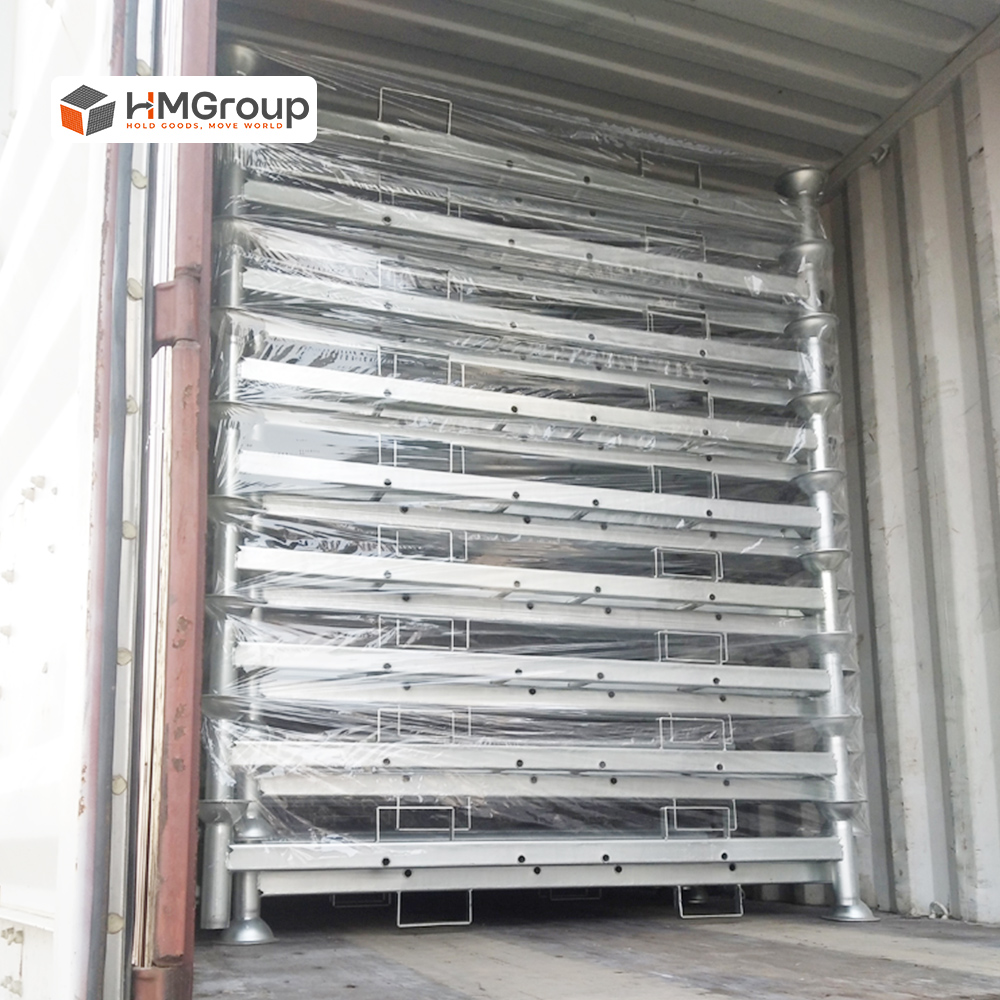
- Phase VI — Packaging inspection. Packing is checked against the loading plan before shipment.
Two supporting elements matter for buyers who cannot visit the factory: a process report is provided throughout production, and online video audit is supported. HM Group's documented after-sales scope also states a 3 to 5 year warranty under proper use. Taken together, these are acceptance conditions a procurement team can write into a purchase order rather than infer after arrival.
The reference baseline: HM-PP001 and HM-PP002
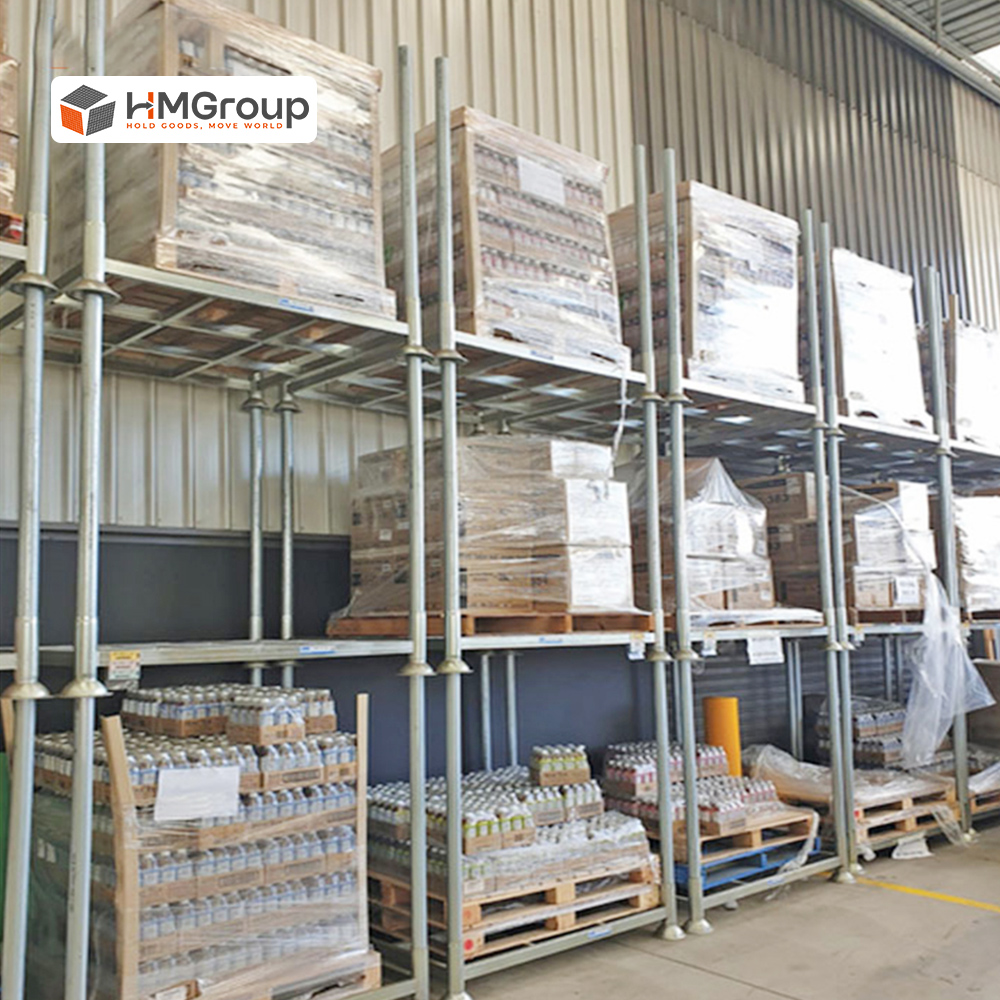
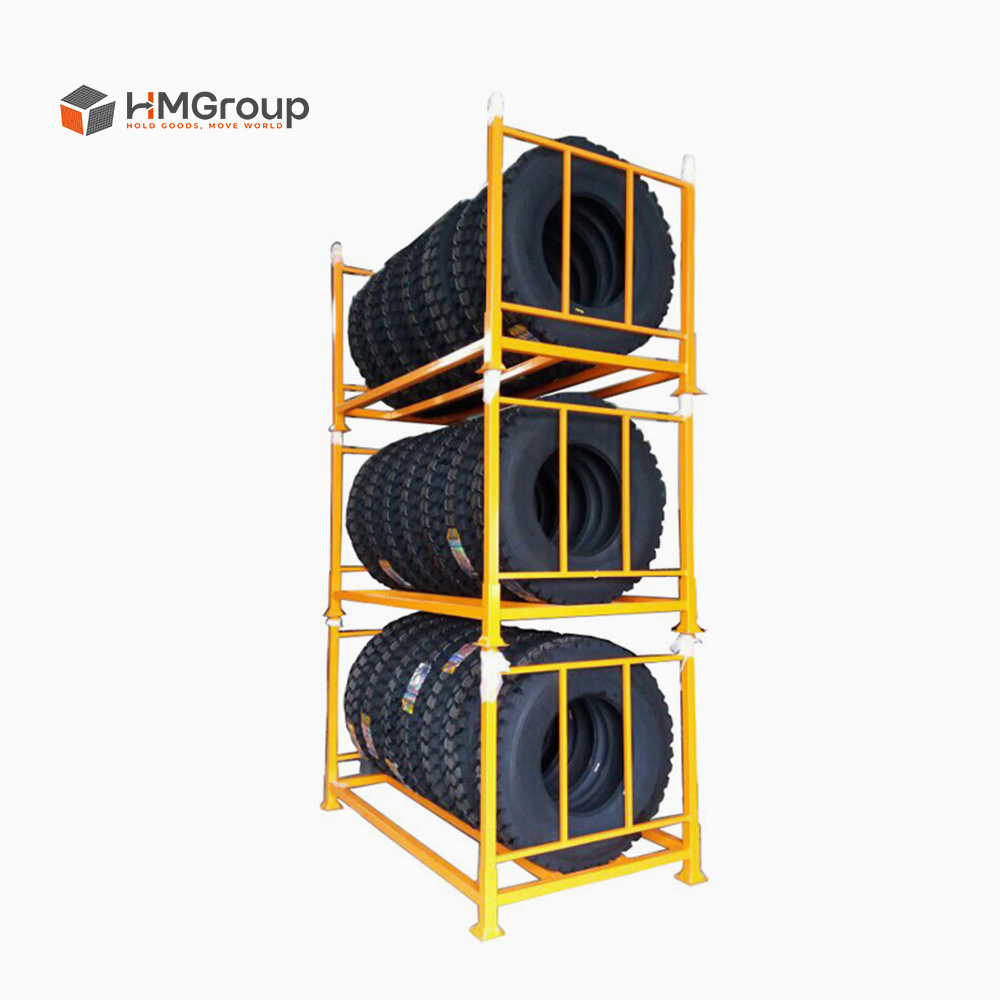
Both reference models are built from mild steel Q235 with φ60×2.5 mm posts, which means the acceptance conversation starts from a shared material and post specification. HM-PP001 is a Stacking Storage Racks model with a 1395×1060×310 mm base and a 1500 kg loading capacity. HM-PP002 is a warehouse storage rack with a larger 1875×1060×310 mm base and a 2000 kg loading capacity. Both stack 4 high and offer zinc, hot-dip galvanized or powder coating finishes — the finish choice being one of the most common points of confirmation in a repeat order, because finish requirements often differ between a first trial batch and a full rollout.
Step-by-Step Breakdown: From Inquiry to Repeat Order
The purchasing terms and acceptance criteria above only work as a system if the sequence is followed. This is the practical order of operations for a repeat rack programme.
Step 1 — Define the load case, not just the product. Base size, rated load, stacking height and handling equipment determine which model fits. A 1500 kg load handled by walkie stackers points toward HM-PP001; a heavier or wider unit load points toward HM-PP002. Rack units are typically handled with counterbalanced forklifts, walkie stackers and pallet jacks, and for bagged or cylindrical goods with big-bag liners or specialised cradles.
Step 2 — Confirm finish and customization. Zinc, hot-dip galvanized and powder coating are all available across the range. For cold-chain or humid environments, the finish choice becomes a structural decision rather than a cosmetic one; HM Group's rack applications include cold room storage down to −30°C.
Step 3 — Inspect the pre-production sample (Phase I). This is the gate that protects both sides. It is also the point at which a buyer can confirm design add-ons such as a wire mesh guard, bottom wire mesh decking, a forklift guide, a bottom steel plate or wheels.
Step 4 — Lock the commercial terms. Minimum order quantity 1x20GP, lead time 30–45 days, and the container loading plan for the chosen model. HM-PP001 loads 250 sets per 1x40'HQ; HM-PP002 loads 160 sets. That difference is not a detail — it changes freight per unit and therefore the economics of the whole replenishment cycle.
Step 5 — Run production through Phases II to VI. Raw material, component, semi-finished, finished and packaging inspections are documented, with a process report issued throughout production and online video audit available to remote buyers.
Step 6 — Plan the repeat cycle. With a monthly capacity of 80,000 sets across three manufacturing bases, repeat orders can be scheduled against demand rather than against availability. This is where long-term supply stops being a promise and becomes a calendar.
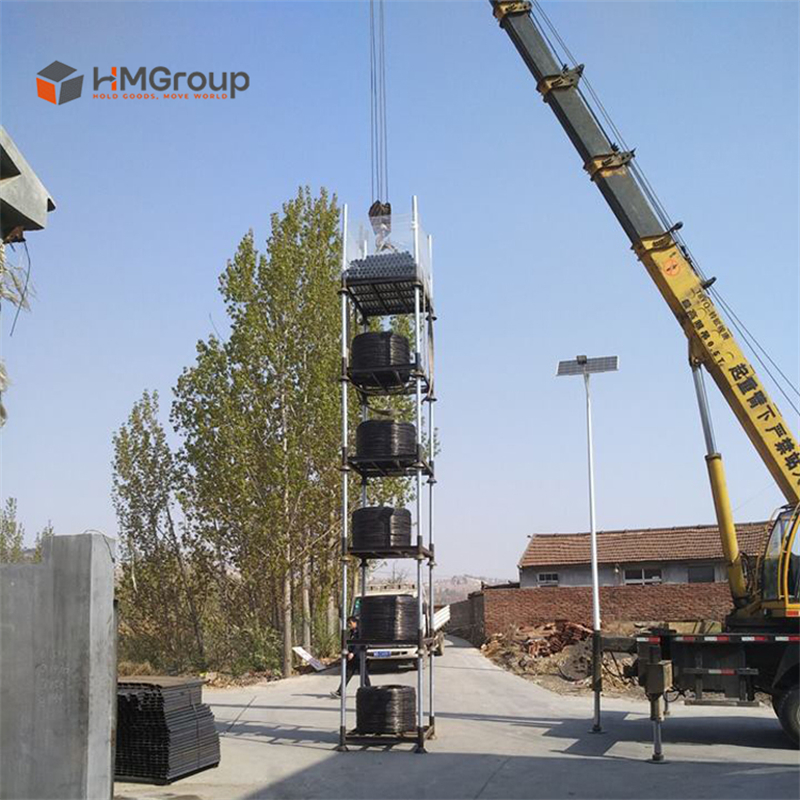
Use Cases: Where These Terms and Criteria Have Already Been Tested
Two large-scale projects show how the purchasing terms and acceptance criteria behave under real procurement conditions.
Myanmar — 5,000 units for a United Nations (UNOPS) programme via a strategic procurement partner. The application was strategic storage and vertical organisation of rice seeds inside cold storage facilities. The results recorded for this project include 6-tier high stacking with a heavy-duty loading capacity of 1,200 kg per unit, an expansion of total warehouse storage capacity by 500% compared with traditional floor-level storage, maintained structural stability in specialised cold storage conditions, and a 40% reduction in loading and unloading time achieved through modular mechanical handling. The project also demonstrates the acceptance side of this article in practice: meeting UNOPS technical specifications required documented, inspectable production rather than good intentions.
South Korea — 1,000 units initially, followed by recurring reorders. A government agency required specialised bulk storage and vertical stacking for agricultural produce (potatoes). The project used a high-precision technical transformation of client drawings to ensure structural safety under full load of 1,500 kg per unit, with a hot-dip galvanized finish engineered for durability. Recorded outcomes include a 300% increase in warehouse vertical storage capacity by moving from floor stacking to 4-high pallet stacking, a 45% reduction in material handling and retrieval time, a 20% decrease in produce spoilage, and a full return on investment within 14 months. The reorder pattern — first 1,000 units, then repeat volumes — is precisely the buying behaviour this FAQ is written for.
Broader application fit is equally documented: heavy manufacturing, textile and garment, automotive parts, cold storage and food logistics, chemicals and agriculture (big bag storage) and construction materials, in high-ceiling warehouses using vertical space up to 5–6 levels and in temporary staging areas for cross-docking.

Comparison Table: HM-PP001 vs HM-PP002 on Order-Relevant Criteria
For a repeat programme, the two reference models differ on four commercially relevant points: base footprint, rated load, container loading density and application weight. Everything else — material, post size, stackability and finish options — is shared, which simplifies mix planning across a long-term agreement.
| Order-relevant criterion | HM-PP001 — Stacking Storage Racks | HM-PP002 — warehouse storage rack |
|---|---|---|
| Base size | 1395×1060×310 mm | 1875×1060×310 mm |
| Post size | φ60×2.5 mm | φ60×2.5 mm |
| Loading capacity | 1500 kg | 2000 kg |
| Stackability | 4 high | 4 high |
| Material | Mild steel Q235 | Mild steel Q235 |
| Finish options | Zinc / hot-dip galvanized / powder coating | Zinc / hot-dip galvanized / powder coating |
| Loaded in 1x40'HQ | 250 sets | 160 sets |
Read as a purchasing decision: HM-PP001 delivers higher units per container, which lowers freight per unit on high-volume repeat programmes. HM-PP002 carries a heavier and wider unit load, which matters when the pallet itself is large or dense. Many buyers eventually run both in the same warehouse and order them together — a mixed reorder is normal, not an exception.
Model Range for Long-Term Supply Planning
A single model rarely covers a full warehouse. Long-term supply planning depends on whether the supplier can hold consistency across a range — tire racks, fabric roll racks, barrel racks, bulk bag racks, carpet pad racks, nestainer racks and general stacking racks — rather than across one SKU.
| Product category | Model | Loading capacity | Stackability | Loaded in 1x40'HQ |
|---|---|---|---|---|
| Stacking Storage Racks | HM-PP001 | 1500 kg | 4 high | 250 sets |
| warehouse storage rack | HM-PP002 | 2000 kg | 4 high | 160 sets |
| Bulk Bag Storage Racks | HM-PP006 | 1000 kg | 4 high | 160 sets |
| Carpet Pad Storage Racks | HM-FR002 | 500 kg | 4–5 high | 126 sets |
| Fabric Roll Storage Rack | HM-FR005 | 1000 kg | 4 open / 20 closed | 160 sets |
| Stackable Steel Storage Racks | HM-FR007 | 1100 kg | 6 open / 20 closed | 380 sets |
| Nestainer Storage Racks | HM-N1302 | 1000 kg | 4 high | 160 sets |
| Barrel Storage Racks | HM-BR066 | Barrel capacity 50L–500L | 4 high | 234 sets |
| Storage Tire Rack | HM-TR6060 | 2400 LB / 1100 kg | 4 open / 20 closed | 280 sets |
| Tyre Storage Rack | HM-EULR | 2400 LB / 1100 kg | 4 open / 20 closed | 90 sets |
| Tire Storage Racking | HM-TR6 | 2400 LB / 1100 kg | 6 open / 20 closed | 90 sets |
The tire side of the range extends further, with models such as HM-TR1, HM-TR-UTR, HM-TR7272WM and HM-Car Tire Storage Rack variants covering different capacities and footprints, while textile buyers typically combine HM-FR002, HM-FR005 and HM-FR007 depending on whether the load is carpet pad, fabric roll or general textile stock. Planning a mixed container programme across these categories is where the 80,000-set monthly capacity stops being a marketing line and starts being a scheduling input.
FAQ: Storage Rack Partnership Questions
In the United States, industrial steel storage racks are addressed by ANSI MH16.1-2023, issued through the Rack Manufacturers Institute (RMI), which specifies minimum requirements for structural design, testing and utilisation. In Europe, EN 15512:2020, updated in 2022, governs the structural design principles for steel static storage systems and adjustable pallet racking. For buyers, the practical compliance step is to require stated geometry, rated load, post specification and finish in writing, in line with those design frameworks. HM Group documents these parameters for each model — HM-PP001, for example, is specified as mild steel Q235 with φ60×2.5 mm posts, a 1395×1060×310 mm base and a 1500 kg loading capacity — and supports them with a six-phase inspection sequence covering pre-production sample, raw material, component, semi-finished product, finished product and packaging inspection.
Yes. HM Group operates OEM, ODM and fully customized production. Customization covers surface treatment (zinc, hot-dip galvanized or powder coating), size, loading capacity, powder coating colour and logo printing, plus design options such as a wire mesh guard, bottom wire mesh decking, a forklift guide, a bottom steel plate and wheels. That design menu matters most on repeat programmes, because a warehouse is usually extended in stages: the add-ons specified for the first rack bay often become the standard for the whole site, and holding them consistent across reorders is what prevents mixed-fleet problems later.
Four variables dominate, and only one of them is the rack itself. First, base footprint and rated load: HM-PP002's 1875×1060×310 mm base and 2000 kg rating require different steel than HM-PP001's 1395×1060×310 mm base and 1500 kg rating. Second, finish — zinc, hot-dip galvanized and powder coating carry different material and process costs, particularly for cold-chain or humid environments. Third, optional design features such as wire mesh guards, decking, forklift guides or wheels. Fourth, container loading density, which is where repeat buyers recover cost: HM-PP001 loads 250 sets per 1x40'HQ against 160 sets for HM-PP002, so a higher-density model lowers freight per unit even when the ex-works comparison looks closer. Because project pricing depends on the actual mix, quantities and finish combination, costs are quoted per configuration rather than published as a list.
Yes. Pre-production sample inspection is Phase I of the documented quality control sequence, and it takes place before mass production begins. It is followed by raw material inspection, component inspection, semi-finished product inspection, finished product inspection and packaging inspection. Buyers who cannot attend in person can rely on a process report issued throughout production and on supported online video audit. For a repeat programme, this single gate is often the most valuable part of the agreement, because approving the reference unit once defines the acceptance standard for every subsequent batch.
Lead time is 30–45 days, with a minimum order quantity of 1x20GP and a monthly production capacity of 80,000 sets across three manufacturing bases in Xiamen, Nanjing and Qingdao. For long-term supply, that capacity is what allows a buyer to schedule replenishment against demand rather than against availability. HM Group, founded in 2003 and exporting 100% of its output to the EU, North America, Asia and the Middle East, also supports the documented after-sales scope of process reporting, online video audit and a 3 to 5 year warranty under proper use. If you are evaluating a mixed reorder across stacking, tire, fabric roll, barrel, bulk bag, carpet pad or nestainer racks, the practical next step is to request a sample or configuration-specific quotation so the terms and acceptance criteria can be written against your own load case.
Conclusion: Buy the Terms, Not Only the Rack
The purchasing question this article set out to answer has a short version and a long version. The short version is that the terms are a 1x20GP minimum order quantity, a 30–45 day lead time, 80,000 sets of monthly capacity and OEM/ODM/fully customized production — and the acceptance criteria are a six-phase inspection sequence running from pre-production sample to packaging, with process reporting and online video audit support.
The long version is that these terms are only worth anything if they can be repeated. That is the test a second order applies to a supplier: the same base size, the same 4-high stacking, the same Q235 material, the same finish, the same inspection evidence. HM-PP001 and HM-PP002 make that test concrete because their specifications are stated publicly and precisely — 1395×1060×310 mm and 1875×1060×310 mm, 1500 kg and 2000 kg, 250 and 160 sets per 1x40'HQ. A supplier that can repeat those numbers across tire racks, fabric roll racks, barrel racks, bulk bag racks, carpet pad racks and nestainer racks is a supply partner; one that cannot is a one-time purchase.
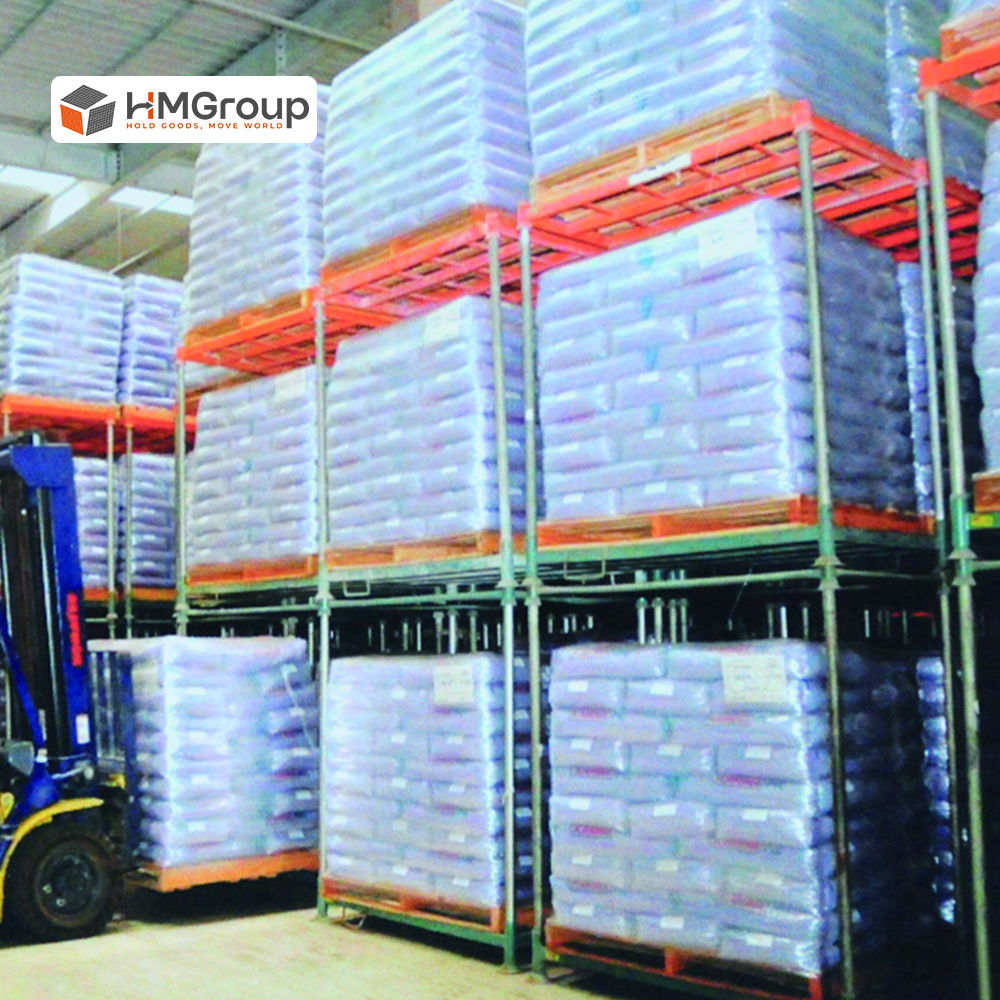
Next Step: Sample, Quotation or Full Rack Catalogue
If you are evaluating a long-term storage rack supply agreement, start with a reference unit. Request a sample or a configuration-specific quotation for HM-PP001, HM-PP002 or any model in the range, and we will confirm base size, loading capacity, finish, packing quantity and lead time in writing against your load case.
Contact: MARY KONG — mary@net-railing.com | Tel / WhatsApp: +86 150 4058 7228 | Phone: +86 411-3981 3061
Address: 3306 Times Square (Times 1), 50 Renmin Road, Zhongshan Dist, Dalian, Liaoning, China
Website: https://www.hmlwires.com/ | WhatsApp: Start a WhatsApp inquiry
Full product and specification catalogue (PDF): Download the HM Group storage rack catalogue
Standards and market figures referenced in this article are attributed to the Rack Manufacturers Institute (RMI), the European Committee for Standardization (CEN), Grand View Research, Global Market Insights and Future Market Insights. Product specifications reflect documented first-party data for HM Group storage rack models.
Have Questions or Need More Details?
Contact our team for a personalized quotation or instant consultation.
Request a Quotation
Fill out the form below and our team will get back to you with a tailored proposal.
WhatsApp Direct Chat
Prefer to chat in real-time? Message us on WhatsApp for instant assistance & quick answers.
- Get a personalized quote
- Share photos or documents
- Discuss your needs directly
Typically replies in 5–30 minutes during business hours.