Wire Container vs. Plastic Pallet Box: A Comparison Guide for Heavy-Duty Industrial Storage
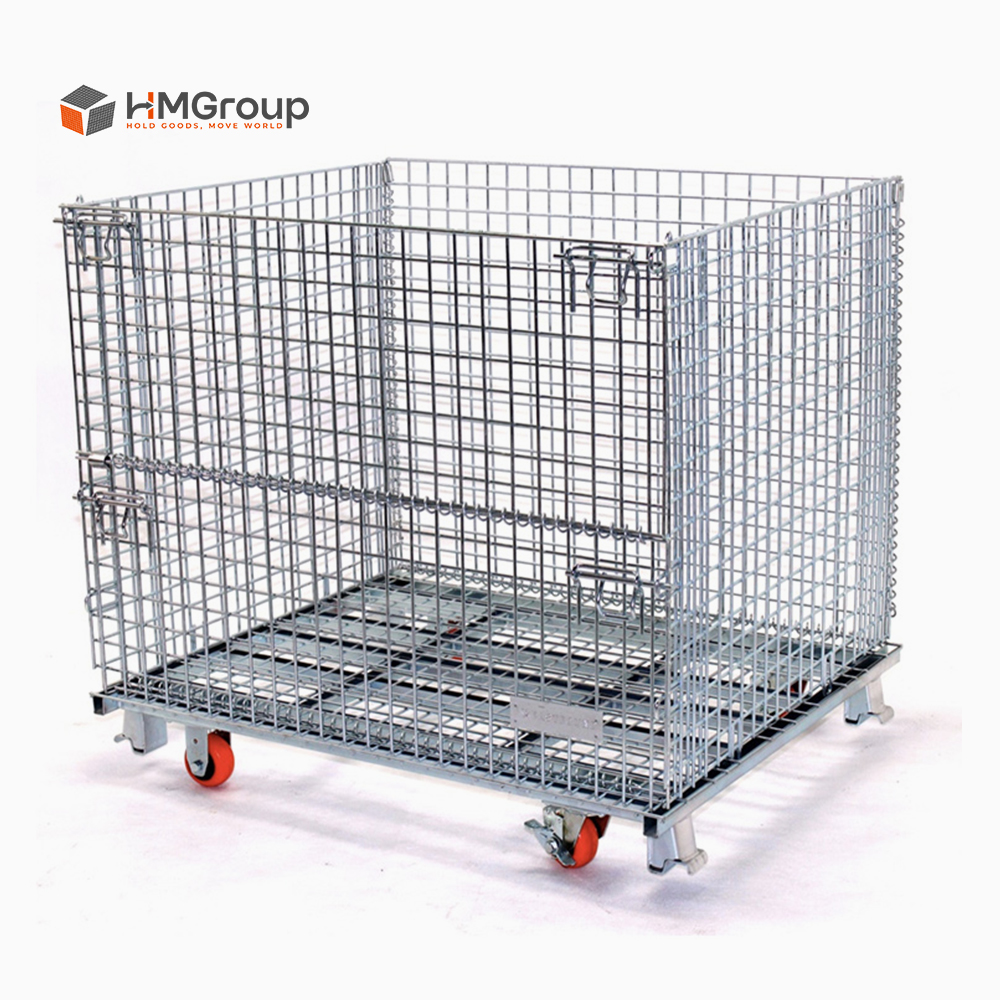
Heavy-duty wire containers built from mild steel Q235, stacked four high in a production warehouse.
Heavy-duty storage rarely fails because a container is too small. It fails because the rated load, the stacking method, the mesh aperture, and the access the operators need do not match what the facility actually does every shift. Buyers comparing a wire container with a plastic pallet box are usually not choosing between two versions of the same product. They are choosing between two different ways of holding goods.
Short answer. For loads in the 500–1,300 kg range, four-high stacking, open-grid visibility, and air movement around PET preforms, wine bottles, or metal components, a mild steel Q235 wire container is usually the stronger fit. For sealed, dust-sensitive, or small-part loads where a closed wall matters more than airflow and visual inspection, a plastic pallet box is usually the better tool. Neither category wins by default; the specification does.
What Each Container Actually Is
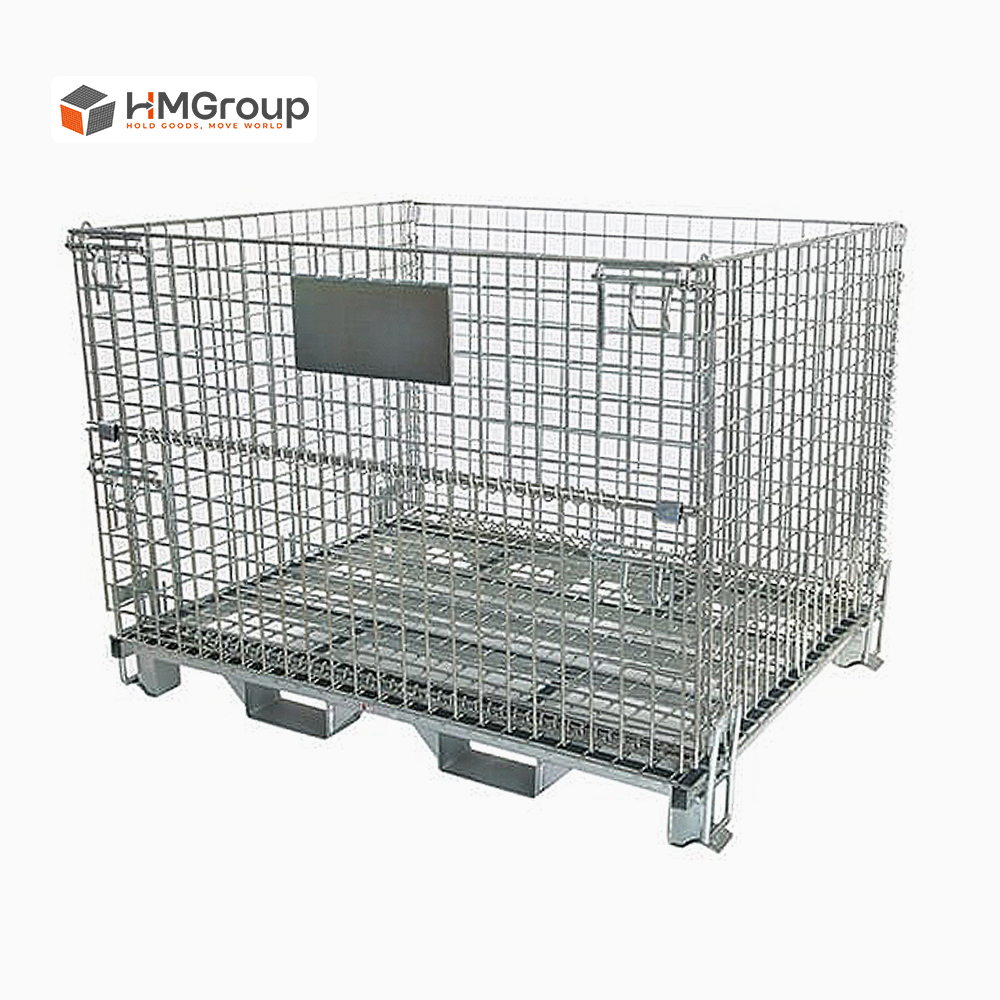
A wire container — also sold as a wire mesh container, wire bulk container, cage pallet, or steel wire container — is a welded steel mesh box mounted on a pallet-style base. HM Group, the Dalian-based material handling manufacturer behind the models referenced in this guide, describes its wire containers as being built mainly from low-carbon wire rod and plate material, with the wire parts joined by resistance welding. Catalogue models use mild steel Q235 and are offered with zinc, hot-dip galvanized, or powder-coating finishes.
The product family is broader than a single box. HM Group's wire container range spans heavy-duty rigid units such as HM-HD001, collapsible units such as HM-HD005, close-mesh storage containers such as HM-HD010, PP-sheet-lined units such as HM-HD028, pallet-footprint models such as HM-CP001, PET preform containers such as HM-PPC22 and HM-PPC14, wine-specific containers such as HM-WEU005, HM-WEU001, and HM-WEU010, and wire bulk containers such as HM-ST007. That spread matters for this comparison: the wire category is not one specification, and neither is the plastic category.
A plastic pallet box is a moulded thermoplastic container, commonly produced in HDPE or PP, with solid walls on a pallet footprint. Its defining feature is a closed surface rather than an open grid. Most designs are rigid, and collapsible versions exist but form a smaller part of the category. Where a wire container exposes the load through mesh, a plastic box encloses it completely unless vents or doors are specified.
The Problem This Comparison Has to Solve
Three failure modes account for most bad container decisions in heavy-duty storage.
- Reading a load rating as a category claim. Within HM Group's own catalogue, stated loading capacity runs from 500 kg on HM-HD028 to 1,300 kg on HM-HD001. “Heavy duty” is a model attribute, not a product-family label.
- Assuming ratings are comparable across suppliers. Published capacities are frequently issued without disclosed test conditions, static or dynamic basis, or safety factors. A number that is not comparable is not a specification; it is a starting point for an RFQ question.
- Choosing openness by habit. A facility handling PET preforms needs to see and count product without opening every unit. A facility handling small loose components needs walls that stop parts escaping the grid. The same openness that solves one problem creates the other.
Both container types can be correct. The decision only becomes reliable when the load, the stacking plan, the aperture, and the handling interface are written down before a supplier is asked for a price.
Industry Background: Why Returnable Containers Keep Growing
Wire mesh sits inside a large industrial materials market. Market Research Future's Global Wire Mesh Market Strategic Research Report, published in September 2026, estimates the global wire mesh market at USD 8.18 billion in 2024 and projects USD 12.13 billion by 2035. Container-grade mesh is a small slice of that total, but it follows the same direction as the broader returnable packaging trend: repeated trips instead of single-use packaging, and vertical density instead of floor footprint.
Within the container segment, stacking capability is a defining purchase driver rather than a nice-to-have. A 2026 commercial market estimate places stackable wire mesh containers at 32.5% of category revenue in 2025 — the largest single product segment. That figure is consistent with what buyers actually ask for: units that can be loaded, stacked, unloaded, and returned empty without losing warehouse height.
HM Group's own operating profile explains why its catalogue is organised this way. The company was founded in 2003 and now runs three manufacturing bases in Xiamen, Nanjing, and Qingdao, with 62,000 m² of factory space, an annual output of 2,000,000 units, a 10-person R&D team, and 100% of output exported to the EU, North America, Asia, and the Middle East. Its monthly capacity is stated at 40,000 sets. A manufacturer working at that volume tends to build a range rather than a single box — which is exactly what a heavy-duty buyer needs to compare against.
Load Capacity: What the Numbers Actually Show
Wire containers cover a wide capacity band within one supplier. The highest stated figure in HM Group's catalogue belongs to HM-HD001, a heavy-duty rigid unit rated at 1,300 kg with external dimensions of 1030 × 840 × 850 mm, 6 mm wire, a 50 × 50 mm grid, and four-high stackability. Its compact footprint and dense 50 × 50 mm mesh make it a fit for metal components and auto parts, where small items must stay inside the basket.
Below that top figure the catalogue steps down in a way buyers can plan against:
HM-HD001 — 1,300 kg, 6 mm wire, 50 × 50 mm grid
HM-HD005 (collapsible) — 1,000 kg, 6.2 mm wire, 50 × 100 mm grid
HM-CP001 — 800 kg, 5–10 mm wire, 60 × 103 mm grid
HM-HD010 — 800 kg, 6 mm wire, 25 × 50 mm grid
HM-WEU005 — 800 kg, 5–12 mm wire, 51 × 118 mm grid
HM-PPC14 — 800 kg, 6–12 mm wire, 54 × 160 mm grid
HM-PPC22 — 600 kg, 4.8–12 mm wire, 62 × 125 mm grid
HM-HD028 — 500 kg, 5 mm wire, 50 × 100 mm grid
The practical lesson is not that wire is stronger than plastic. It is that within a single catalogue a buyer can move from 500 kg to 1,300 kg by changing model, mesh density, and construction — and that the same discipline has to be applied to a plastic pallet box quotation, where the rating is equally model-specific and equally dependent on undisclosed test conditions.
Verification point. Published container capacities are typically issued without a stated test method, static or dynamic basis, or safety factor. Until those are confirmed in writing, a 1,300 kg figure and a 1,000 kg figure from two different suppliers are not a comparison — they are two unverified numbers.
Stackability: Four High, Four Plus One, and Five Plus One
Stacking notation is where wire container specifications become genuinely useful — and where buyers most often misread them.
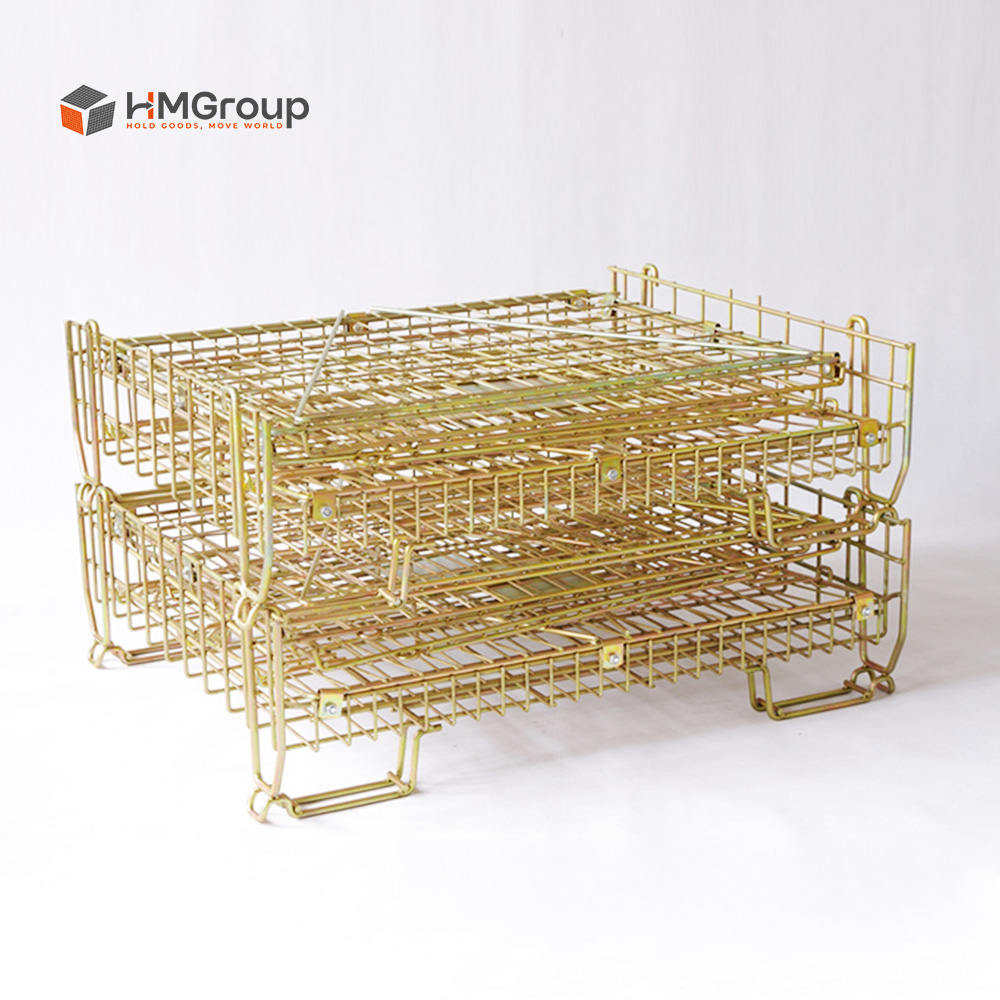
HM-CP001, a pallet-footprint wire mesh pallet container measuring 1200 × 800 × 1000 mm, is listed at 4 high with 800 kg capacity and 550 sets loaded into a 40-foot high-cube container. HM-HD001, HM-HD005, HM-HD010, and HM-HD028 are also listed at 4 high. The wine and beverage-oriented models move to a different notation: HM-WEU005, HM-WEU001, and HM-WEU010 are listed at 4+1 high, and the PET preform container HM-PPC22 at 5+1 high.
Two conclusions follow. First, stack height is model-dependent, not category-dependent, so the required stack height must be decided before model selection. Second, notation such as “4+1” and “5+1” should be confirmed with the supplier against your own stacking configuration, because the way a notation is applied to a base unit and loaded units on site is what determines whether the stack is actually safe. Ask for the interpretation in writing, and match it to your racking or floor-stacking plan.
A plastic pallet box carries stack load through its walls and corner columns rather than through a welded steel frame, so its stack rating is equally manufacturer-specific. The difference to watch is behaviour over time: a steel frame holds its geometry under a static stack, while a moulded box depends on wall stiffness and base design. In both categories, the only defensible input is the supplier's documented stack rating for the exact model.
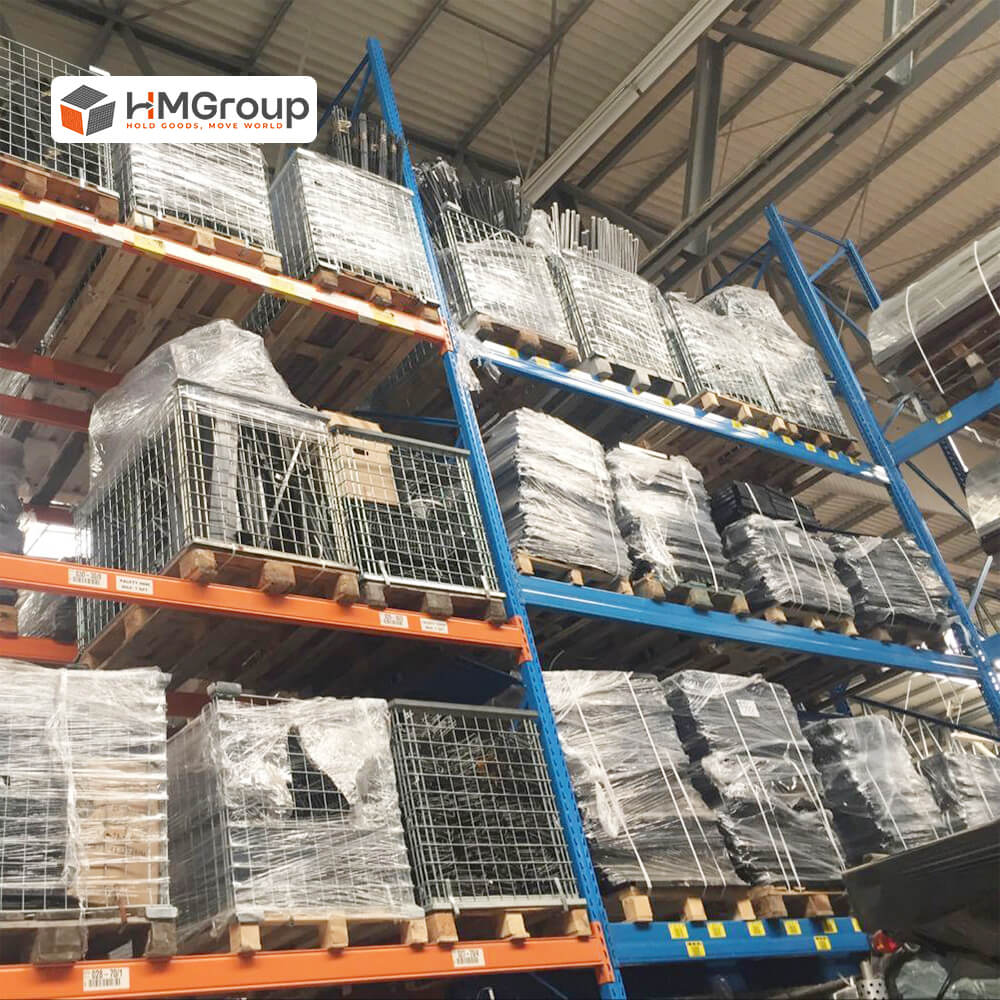
HM-CP001 wire mesh pallet containers: 1200 × 800 × 1000 mm, 800 kg, 4 high, 550 sets per 40-foot high-cube container.
Wire Gauge and Grid Size: The Real Specification Layer
HM Group states that its wire containers use wire gauges from 4.8 mm to 12 mm. That range is not a marketing bracket — it is the variable that connects a container to a load. Heavier gauge and denser grid raise structural stiffness and containment; lighter gauge and wider aperture reduce weight and open the load to airflow and visibility.
Grid sizes in the current catalogue illustrate how deliberately the aperture is chosen:
- 25 × 50 mm — HM-HD010, the tightest grid in the range, at 800 kg capacity
- 50 × 50 mm — HM-HD001, paired with the highest stated capacity of 1,300 kg
- 50 × 100 mm — HM-HD005 (1,000 kg) and HM-HD028 (500 kg)
- 51 × 118 mm — HM-WEU005, wine bottle format
- 54 × 160 mm — HM-PPC14, preform format
- 55 × 113 mm — HM-WEU001, Burgundy bottle format
- 60 × 103 mm and 60 × 120 mm — HM-CP001 and HM-WEU010
- 62 × 125 mm — HM-PPC22, preform format
The rule for buyers is simple: measure the smallest item in the load and select an aperture smaller than it, then confirm that the resulting mesh still gives the airflow and visibility the process needs. A plastic pallet box removes this variable entirely — containment comes from the wall, so there is no aperture to select and no grid to tune. That is an advantage when the load is loose and small. It is a disadvantage when the process depends on seeing or ventilating the load.
Ventilation and Product Protection: PET Preforms and Wine Bottles
Two load types make the openness question concrete: PET preforms and wine bottles.
PET preforms
PET preforms are lightweight, high-volume, and sensitive to scuffing and dust. HM-PPC22 is a dedicated preform container measuring 1196 × 1008 × 1174 mm, with a 62 × 125 mm grid, stated capacity of 600 kg, 5+1 stackability, and 170 sets loaded into a 40-foot high-cube container. HM-PPC14, a foldable preform container, is listed at 1120 × 971 × 1050 mm with a 800 kg capacity and 240 sets per 40-foot high-cube container.
Where dust and surface protection matter more than pure airflow, the PP-sheet option changes the equation. HM-HD028 is a wire container with PP sheet at 1200 × 1000 × 1140 mm, 5 mm wire, 50 × 100 mm grid, 500 kg capacity, and 4-high stacking. The steel frame supplies the structure; the PP sheet supplies the closed, smooth surface. This hybrid is the closest a wire container gets to plastic box behaviour — while keeping the collapsible steel frame and the option to remove or replace the liner.
HM Group reports that this combination has been deployed at scale in beverage supply chains. For a global food and beverage customer, the company states that 10,000 units were supplied with PP sheet inner lining for preform storage, supporting four-high stacking, a reported 40% improvement in stock counting and identification speed, and a reported 25% reduction in logistics-related downtime. For a beverage customer in South Africa, 5,000 units were supplied, with a reported 35% increase in internal material handling efficiency and full visual stock checks through the open mesh.
Wine bottles
Wine storage uses the same logic with different dimensions. HM-WEU005 is listed at 1200 × 920 × 1018 mm with a 51 × 118 mm grid, 800 kg capacity, 4+1 stackability, and capacity for 400 Bordeaux bottles. HM-WEU001 stores 500 Burgundy bottles at 1140 × 830 × 980 mm with a 55 × 113 mm grid and 4+1 stacking. HM-WEU010 sits at 1183 × 948 × 991 mm with a 60 × 120 mm grid and 4+1 stacking. In cellar and export conditions, corrosion protection becomes the deciding finish question, which is why hot-dip galvanized or higher-build zinc finishes are commonly specified for humid storage.
A closed plastic box protects bottles from light and dust, but it also stops air movement and blocks inspection. In a cellar where stock rotation and vintage visibility matter, that trade is usually the wrong one; in a dry goods export chain where dust control dominates, it can be the right one.
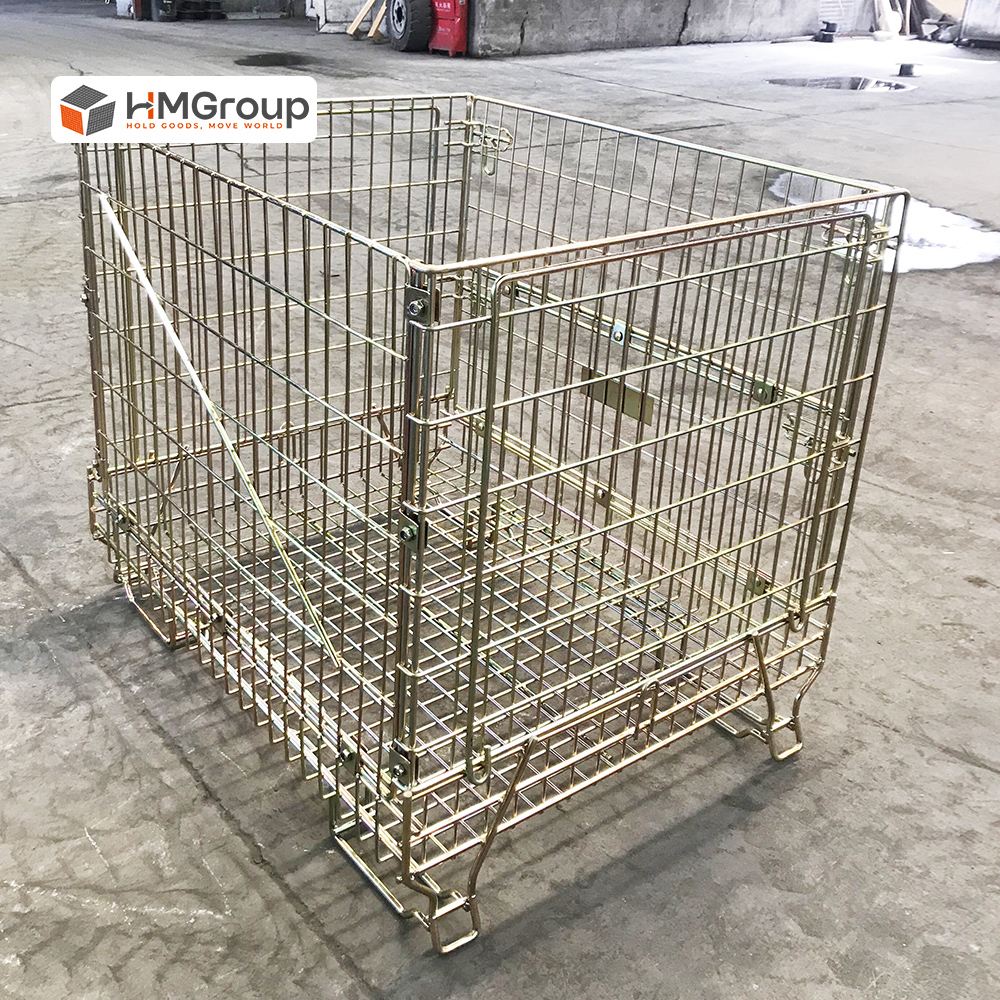
Open-mesh wine storage: HM-WEU005 holds 400 Bordeaux bottles, 800 kg, 4+1 stackability.
Where Plastic Pallet Boxes Remain the Better Choice
A fair comparison has to state the boundary conditions, and plastic pallet boxes hold real ground in several of them.
- Small loose parts. A 25 × 50 mm grid is the tightest aperture in HM Group's range, but it is still a grid. If components can pass through it, a closed box or a lined wire container is the correct answer.
- Sealed, dust-sensitive loads. Where the requirement is a closed environment with no liner to maintain, a solid-wall box is simpler than a mesh frame plus PP sheet.
- Corrosion exposure without finish maintenance. Steel depends on zinc, hot-dip galvanizing, or powder coating for corrosion resistance. Thermoplastic does not rust, so wet or chemically aggressive environments may favour plastic on maintenance grounds alone.
- No in-house repair capability. This cuts both ways. Welded steel mesh panels can be re-welded or replaced in many workshops; moulded thermoplastic is generally harder to repair in the field and tends to be replaced instead.
- Static-sensitive environments. Standard thermoplastics can accumulate static charge, so where electronics or flammable atmospheres are involved, the material specification — not the container shape — becomes the deciding factor.
Conversely, wire containers hold ground where the process needs the load visible, ventilated, and mechanically handled at height. Neither list is a verdict; both are constraints to be checked against the actual load.
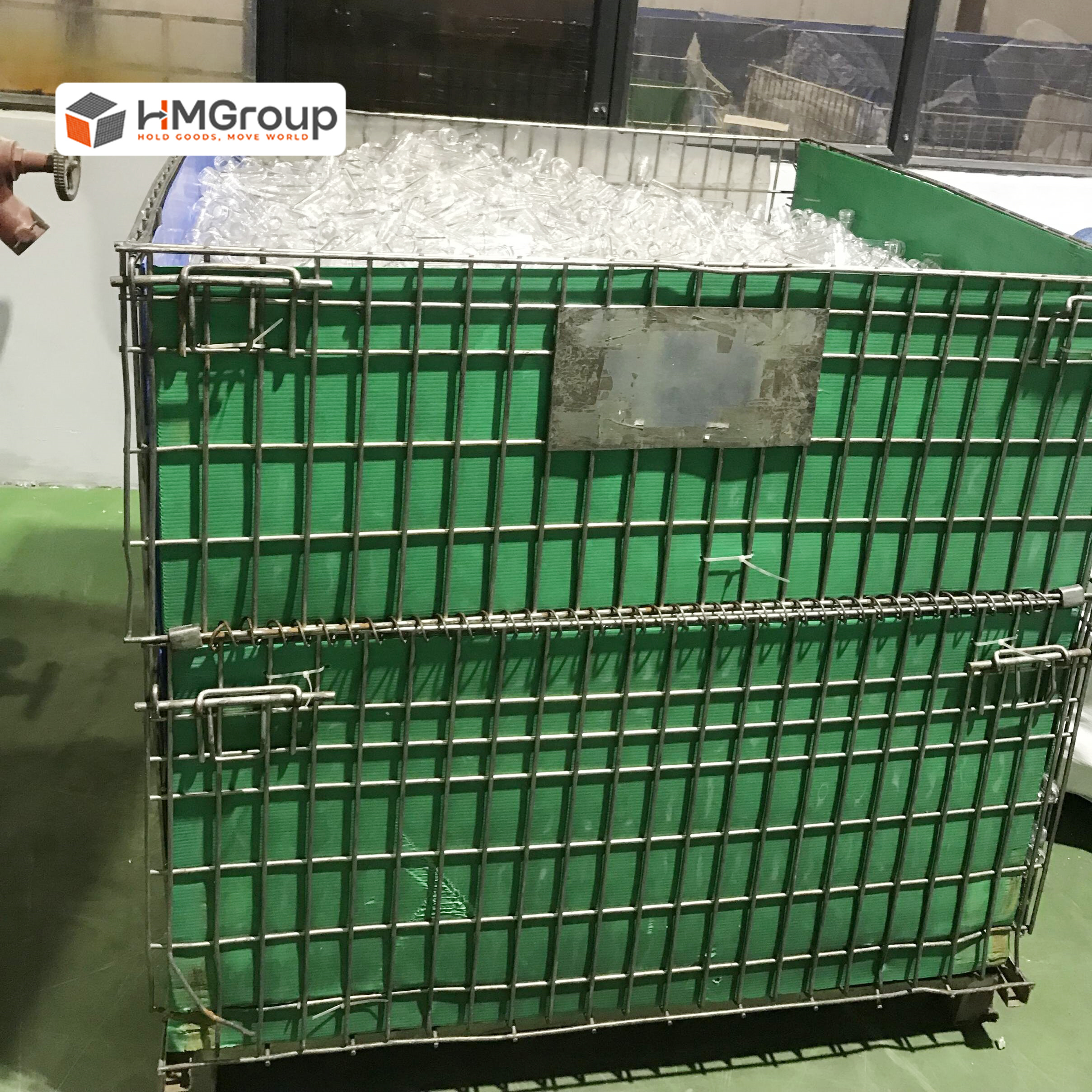
Wire container with PP sheet HM-HD028: steel frame with a closed liner, 500 kg capacity, 4 high.
Comparison Table: Wire Container vs. Plastic Pallet Box
| Attribute | Mild steel Q235 wire container | Plastic pallet box |
|---|---|---|
| Base material | Mild steel Q235; low-carbon wire rod and plate with resistance-welded wire construction | Moulded thermoplastic, commonly HDPE or PP; confirm grade with supplier |
| Sides | Open welded mesh with a defined grid aperture | Solid moulded walls; vents only if specified |
| Stated loading capacity | 500 kg (HM-HD028) up to 1,300 kg (HM-HD001) | Model-specific; supplier documentation required, basis and safety factor must be confirmed |
| Stackability | 4 high (HM-HD001, HM-HD005, HM-HD010, HM-HD028, HM-CP001); 4+1 (HM-WEU005, HM-WEU001, HM-WEU010); 5+1 (HM-PPC22) | Manufacturer-specific stack rating; confirm for the exact model |
| Wire gauge | 4.8 mm to 12 mm across the range | Not applicable |
| Grid aperture options | 25 × 50, 50 × 50, 50 × 100, 51 × 118, 54 × 160, 55 × 113, 60 × 103, 60 × 120, 62 × 125 mm | Not applicable — containment provided by the wall |
| Ventilation | Continuous airflow through sides and base | Closed by default; ventilation only where vents are specified |
| Visual inspection | Load visible without opening the unit | Requires opening the lid or door |
| Surface options | Zinc, hot-dip galvanized, or powder coating; colour and logo printing available as customization | Colour is generally moulded in |
| Empty volume | Collapsible and foldable models available (e.g. HM-HD005, HM-PPC14) | Rigid designs dominate; collapsible plastic versions exist |
| Repair | Welded mesh panels can be re-welded or replaced in many workshops | Generally not field-repairable; typically replaced |
| Container loading (40-foot high-cube) | 550 sets (HM-CP001), 500 sets (HM-HD001), 330 sets (HM-HD028), 228 sets (HM-WEU005), 170 sets (HM-PPC22) | Supplier-specific; must be confirmed per model and packing configuration |
Wire container figures are stated catalogue specifications. Plastic pallet box values are deliberately left to supplier documentation because no comparable verified figures apply across the category.
Step-by-Step Selection Checklist for Industrial Buyers
This sequence works for either container type and keeps the comparison honest.
- Write down the load, not the product name. Record weight per container, whether the load is static in storage or dynamic during forklift movement, and whether point loads or sharp edges are present. This single step eliminates most wrong-model selections.
- Fix the stack plan before choosing a model. Decide the required stack height and confirm how the supplier's notation (4 high, 4+1, 5+1) applies to your base unit and loaded units. HM-PPC22 at 5+1 and HM-CP001 at 4 high are not interchangeable answers to the same stacking requirement.
- Match the aperture to the smallest item. Use the grid list above; if no aperture contains the item safely, move to a PP-sheet lined wire container such as HM-HD028 or to a closed plastic box.
- Decide the openness question explicitly. Open mesh for visibility, airflow, and rapid counting; PP sheet for dust and surface protection; closed plastic where a sealed wall is mandatory.
- Match the finish to the environment. Zinc, hot-dip galvanized, or powder coating for steel. Humid cellars and outdoor-adjacent storage push the specification toward hot-dip galvanizing. If no finish maintenance is realistic, reconsider the material.
- Confirm the handling interface. Forklift entry, the option of casters or wheels, half-drop gates for picking at height, dividers, runner bars, name plates, and lids are all available as customization on HM Group's wire containers. Specify them at RFQ stage, not after the order.
- Validate the documentation. Ask for the load rating basis, material grade, and certification. HM Group holds ISO 9001:2015 certificate CN24/00004786 issued by SGS, valid through 29 July 2027, covering the sale of material handling equipment for logistics turnover.
- Calculate freight per unit, not per container. Container loading varies widely by model — 550 sets of HM-CP001 versus 170 sets of HM-PPC22 per 40-foot high-cube container. That difference changes the landed cost per unit far more than most specification choices.
Use Cases: Which Load Goes Where
Automotive components and metal parts. The 50 × 50 mm grid and 1,300 kg rating of HM-HD001 suit dense metal loads where small items must stay contained. Auto parts and agricultural applications are both listed for this model.
PET preform production and bottling. HM-PPC22 and HM-PPC14 are built around preform dimensions and stack height, with PP sheet lining available where surface protection is required. Preform handling is the clearest case where open mesh wins on counting speed and closed walls win on dust control — and where the PP-lined wire container resolves both.
Wine cellars and beverage export. HM-WEU005, HM-WEU001, and HM-WEU010 are sized around Bordeaux and Burgundy bottle formats, with 4+1 stacking and 800 kg capacity across the three.
Warehouse and fulfilment operations. HM-CP001 at 550 sets per 40-foot high-cube container and 4-high stacking is the volume-oriented option, with HM-HD010's 25 × 50 mm close mesh available where smaller components are involved.
Where a plastic box belongs. Sealed small-part kits, dust-critical assemblies, and wet environments without finish maintenance are legitimate plastic-box applications. If the load is loose, small, and does not need to be seen or ventilated, the closed box is the simpler specification.
HM-PPC22 preform container: 62 × 125 mm grid, 600 kg capacity, 5+1 stackability, 170 sets per 40-foot high-cube container.
Frequently Asked Questions
1. What compliance documents should I verify before ordering wire containers or plastic pallet boxes?
For a steel wire container, verify three things: the quality management certificate, the load rating basis, and the material and finish specification. HM Group holds ISO 9001:2015 certificate CN24/00004786, issued by SGS and valid through 29 July 2027, with a scope covering the sale of material handling equipment for logistics turnover. The load rating basis deserves its own question, because published capacities are commonly issued without a stated test method, static or dynamic basis, or safety factor — so a 1,300 kg claim and a 1,000 kg claim from two suppliers are not yet comparable. For a plastic pallet box, request the material grade, the load rating test method, and the stack rating for the exact model. In both cases, ask for the documents behind the claim rather than the claim itself.
2. Can a wire container match a plastic pallet box on load capacity and stacking?
On load, yes within a defined band. HM Group's catalogue runs from 500 kg on HM-HD028 to 1,300 kg on HM-HD001, with 1,000 kg on the collapsible HM-HD005 and 800 kg on HM-CP001, HM-HD010, HM-WEU005, HM-PPC14, HM-WEU001, and HM-WEU010. On stacking, ratings are model-specific: 4 high for HM-HD001, HM-HD005, HM-HD010, HM-HD028, and HM-CP001; 4+1 for the wine models; 5+1 for HM-PPC22. Plastic pallet boxes also carry model-specific ratings, so the correct answer is the same in both categories — select on the documented rating for the exact model, and confirm the interpretation of the stacking notation against your own stack plan.
3. What drives the cost difference between the two options?
No verified price benchmark for either category applies across suppliers, so the honest answer is to compare cost drivers rather than headline prices. On the wire side, the drivers are wire gauge, grid density, surface treatment (zinc, hot-dip galvanized, or powder coating), and added options such as casters, PP sheet liners, dividers, runner bars, name plates, and lids. Freight is the driver most often missed: HM Group loads 550 sets of HM-CP001, 500 sets of HM-HD001, 330 sets of HM-HD028, 228 sets of HM-WEU005, and 170 sets of HM-PPC22 into a 40-foot high-cube container, so landed cost per unit varies substantially between models. The minimum order quantity is 1 × 20GP, which sets the entry point for a first order.
4. How do I validate a sample before committing to a full order?
Treat the sample as an inspection event, not a courtesy. HM Group's quality control runs through six phases: pre-production sample inspection, raw material inspection, component inspection, semi-finished product inspection, finished product inspection, and packaging inspection. Online video audits are supported for buyers who want to see the process rather than a finished unit. Use the sample to check the aperture against your smallest item, confirm the stated wire gauge and grid size against the drawing, verify the finish, and test the handling interface you specified — forklift entry, casters, gate, or divider position. Customization at this stage covers size, loading capacity, surface treatment, powder-coating colour, logo printing, and designs such as forklift guides, wire dividers, runner bars, name plates, and wheels.
5. What are typical lead times, and how do I move from comparison to a quotation?
HM Group states a lead time of 30–45 days, a monthly capacity of 40,000 sets, and a minimum order quantity of 1 × 20GP, with a warranty of 3 to 5 years under proper use. To get from this comparison to a usable quotation, send the load weight, the required stack height, the item dimensions, the aperture constraint, the finish, and the handling options in one package — those six inputs are enough to pin down a model instead of a category. HM Group's team can be reached at mary@net-railing.com or on WhatsApp at +86 150 4058 7228, and the full product range is published at hmlwires.com.
Conclusion
The wire container versus plastic pallet box question resolves once the requirement is written in load, stack height, aperture, and openness rather than in product names. A mild steel Q235 wire container covers 500 kg to 1,300 kg, stacks four high or higher depending on model, and gives airflow and visual access that a closed box cannot. A plastic pallet box gives containment and a sealed surface that an open grid cannot. Both statements are true at the same time, which is why the specification — not the category — decides.
For heavy-duty industrial storage where loads are dense, stacking is vertical, and operators need to see what they are handling, the wire container is usually the more capable tool. Where loads are sealed, small, and dust-critical, the closed box earns its place. The crossover cases are the interesting ones: a PP-sheet lined wire container such as HM-HD028 delivers closed-surface protection on a steel frame, and a hot-dip galvanized wine container such as HM-WEU005 delivers bottle-specific containment with full ventilation.
Next Step: Match a Model to Your Load
HM Group manufactures wire containers, PET preform containers, wine storage containers, and cage pallets at three production bases in Xiamen, Nanjing, and Qingdao, with customization for size, loading capacity, surface treatment, and handling options.
Download the full product catalogue: HM Group Wire Container Catalogue (PDF)
For a specification review, a sample request, or a quotation, contact MARY KONG at mary@net-railing.com, WhatsApp +86 150 4058 7228, or visit www.hmlwires.com.
Have Questions or Need More Details?
Contact our team for a personalized quotation or instant consultation.
Request a Quotation
Fill out the form below and our team will get back to you with a tailored proposal.
WhatsApp Direct Chat
Prefer to chat in real-time? Message us on WhatsApp for instant assistance & quick answers.
- Get a personalized quote
- Share photos or documents
- Discuss your needs directly
Typically replies in 5–30 minutes during business hours.