
Storage Rack Compliance Guide: Verified Q235, Load, and Finish Specs for Regional Reviews
A storage rack rarely fails a regional review because the steel is too thin. It fails because the buyer cannot trace a claim on the quotation back to a document a reviewer will accept. The verified specification set for HM Group’s storage rack range can be documented line by line: mild steel Q235 construction, per-unit load ratings from 500 kg on the HM-FR002 carpet pad rack to 2,000 kg on the HM-PP002 warehouse storage rack, stacking up to 4 high on the general-purpose stacking models, and three finish options — zinc, hot-dip galvanized, or powder coating. What that set does not contain is a statement that any rack has been approved to a named standard in a named market. This guide shows how to map the facts you do have onto a reviewer’s checklist, and exactly where the buyer has to fill the gap.
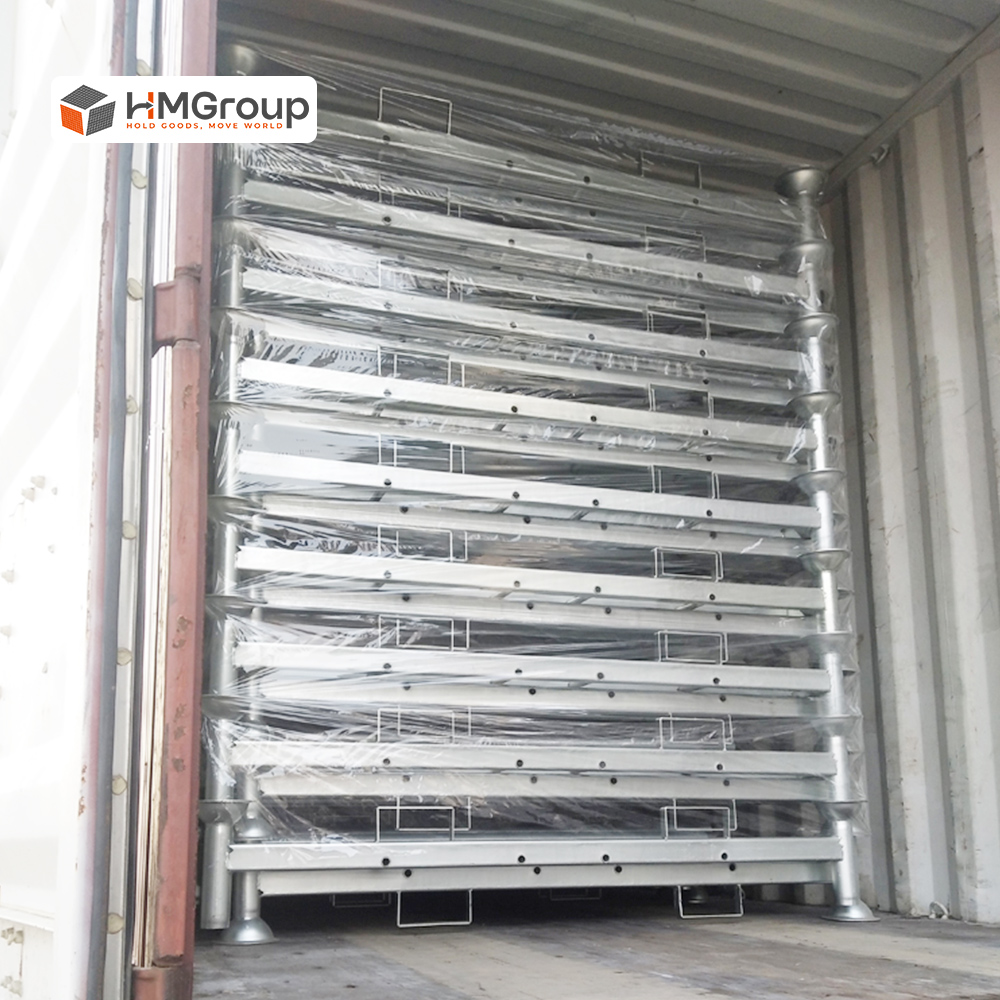
It is written for importers, distributors, warehouse engineers and procurement managers who have already passed the question of whether a stackable steel storage rack can carry their load, and are now asking whether they can defend the purchase internally — to a customs broker, an insurer, a health and safety inspector, or their own engineering sign-off. That shift, from product selection to document selection, is where most storage rack projects lose weeks.
Problem Definition: Why Storage Rack Reviews Stall on Paper
Three different things get collapsed into one word — “certified” — and each is answered by a different document.
- Layer 1 — Product specification. Material grade, load capacity, base and post dimensions, stack height, finish. This is data, and it belongs to a specific model, not to a brand.
- Layer 2 — Inspection and test documentation. A report describing what was examined, on which item, on which date, by whom. A report has a scope line. The scope line is the part that matters.
- Layer 3 — Market approval or declaration of conformity. A formal statement that a product meets a named standard in a named jurisdiction. This is granted against a standard number, not against a supplier relationship.
The failure pattern is predictable. A buyer asks a supplier whether a storage rack is certified. The supplier sends a certificate with a logo on it. The reviewer then asks three questions the certificate was never written to answer: certified to what standard, for which model or style, and for which market. If those three answers are not on the page, the submission stalls — even when the rack itself is perfectly suited to the load.
A second, quieter problem sits inside Layer 1. Load ratings are routinely quoted without their configuration. A figure such as 1,100 kg means one thing when a rack is stacked four units high with product inside, and another when the same racks are folded and stacked twenty high for empty return. HM Group publishes both numbers separately on most models — for example 4 open / 20 closed on the HM-TR6060 storage tire rack — but a quotation that shows only one of them gives the reviewer nothing to check against the actual warehouse layout.
Industry Background: What Reviewers in Different Regions Are Actually Testing
The storage rack category is large and still growing. The global industrial racking systems market was valued at USD 16.76 billion in 2024, according to Market Research Future. Growth of that kind pushes new suppliers into export channels faster than documentation practices mature, which is exactly why buyers now see wide variation in what arrives attached to a quote.
Regional review regimes do not converge on a single test. As one documented example, in the United States, OSHA 29 CFR 1910.176(b) addresses the stable and secure storage of material in tiers. That rule speaks to how material is stored and stacked in a workplace — it is a storage-practice requirement, not a product certificate issued to a rack supplier. A reviewer applying it will look at stack configuration, interlocking and height limits, which is why the open-versus-closed stacking figures and the 4-high limits in a specification table become directly relevant to a safety conversation.
Across the EU, North America, Asia and the Middle East, the phrasing differs but the underlying demand is the same: a document trail that lets a reviewer connect a physical unit to a described test or a described quality system. That is a documentation task, and it can be completed before the container ships — provided the buyer separates what the supplier has verified from what the supplier has merely asserted.
The Verified Specification Block: Q235, Load, Geometry, Finish
Four lines carry almost all of the compliance value in a storage rack submission. If a quotation or datasheet answers these four cleanly, the technical review is usually short.
Line 1 — Material: mild steel Q235
Every model in the storage rack range covered here is specified as mild steel Q235. That is a material designation, and it is the first thing a reviewer will want stated explicitly rather than implied by “steel”. It is also the line most often missing from a one-page quotation. State it once, in the model row, and keep it consistent across the datasheet and the commercial invoice description.
Line 2 — Load: per-unit ratings, not category claims
Load capacity in this range is published per unit, per model, and it varies widely by design intent: 500 kg on the HM-FR002 carpet pad rack, 600 kg on the HM-TR1 stacking tire storage rack, 1,000 kg on the HM-FR005 fabric roll storage rack, 1,100 kg on the HM-FR007 stackable steel storage rack and on the HM-TR6060, HM-TR7272WM and HM-TR6 tire racks, 1,500 kg on the HM-PP001 stacking storage rack, and 2,000 kg on the HM-PP002 warehouse storage rack.
Two exceptions deserve their own line in a review file. The HM-BR066 barrel storage rack is specified by container volume — 50 L, 200 L, 225 L, 300 L and 500 L — not by a kilogram rating, so a reviewer assessing it will need the filled weight of the barrels you intend to store. And the tire racks are published with both a mass rating and a tire count: 24 to 32 tires on the HM-TR6060, 34 to 50 on the HM-TR6, and 42 to 63 on the HM-TR7272WM. Tire count and mass rating must both appear, because a reviewer checking density will use one and a reviewer checking structure will use the other.
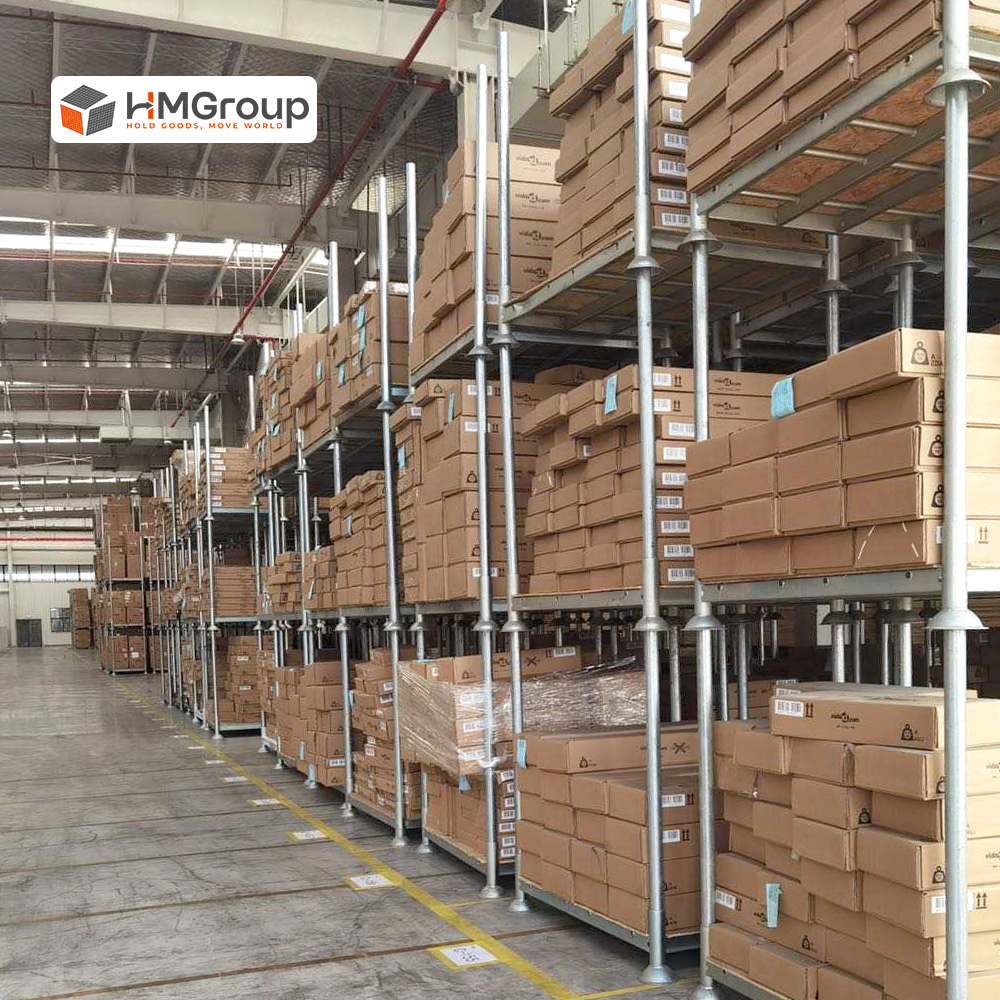
Line 3 — Geometry: base size, post size, exterior dimensions
The two general-purpose models share a post specification — φ60×2.5 mm — and differ in base: 1395×1060×310 mm on the HM-PP001, 1875×1060×310 mm on the HM-PP002. The roll and tire models are quoted in exterior dimensions instead: 48×48×36 inch on the HM-FR007, 1500×1100×900 mm on the HM-FR005, 1521×1000×1360 mm on the HM-FR002, 1130×775×453 mm on the HM-BR066, 60×60×60 inch on the HM-TR6060, 72×72×72 inch on the HM-TR7272WM, 90×40×52 inch on the HM-TR6 and 2290×1100×1250 mm on the HM-TR1. Feed these straight into the warehouse layout drawing; a reviewer comparing the drawing against the datasheet will notice a mismatch faster than any other error.
Line 4 — Finish: three documented options
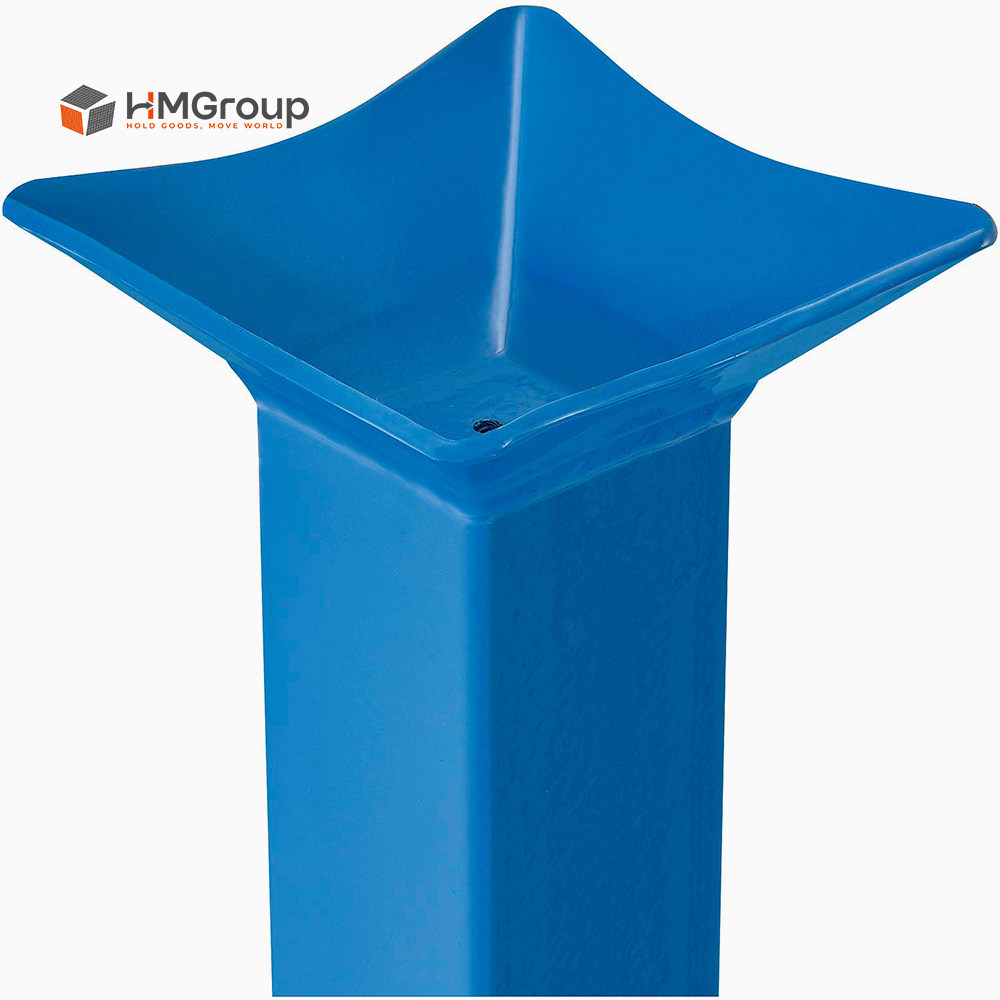
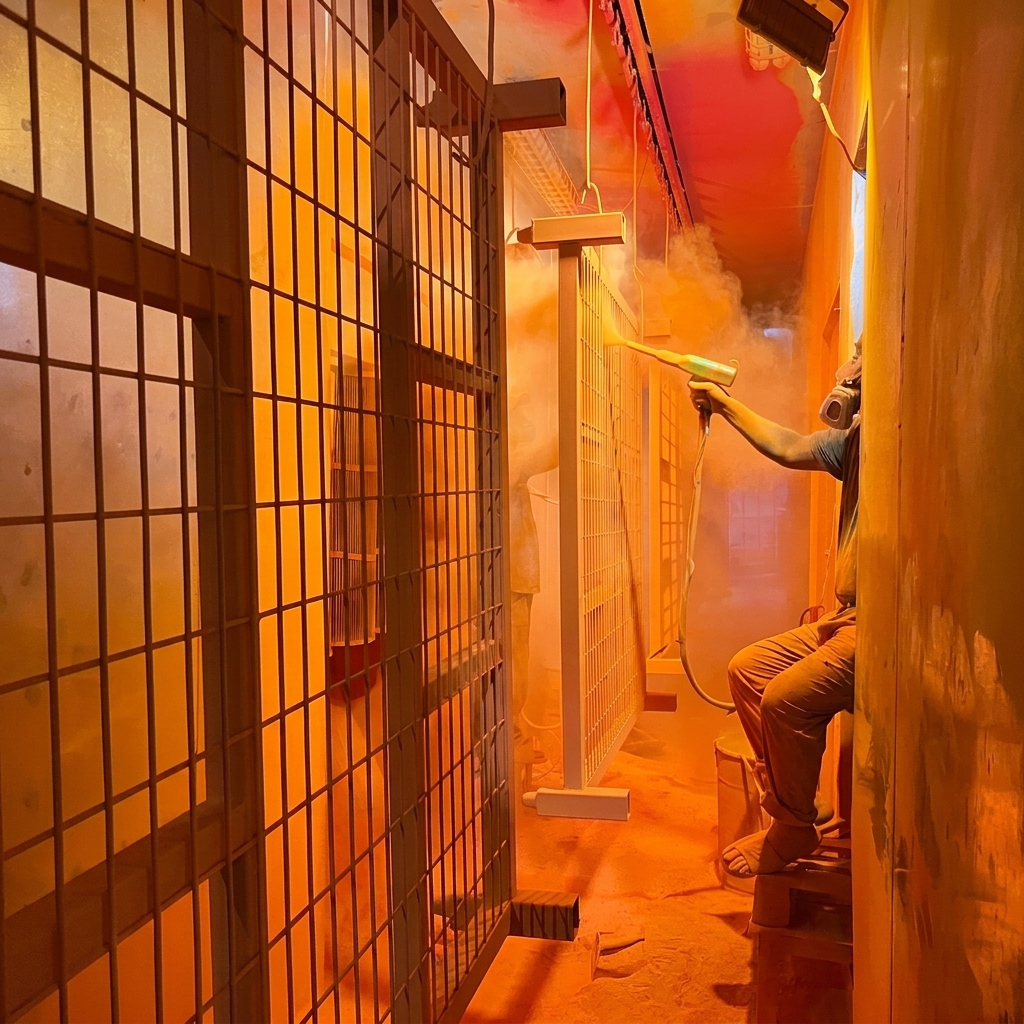
Zinc, hot-dip galvanized, or powder coating — the same three-option set is listed across the range, and surface treatment is named as a customization item. HM Group’s factory image set also includes an indoor zinc plating line and an indoor powder coating line, which is useful context when a reviewer asks whether finishing is controlled in-house or bought in.
What the verified data does not contain is a published corrosion-hour rating for any of the three finishes, so do not put one in your submission. Where a durability horizon is documented, it is stated as 3 to 5 years of corrosion resistance for hot-dip galvanized or powder-coated equipment in a humid cellar application, and separately as a 3 to 5 year warranty under proper use. Treat both as company-stated horizons, not as independent corrosion test results.
Specifications Are Not Approvals: Reading the HM Group Document Set
HM Group (Dalian HuaMao Logistics Equipment Group Co., Ltd.) was founded in 2003 and operates from a 62,000 m² manufacturing footprint across three bases in Xiamen, Nanjing and Qingdao, exporting 100% of output to the EU, North America, Asia and the Middle East. Four documents in the verified set are relevant to a review file. None of them is a market approval, and reading each one by its scope line is the whole exercise.
| Document | Issuer | Reference | Issue / validity | Scope as recorded | What it supports in a review |
|---|---|---|---|---|---|
| ISO 9001:2015 certificate | SGS | CN24/00004786 | Issued 2024-07-30, valid to 2027-07-29 | Sales of material handling equipment for logistics turnover | A certified quality management system covering the stated sales scope |
| Survey Report | SGS | CANWT00478167 | Issued 2026-01-23 | Stacking Shelves (Style No. M2); standard field recorded as N/A | A survey document tied to one stacking shelf style; filed in HM Group records against HM-PP001, HM-PP002 and HM-PP006 |
| TÜV inspection report | TÜV | ITD2025N0087 | Issued 2025-02-28 | Steel pallet; standard field recorded as N/A; markets listed as EU, North America, Asia, Middle East | An inspection document for the steel pallet scope; filed against HM-FR007, HM-PP002 and HM-PP001 |
| Verified supplier verification | SGS via Alibaba.com | 486803081_T | Valid 2026-03-06 to 2027-03-06 | All logistics equipment products | Platform-level supplier verification — not a product certification |
Three observations follow directly from the table, and they are the ones a reviewer will make independently if you do not make them first.
The quality certificate covers sales, not manufacturing. The ISO 9001:2015 scope line reads “Sales of material handling equipment for logistics turnover.” Read literally, it supports the argument that the selling entity runs a certified management system within that scope. It is not a statement about welding, coating, or factory process control, and a careful reviewer will notice that distinction. If the review file needs manufacturing-process evidence, ask for the process documentation separately rather than stretching this certificate.
The survey report has a style scope, not a range scope. CANWT00478167 covers “Stacking Shelves (Style No. M2)” and records no standard number. The file itself is captioned as a loading test report at 2 tons per level. That caption describes what the file contains — it does not extend the report’s scope to every rack model HM Group sells. When you submit it for an HM-PP001 or HM-PP002 order, state that HM Group’s records link the report to those models, and let the reviewer decide whether the linkage is sufficient.
The inspection report names a steel pallet scope. ITD2025N0087 lists “Steel pallet” and no standard number, with market coverage recorded as the EU, North America, Asia and the Middle East. Submitting it as evidence that a tire rack or barrel rack has been inspected to a regional standard would be a misstatement. Submitting it as the inspection document a supplier holds for steel pallet construction is accurate and defensible.
Nothing in the verified set states that any rack carries a CE marking, a UL listing, or a declaration of conformity to a named rack design standard. That absence is not unusual for the category, but it must be visible in your file rather than discovered by the reviewer.
Step-by-Step: Mapping Verified Specs to a Regional Checklist
The sequence below converts a supplier quotation into a reviewable file in six passes. Each step produces one page or one row that a reviewer can check without asking you for clarification.
Step 1 — Fix the load definition before anything else
Decide whether the figure on the checklist is the rated load per unit, the total stacked load, or the load per level. HM Group publishes per-unit ratings — 1,500 kg for HM-PP001, 2,000 kg for HM-PP002 — and separate stack heights. Write both on the same row. Do not convert, add, or divide; if a reviewer wants a per-level figure, ask the supplier for it in writing instead of deriving it yourself.
Step 2 — Convert stack height into a layout number
Stacking is where specifications and workplace rules meet. The general-purpose models and the barrel rack are published at 4 high; the HM-FR002 carpet pad rack at 4 to 5 high; the HM-FR007, HM-TR6, HM-TR6060, HM-TR7272WM, HM-TR1 and HM-FR005 are published with both an open and a closed figure — commonly 4 open / 20 closed or 6 open / 20 closed. The open figure is the one that matters for a stack-height rule. The closed figure matters for return freight and should be quoted in the logistics annex, not the safety annex.
Step 3 — Check geometry against handling equipment and floor
Confirm the base size against your forklift or pallet-truck footprint and against the aisle width in the drawing. The HM-PP001 base is 1395×1060×310 mm and the HM-PP002 base is 1875×1060×310 mm — the same post, a materially different footprint. A specification that fits a 1,060 mm handling width may not fit a layout drawn around the wider base, and that mismatch is a review finding, not a shipping detail.
Step 4 — Select the finish against the environment, not against habit
Zinc, hot-dip galvanized and powder coating are all offered across the range. Match the choice to what the reviewer will ask about: humidity and washdown, indoor versus outdoor exposure, cold-store operation, or appearance in a customer-facing area. Because no corrosion-hour rating is published, keep the justification qualitative and cite the 3 to 5 year company-stated horizon where it applies, attributed as company data.
Step 5 — Match the model family to the stored product
Tire storage racks for tire inventory, fabric roll storage racks and carpet pad racks for roll goods, barrel storage racks for liquid containers, nestainer storage racks and general stacking racks for mixed pallet loads. A reviewer who sees a fabric roll storage rack proposed for barrel storage will question the whole submission, so keep the pairing explicit in the technical narrative.
Step 6 — Assemble the document pack and mark the gaps
Attach the four documents above with their scope lines and dates visible, then add a short gaps page listing what is not covered: no named-standard conformity declaration, no corrosion test data, no independently verified factory audit in the published set. A gaps page is not an admission of weakness; it is what prevents a reviewer from finding the gap later and freezing the order. HM Group supports this stage with a process report throughout the order and online video audit support, which lets a buyer’s engineer observe production without travelling.
Use Cases: Where the Specs Have to Survive Real Loads
Specifications become reviewable when they are tied to a stored product and a stacking decision. Four patterns cover most of the range.
Tire distribution and seasonal storage. The HM-TR6060 storage tire rack is rated 1,100 kg (2,400 lb) with a tire capacity of 24 to 32 pieces, 60×60×60 inch exterior, stacking 4 open / 20 closed, and 280 sets per 1×40’HQ. For higher tire counts per unit, the HM-TR7272WM raises capacity to 42 to 63 tires at the same 1,100 kg rating, and the HM-TR6 reaches 34 to 50 tires with stacking up to 6 open. A reviewer assessing these will want the tire size and the mass per tire, because the count and the mass rating constrain each other.
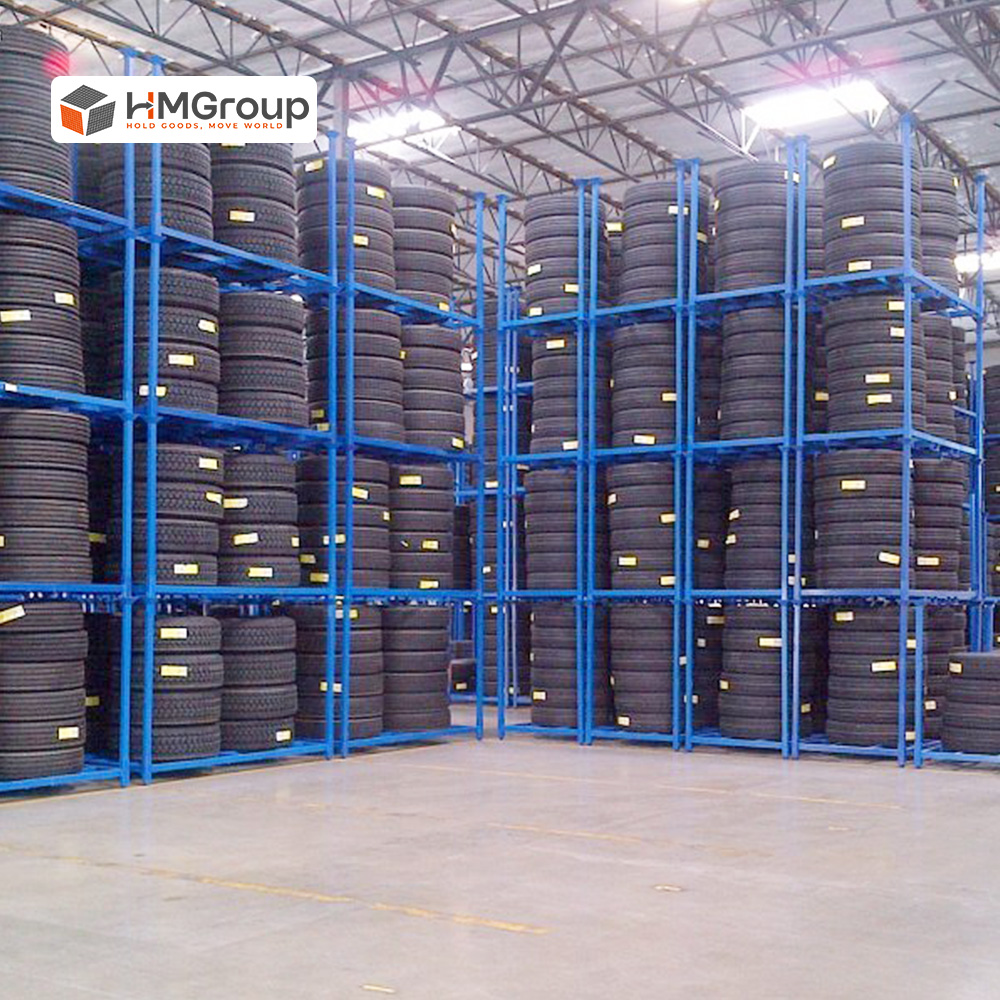
Textile and fabric roll warehousing. The HM-FR005 fabric roll storage rack is rated 1,000 kg at 1500×1100×900 mm with 4 open / 20 closed stacking. The HM-FR007 stackable steel storage rack carries 1,100 kg at 48×48×36 inch and stacks 6 open / 20 closed. Carpet pad storage sits lower in mass terms — the HM-FR002 is rated 500 kg at 1521×1000×1360 mm with 4 to 5 high stacking — which makes roll diameter and orientation the decisive review inputs rather than load alone.
Barrel and liquid container storage. The HM-BR066 barrel storage rack accepts 50 L to 500 L containers in a 1130×775×453 mm footprint and stacks 4 high, with 234 sets per 1×40’HQ. Its published capacity is volumetric, so a compliance file for barrel storage must add the filled weight per container and the total per stack, both of which sit outside the rack datasheet.
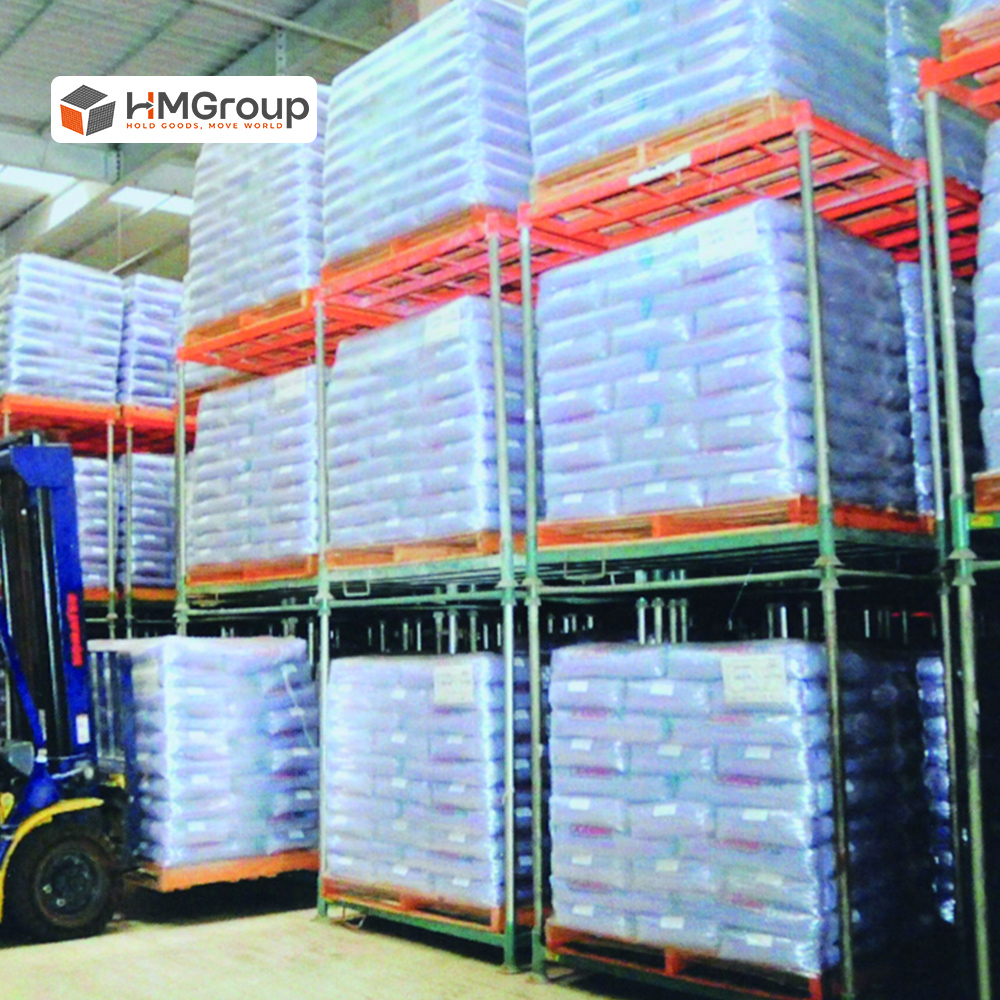
General warehouse and agricultural pallet loads. The HM-PP001 and HM-PP002 stacking storage racks cover mixed pallet loads at 1,500 kg and 2,000 kg respectively, both stacking 4 high and both adaptable with wire mesh guards, bottom wire mesh decking, forklift guides, bottom steel plates or wheels. Documented deployments of this family include 5,000 units supplied through a strategic procurement partner for UNOPS, used for rice seed storage in cold-store conditions with 6-high vertical stacking, and 1,000 units for a Korean government agency storing potatoes, where the hot-dip galvanized finish was specified for durability and units were built to a 1,500 kg full-load requirement.
Comparison Table: Verified Storage Rack Specifications
All figures below are model-level specifications as published by HM Group. They are not category averages, and they should not be transferred between models.
| Model | Product type | Material | Load capacity | Key dimensions | Stacking | Finish options | Units per 1×40’HQ |
|---|---|---|---|---|---|---|---|
| HM-PP001 | Stacking Storage Racks | Mild steel Q235 | 1,500 kg | Base 1395×1060×310 mm; post φ60×2.5 mm | 4 high | Zinc / hot-dip galvanized / powder coating | 250 sets |
| HM-PP002 | warehouse storage rack | Mild steel Q235 | 2,000 kg | Base 1875×1060×310 mm; post φ60×2.5 mm | 4 high | Zinc / hot-dip galvanized / powder coating | 160 sets |
| HM-FR007 | Stackable Steel Storage Racks | Mild steel Q235 | 1,100 kg | 48×48×36 inch | 6 open / 20 closed | Zinc / hot-dip galvanized / powder coating | 380 sets |
| HM-FR005 | Fabric Roll Storage Rack | Mild steel Q235 | 1,000 kg | 1500×1100×900 mm | 4 open / 20 closed | Zinc / hot-dip galvanized / powder coating | 160 sets |
| HM-FR002 | Carpet Pad Storage Racks | Mild steel Q235 | 500 kg | 1521×1000×1360 mm | 4 to 5 high | Zinc / hot-dip galvanized / powder coating | 126 sets |
| HM-BR066 | Barrel Storage Racks | Mild steel Q235 | 50 L to 500 L containers (no kg rating published) | 1130×775×453 mm | 4 high | Zinc / hot-dip galvanized / powder coating | 234 sets |
| HM-TR6060 | Storage Tire Rack | Mild steel Q235 | 1,100 kg (2,400 lb); 24 to 32 tires | 60×60×60 inch | 4 open / 20 closed | Zinc / hot-dip galvanized / powder coating | 280 sets |
| HM-TR7272WM | Car Tire Storage Rack | Mild steel Q235 | 1,100 kg (2,400 lb); 42 to 63 tires | 72×72×72 inch | 4 open / 20 closed | Zinc / hot-dip galvanized / powder coating | 130 sets |
| HM-TR6 | Tire Storage Racking | Mild steel Q235 | 1,100 kg (2,400 lb); 34 to 50 tires | 90×40×52 inch | 6 open / 20 closed | Zinc / hot-dip galvanized / powder coating | 90 sets |
| HM-TR1 | Stacking Tire Storage Rack | Mild steel Q235 | 600 kg | 2290×1100×1250 mm | 4 open / 20 closed | Zinc / hot-dip galvanized / powder coating | 110 sets |
Model-level data only. Load ratings are per unit as published; stacking figures distinguish open (loaded) from closed (empty) configuration.
FAQ
Does HM Group hold a certification proving that a storage rack meets EU or US requirements?
No document in the verified set declares conformity to a named regional rack standard. The set contains an ISO 9001:2015 certificate, CN24/00004786, issued by SGS, valid from 2024-07-30 to 2027-07-29, with the scope recorded as “Sales of material handling equipment for logistics turnover”; an SGS Survey Report, CANWT00478167, issued 2026-01-23, covering “Stacking Shelves (Style No. M2)” with the standard field recorded as N/A; and a TÜV inspection report, ITD2025N0087, issued 2025-02-28, covering “Steel pallet” with markets listed as the EU, North America, Asia and the Middle East. Each is a real document with a defined scope. Whether any of them satisfies a specific reviewer is that reviewer’s decision, which is why the scope line should be submitted along with the document.
Can load rating, dimensions, or finish be adjusted to match a specification?
Yes. HM Group works in OEM, ODM and fully customized modes. The documented customization options are surface treatment (zinc, hot-dip galvanized or powder coating), size, loading capacity, powder coating color, logo printing, and design features including wire mesh guard, bottom wire mesh decking, forklift guide, bottom steel plate and wheels. Monthly capacity is 80,000 sets, so customized volume is handled within normal production planning. Any change to load rating or dimensions moves a unit outside the published figures in the comparison table above, and the changed value should be confirmed in writing and re-entered on the review checklist as a new line.
What drives the price band of a storage rack order?
No unit price is published in HM Group’s verified data, so a price band has to be built from documented cost levers rather than assumed: the Q235 material base, the load rating chosen (500 kg to 2,000 kg across the range), the finish selected, any customization, and the container loading quantity, which is 250 sets for HM-PP001, 160 for HM-PP002, 380 for HM-FR007 and 280 for HM-TR6060 per 1×40’HQ. Container loading is the lever most often overlooked, because it sets freight per unit and therefore the landed cost band. The minimum order quantity is 1×20GP.
How is a sample or first article validated before an order is released?
Quality control runs through six documented phases: pre-production inspection (sample inspection), raw material inspection, component inspection, semi-finished product inspection, finished product inspection, and packaging inspection. HM Group also provides a process report throughout the order and supports online video audit, so a buyer’s engineer can observe stages without an on-site visit. Warranty is 3 to 5 years under proper use.
What is the lead time, and what should be in the first order?
Lead time is 30 to 45 days, with a minimum order quantity of 1×20GP. For a first order, the practical recommendation is to pair the commercial documents with the review file from Step 6 — model row, load and stacking configuration, finish selection, and the four scoped documents with their issue dates — so the receiving inspection and the internal sign-off use the same numbers. HM Group’s catalogue can be downloaded from the link below, and a configuration-specific quotation, including the document pack for your selected models, can be requested directly from the export team at mary@net-railing.com or via WhatsApp on +86 150 4058 7228.
Conclusion
A storage rack submission survives a regional review when every claim on it has a model, a configuration and a document behind it. For HM Group’s range, the verified facts are precise and usable: mild steel Q235 across the line, per-unit load ratings from 500 kg on the HM-FR002 to 2,000 kg on the HM-PP002, stacking up to 4 high on the general-purpose stacking storage racks with published open-and-closed figures elsewhere, and three finish options in zinc, hot-dip galvanized and powder coating. The documents are equally specific — an ISO 9001:2015 certificate scoped to sales, an SGS survey report scoped to one stacking shelf style, and a TÜV inspection report scoped to steel pallets.
The buyer’s task is not to make those documents say more than they do. It is to state the scope plainly, list the gaps, and let the reviewer evaluate an honest file. That approach also shortens the commercial cycle, because a quotation that already carries its configuration does not come back with questions.
Next Step: Build the Review File for Your Models
Download the HM Group product catalogue for the full storage rack specification set, or send your stored product, load, stack height and target market to the export team and request a configuration-specific quotation with the matching document pack.
Download the HM Group catalogue (PDF)
HM Group — Dalian HuaMao Logistics Equipment Group Co., Ltd.
Website: www.hmlwires.com
Email: mary@net-railing.com · WhatsApp: +86 150 4058 7228 · Tel: +86 411-3981 3061
Address: 3306 Times Square (Times 1), 50 Renmin Road, Zhongshan District, Dalian, Liaoning, China
Have Questions or Need More Details?
Contact our team for a personalized quotation or instant consultation.
Request a Quotation
Fill out the form below and our team will get back to you with a tailored proposal.
WhatsApp Direct Chat
Prefer to chat in real-time? Message us on WhatsApp for instant assistance & quick answers.
- Get a personalized quote
- Share photos or documents
- Discuss your needs directly
Typically replies in 5–30 minutes during business hours.