Wire Container OEM/ODM: How to Verify Factory Capability
Wire Container OEM/ODM: How to Verify Factory Capability
You have narrowed your list of wire container suppliers. The next question is no longer about catalogs or price levels—it is about execution. Can a factory deliver a custom wire container that performs in your specific production environment, and can it prove that capability before you commit? For buyers moving from evaluation to execution, this distinction decides whether a project runs on time or turns into a long chain of corrections.
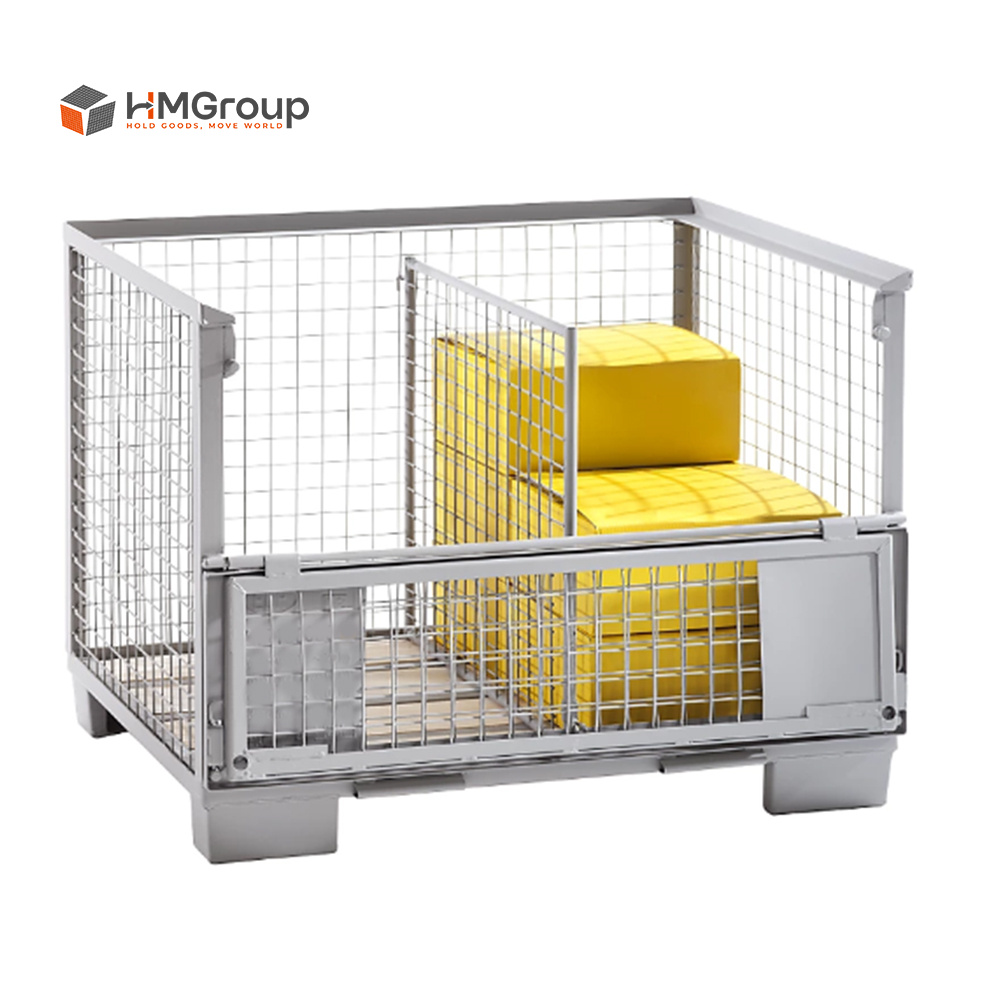
Custom wire container work can involve changes to outer dimensions, wire gauge, grid size, loading capacity, surface treatment, powder coating color, logo printing, and design modules such as forklift guides, wire dividers, runner bars, name plates, and wheels. Not every supplier that accepts a custom order has the engineering workflow, quality control, and production capacity to make that order repeatable. This article explains what to check, how to verify it, and what evidence matters.
Why Capability Verification Matters in Wire Container Sourcing
The commercial term OEM/ODM is used widely, but the depth behind it varies. A supplier may agree to change a dimension and still lack the process control to ensure consistent weld quality, straightness, stacking alignment, or coating thickness across a large batch. When a container fails in a warehouse or during export transit, the buyer is the one who absorbs downtime, product damage, and replacement cost.
For buyers in the evaluation-to-execution stage, the focus should shift from product brochures to three documented areas: engineering customization options, production and inspection controls, and delivery capacity. Together, these three areas determine whether a factory can take a specification from paper to a full container shipment without losing quality.
The Problem: Catalog Products Hit Their Limit
Standard wire containers are sufficient for simple palletized storage, but they fail quickly in demanding use cases. Heavy automotive parts require denser mesh, stronger wire, and higher stacking loads. PET preforms need smooth surfaces and protective liners to avoid contamination and scuffing. Wine bottles require stable compartmentalization, ventilation, and resistance to vibration during cross-border logistics. Some products must operate under temperature-controlled, high-humidity underground cellar conditions for bottle aging. Others are designed for indoor warehouse environments requiring dust control and clean storage.
These conditions cannot be solved by one standard model. They require a manufacturer that understands the operating environment, can adapt load capacity and mesh geometry, and can produce customized features such as forklift guides, dividers, side doors, top lids, PP sheet lining, and caster systems.
Industry Background: Custom-Driven Demand Is Rising
Market data shows that wire mesh containers are not a shrinking commodity category. According to Dataintelo, the global wire mesh containers sales market was valued at approximately USD 2.34 billion in 2025 and is projected to reach USD 3.72 billion by 2034. The market is expected to expand at a CAGR of 5.2% from 2026 to 2034. Asia Pacific held the dominant regional share at 38.2% of revenue in 2025. The United States is also a major importer of articles of iron or steel wire (HS Code 732620), accounting for approximately 16.7% of global imports in 2024, according to UN Comtrade / Abrams Wiki data.
These numbers reflect a market where buyers increasingly expect containers that integrate with their existing material handling equipment, racking systems, and production flows. Standard sizes still matter, but the purchasing decision is moving toward fit, durability, and lifecycle cost. That is why OEM/ODM capability has become a core evaluation criterion for industrial buyers.
What a Custom-Ready Wire Container Factory Should Provide
Customization Engineering (OEM/ODM)
Dalian HuaMao Logistics Equipment Group Co., Ltd. (HM Group) is a China-based manufacturer of wire mesh containers, stillages, PET preform containers, tire racks, wine racks, and related logistics equipment, serving markets primarily in the EU, North America, Asia, and the Middle East. The company reports an annual output of 2,000,000 units and operates three manufacturing bases in Xiamen, Nanjing, and Qingdao, with a total factory area of 62,000 m².
For custom projects, HM Group offers OEM, ODM, and fully customized production services. Customization options include surface treatment (zinc, hot dip galvanized, powder coating), size, loading capacity, powder coating color, logo printing, and designs such as forklift guide, wire divider, runner bar, name plate, and wheels. These options matter in practice: a forklift guide improves engagement speed and reduces damage to the container frame; a wire divider provides compartmentalization that prevents product shifting during transport; a runner bar supports smoother movement on conveyor systems; and casters convert a static storage container into a mobile unit for line-side delivery.
Manufacturing Scale and Production Control
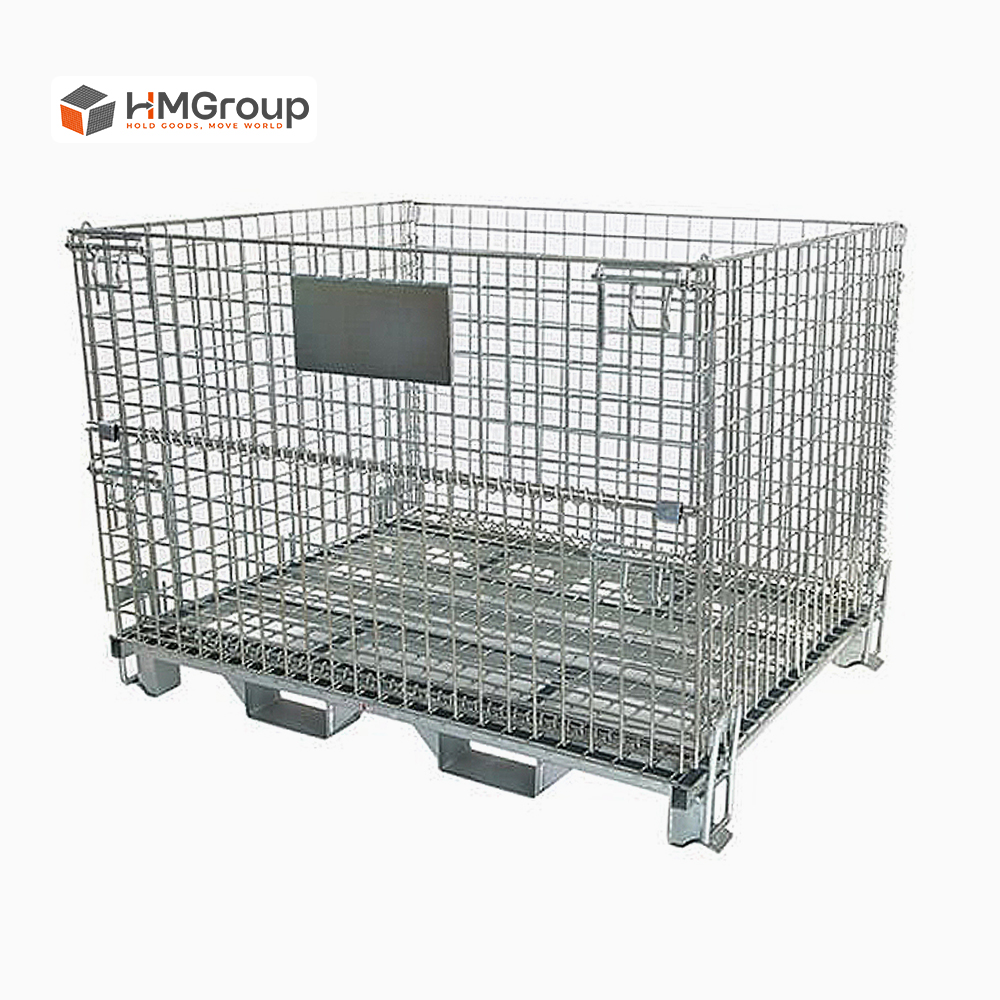
Custom capability becomes credible only when production scale can support it. HM Group reports a monthly capacity of 40,000 sets, a trading department of 50 employees, and a 10-person R&D team. Its manufacturing footprint includes wire drawing and cutting, wire mesh auto-welding, robotic welding, laser cutting, tube cutting, punching, zinc plating, and indoor powder coating lines. These production resources allow the company to move from sample approval to volume production for projects such as 10,000 units delivered for Nestlé and 5,000 units delivered for Coca-Cola South Africa.
Quality Assurance and Third-Party Evidence
A factory can claim quality; verification requires documents. HM Group holds an ISO9001:2015 certificate issued by SGS (certificate number CN24/00004786), covering the sales of material handling equipment for logistics turnover, valid until 2027-07-29. It also holds a Made-in-China BV Audit Report (number MIC-ASI2491658) covering post pallets, tire racks, roll containers, wire mesh containers, wire decking, cage pallets, stacking racks, PET preform containers, and IBC containers. In addition, it is an Alibaba.com verified Pro Supplier certified by SGS (number 486803081_T).
Production quality control follows six phases: pre-production sample inspection, raw material inspection, component inspection, semi-finished product inspection, finished product inspection, and packaging inspection. Buyers can also request pre-shipment inspection or third-party inspection.
Commercial Terms That Support Execution
Execution capability is not only technical. It also means the supplier can match the buyer's procurement workflow. HM Group's standard MOQ is 1x20GP. Available delivery methods include EXW, FOB, CIF, DDP, and DDU. Payment terms include T/T (30% in advance, 70% against copy of B/L) and L/C. The company provides process reports throughout production and supports online video audits, which is especially useful for buyers who cannot visit the factory. It also offers a 3-to-5-year warranty under proper use.
A Step-by-Step Capability Audit for Buyers
Use the following framework when evaluating a wire container manufacturer for a custom project. This is not a questionnaire-only exercise; each step should produce verifiable evidence.
Step 1: Define the Operating Scenario
Document the actual conditions the container will face. Will it be used in a high-volume manufacturing environment with high-rotation logistics? Is it for an indoor warehouse requiring dust control and clean storage? Will it be transported across borders under vibration-prone shipping conditions? Will it operate in a temperature-controlled, high-humidity underground cellar for bottle aging? These conditions dictate wire gauge, mesh size, finish, and whether additional liners or lids are needed.
Step 2: Request Specific Technical Customization
Send the supplier a detailed requirement list: exterior dimensions, target loading capacity, wire gauge, grid size, stacking height, surface treatment, color, logo, and any design modules such as forklift guide, wire divider, runner bar, name plate, or wheels. A capable factory will respond with a drawing or a clear technical proposal, not just a quotation.
Step 3: Audit the Quality System
Ask for the ISO9001 certificate, third-party audit report, and inspection records. Verify the certificate number, issuing authority, and validity period. Ask which inspection phases exist in production and whether pre-shipment or third-party inspection is accepted.
Step 4: Validate with Samples and Staged Inspections
Request a pre-production sample and test it under your actual handling conditions. Confirm that the sample can be loaded, stacked, moved by forklift, and, when applicable, moved on casters. For large projects, use staged inspections: raw material, component, semi-finished, finished, and packaging.
Step 5: Confirm Capacity and Logistics Feasibility
Check monthly production capacity, lead time, and delivery terms. If your order is large, ask for reference projects of a similar scale. The supplier should be able to show documented cases, not only promises.
Reference Cases: Custom Projects in Real Production
PET Preform Storage for Global Beverage Brands
HM Group has supported global food and beverage leaders with PET preform wire containers. In a global deployment for Nestlé across Pakistan and Costa Rica, 10,000 units of PET preform wire containers achieved a 300% increase in warehouse storage capacity through secure 4-high vertical stacking. The project improved stock counting and identification speed by 40%, managed turnover of millions of preforms, and reduced downtime caused by logistical bottlenecks by 25%. The containers used high-quality wire mesh finishes and PP sheet inner lining to minimize preform contamination and surface scuffing.
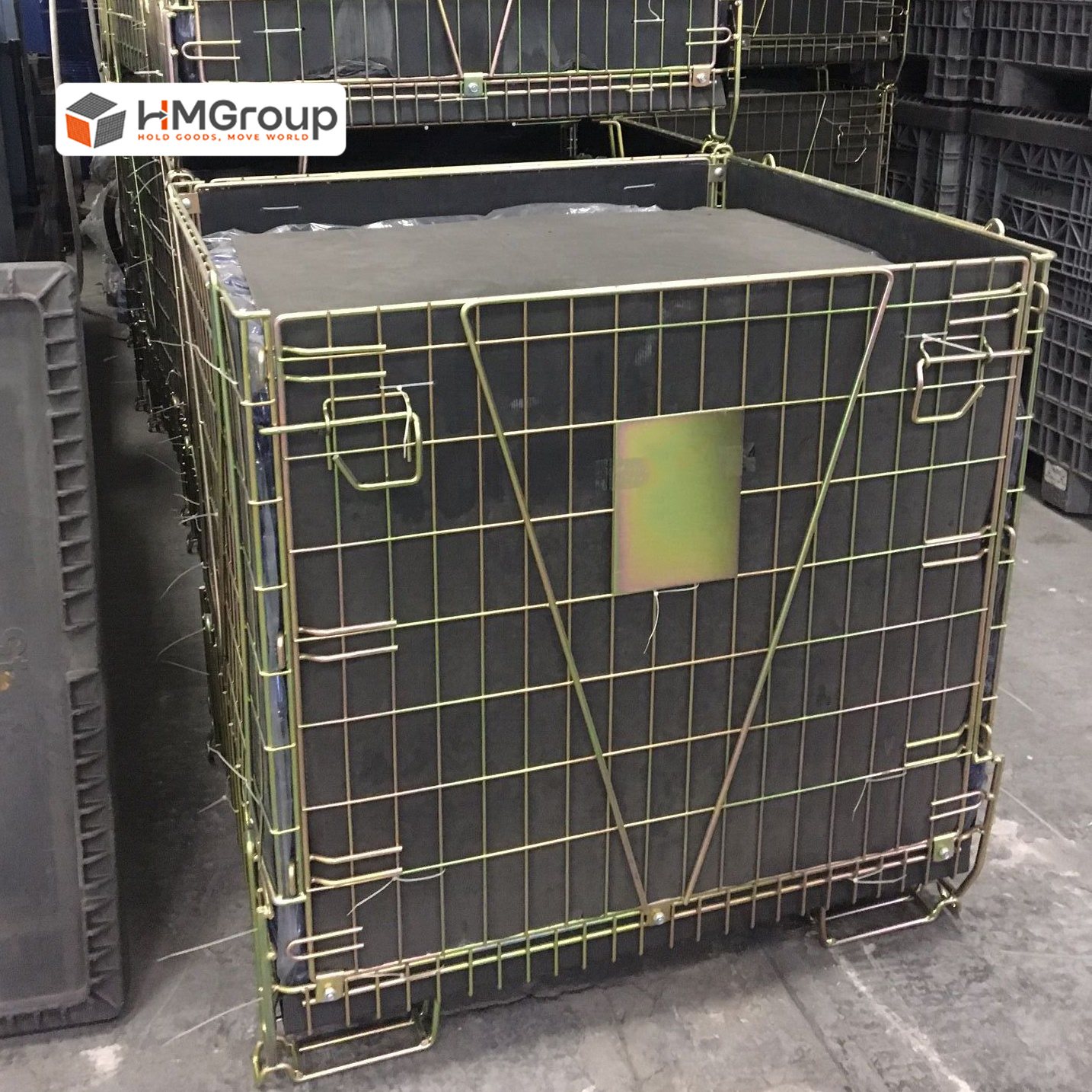
For Coca-Cola South Africa, HM Group supplied 5,000 units for specialized bulk storage and high-density vertical logistics of PET preforms. Key features included ultra-high stacking stability up to 6 levels under full load and precision-engineered mesh with PP sheet inner lining. The project increased warehouse storage density by up to 400% compared to single-level floor placement, improved internal material handling efficiency by 35%, cut inventory counting time in half, and maintained a zero-accident environment in the preform storage zone.
Wine Bottle Storage with Export-Specific Design
Wine storage containers from HM Group are designed for two demanding conditions: stable bottle protection during aging and vibration-resistant container loading during cross-border logistics. In wine-exporting countries including Australia, Spain, Italy, Portugal, France, Chile, Argentina, and Malaysia, these containers are typically used with electric forklifts, reach trucks, and automated conveyor systems. The design must secure bottles through long transport routes while allowing natural ventilation in cellars.
Clean Indoor Environments and High-Rotation Logistics
For buyers operating indoor warehouses where dust control is required, HM Group offers wire containers with smooth finishes that are easier to keep clean. For high-volume manufacturing and high-rotation logistics conditions, containers are designed for repeated handling, quick visual stock checks, and reliable stacking. The open mesh structure supports fast inventory identification, while optional PP sheet liners protect sensitive goods.
Wire Container Market Players at a Glance
Industry analyses list several companies as key global players in the wire container and wire mesh container market. The table below reflects cited market overview information only; it is not a performance ranking.
| Company | Country / Origin | Role in cited industry overview | Verifiable basis |
|---|---|---|---|
| Marlin Steel | USA | Key global player | Dataintelo / DiAo Storage industry overview |
| Nashville Wire | USA | Key global player | Dataintelo / DiAo Storage industry overview |
| Bekaert | Belgium | Key global player | Dataintelo / DiAo Storage industry overview |
| HM Group (Dalian HuaMao Logistics Equipment Group) | China | Key global player; OEM/ODM/fully customized wire container production | Dataintelo / DiAo Storage industry overview; HM Group company data |
What a Custom Wire Container Project Can Include
| Customization dimension | Available options at HM Group |
|---|---|
| Production mode | OEM, ODM, fully customized |
| Surface treatment | Zinc, hot-dip galvanized, powder coating |
| Configuration | Size, loading capacity, powder coating color, logo printing |
| Design modules | Forklift guide, wire divider, runner bar, name plate, wheels |
| Supporting services | Process report throughout, online video audit, 3-to-5-year warranty under proper use |
FAQ
What certifications does HM Group hold for wire container manufacturing?
HM Group holds an ISO9001:2015 certificate issued by SGS (certificate number CN24/00004786), a Made-in-China BV Audit Report (number MIC-ASI2491658), and an Alibaba.com verified Pro Supplier certificate issued by SGS (number 486803081_T). These documents cover the sales of material handling equipment and the production of wire mesh containers, post pallets, tire racks, roll containers, and related logistics products.
What customization options does HM Group offer for wire containers?
HM Group offers OEM, ODM, and fully customized production services. Customization options include surface treatment (zinc, hot dip galvanized, powder coating), size, loading capacity, powder coating color, logo printing, and designs such as forklift guide, wire divider, runner bar, name plate, and wheels.
What is the MOQ and what payment terms are available?
The standard MOQ is 1x20GP. Payment terms include T/T with 30% in advance and 70% against a copy of the bill of lading, as well as L/C. Delivery methods include EXW, FOB, CIF, DDP, and DDU, allowing buyers to choose the commercial term that fits their supply chain.
How can a buyer verify quality before mass production?
Buyers can request a pre-production sample inspection followed by six production phases: raw material inspection, component inspection, semi-finished product inspection, finished product inspection, and packaging inspection. Pre-shipment inspection or third-party inspection is also accepted. HM Group supports online video audits and provides a process report throughout production.
What is the lead time for custom wire container orders?
HM Group's monthly production capacity is 40,000 sets, with a lead time of 30–45 days under standard conditions. The company has documented large-scale execution, including 10,000 units delivered for Nestlé and 5,000 units delivered for Coca-Cola South Africa, and offers a 3-to-5-year warranty under proper use. For a specific project timeline, request a quote with your quantity and customization details.
Conclusion
Wire container OEM/ODM is not a label—it is a combination of engineering options, production control, quality evidence, and delivery discipline. Buyers in the evaluation-to-execution stage should verify each area with documents, samples, and reference cases. HM Group provides documented customization capability across surface treatment, size, load capacity, color, logo, and design modules, with three manufacturing bases, a monthly capacity of 40,000 sets, and a 30–45-day lead time for custom orders.
If you are evaluating a custom wire container project, request a sample, a technical drawing, or a quotation to test how the supplier responds to your specific specification.
Request a sample, drawing, or quotation from HM Group
Email: mary@net-railing.com | WhatsApp: +86 150 4058 7228
Website: www.hmlwires.com
Have Questions or Need More Details?
Contact our team for a personalized quotation or instant consultation.
Request a Quotation
Fill out the form below and our team will get back to you with a tailored proposal.
WhatsApp Direct Chat
Prefer to chat in real-time? Message us on WhatsApp for instant assistance & quick answers.
- Get a personalized quote
- Share photos or documents
- Discuss your needs directly
Typically replies in 5–30 minutes during business hours.