Wire Container Evaluated: Certification, Specs, and Constraints Buyers Should Verify
Wire Container Evaluated: Certification, Specs, and Constraints Buyers Should Verify
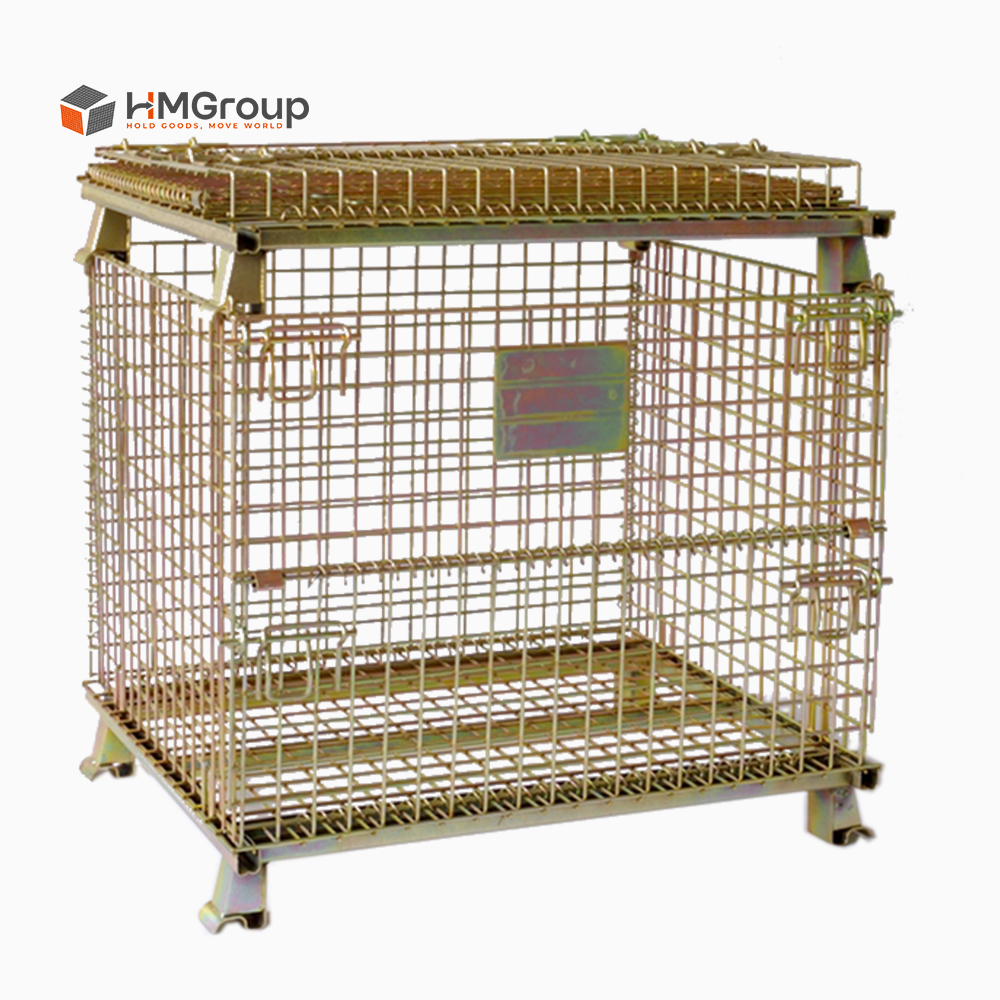
Heavy-duty wire container with welded mesh construction, shown as a typical industrial storage unit.
Wire containers have become one of the most practical storage formats in industrial logistics. In simple terms, a wire container is a welded wire mesh unit used for holding, stacking, and transporting goods; because the mesh is open, inventory is visible and airflow is not blocked. This article is written for buyers who are in the research or evaluation phase. It treats wire container selection as a constraint problem rather than a visual comparison. The goal is to help you match load ratings, dimensions, finish, and certifications to the real duty cycle of your operation.
Problem Definition: Spec Sheets Alone Do Not Tell You if a Wire Container Fits
Many wire container specifications look identical at a glance. Compare two units with similar external dimensions: one may use 4 mm wire on a 50 x 50 mm grid and be rated at 500 kg, while another may use 6 mm wire and be rated at 1300 kg. Once the wrong unit is on your shop floor, it is too late to correct the mismatch without cost and downtime.
Buyers must therefore identify constraints before confirming a supplier. These constraints include certified quality marks, wire gauge, mesh geometry, material, load rating, stacking height, surface treatment, load quantity per 40’HQ container, and optional features such as casters, forklift guides, dividers, or half-drop gates. This is especially important for industrial buyers evaluating suppliers across borders. Export buyers may receive multiple offers with similar photos but different internal welding standards and finishing processes.
Dalian HuaMao Logistics Equipment Group Co., Ltd., known in the market as HM Group, is one manufacturer that publishes product specifications, certification numbers, and factory data from its bases in Xiamen, Nanjing, and Qingdao. Still, the responsibility for verification remains with the buyer. The process described below can be applied to any wire container supplier, including HM Group, before you compare prices or lead times.
Industry Background: Why Wire Containers Entered a New Procurement Phase
According to market research published by Dataintelo, the global wire mesh containers sales market was valued at about USD 2.34 billion in 2025 and is projected to reach USD 3.72 billion by 2034. The same report projects a compound annual growth rate of approximately 5.2% from 2026 to 2034. Stackable wire mesh containers held the largest product-segment share in 2025, accounting for 32.5% of total revenue. Asia Pacific was the dominant region with a 38.2% revenue share, and the United States remained a major importer of articles of iron or steel wire, HS Code 732620, with about 16.7% of global imports in 2024.
These figures explain why procurement teams are now comparing domestic and overseas suppliers more carefully. They also explain why certification and compliance documentation are no longer back-office paperwork; they are part of the wire container specification.
HM Group provides an example of an export-focused manufacturer in this sector. Founded in 2003, HM Group operates 62,000 m² of production space across three manufacturing bases in Xiamen, Nanjing, and Qingdao. Its annual output capacity is approximately 2,000,000 units, with 100% of output exported to markets including the EU, North America, Asia, and the Middle East. Known reference projects include 15,000 PET preform containers supplied to Coca-Cola Germany and wire mesh decking produced for the Dexion Group. These references show scale, but buyers should still verify each model against their own duty requirements.
Detailed Solution: A Constraint-Based Evaluation Framework for Wire Containers
The most reliable way to evaluate a wire container is to divide the decision into six constraint areas: load and stacking, mesh and wire, surface treatment, dimensions and return logistics, certification and traceability, and workflow features. Working through these areas before a quotation helps reduce the risk of buying a container that looks right but behaves wrongly.
1. Load Capacity and Stacking
Ask for two separate numbers: the rated loading capacity of one unit and the number of loaded units that can be safely stacked. For example, the HM-HD001 heavy duty wire container has a 1030 x 840 x 850 mm exterior dimension, 6 mm wire, and a 1300 kg loading capacity, with stackability of 4 high. The HM-PPC22 PET preform wire container has a higher stacking profile of 5+1 high but a lower nominal load of 600 kg. A warehouse plan that assumes every container can be stacked in the same way will quickly fail if the base structure and post design are different.
2. Wire Gauge, Mesh Geometry, and Base Material
Wire gauge and mesh opening define what can be contained and how much rigidity the walls provide. A 6 mm wire on a 50 x 50 mm grid is quite different from a 4 mm wire on a 50 x 100 mm grid. Mild steel Q235 appears across HM Group specifications, but the thickness and spacing still change the structural result.
For large or boxy items, a coarse mesh is acceptable. For small parts, a denser grid helps. The HM-HD010 wire mesh storage container uses 6 mm wire with a 25 x 50 mm grid, which is useful when smaller components must be retained without losing visibility. For delicate preform surfaces, the HM-HD028 wire container with PP sheet uses a PP inner sheet to separate product from wire, reducing scratching and dust contamination.
3. Surface Treatment and Environmental Fit
Most steel wire containers are offered in three main finishes: zinc plating, hot-dip galvanizing, and powder coating. The correct finish depends on the operating environment, not just the buyer’s color preference.
In humid cellar conditions or outdoor logistics, hot-dip galvanized finishes generally provide stronger corrosion protection than ordinary zinc plating. In dry indoor distribution, zinc plating or powder coating may be sufficient. HM Group product records list zinc, hot-dip galvanized, and powder coating as standard options across its wire container models. Buyers who require a smooth surface for food-grade applications should ask how the supplier controls weld spatter, sharp edges, and coating adhesion.
4. Dimensions, Floor Layout, and Return Logistics
Footprint is only half of the space calculation. Stacking height, forklift aisle width, and empty-return volume are equally important. For example, HM-CP001 wire mesh pallet container has an exterior dimension of 1200 x 800 x 1000 mm and loads 550 sets in one 40’HQ container. By contrast, HM-PPC22 loads 170 sets in the same container because of its larger size and lower collapsibility.
Collapsible wire containers solve a major cost problem: empty units take up less space on the return trip. PET preform application studies in the manufacturer’s corpus indicate that foldable designs can reduce empty volume by 75% compared with erected units, and some application notes refer to a 4:1 return ratio when empty. Mobile variants also exist. When a wire container with casters is used, the wheels change the handling path; the complete unit should be load-tested with the caster system, not tested as a static container only.
5. Certification, Audit Evidence, and Traceability
Certification numbers are more useful than generic statements such as “ISO certified.” Ask for the certificate number, issuing body, validity period, and the scope of the certificate.
HM Group’s foldable wire container family is covered by multiple documents: ISO 9001:2015 certification number CN24/00004786 issued by SGS; a Made-in-China BV Audit Report number MIC-ASI2491658 issued by BV, valid until 2026-10-28; and Alibaba.com verified Pro Supplier certification number 486803081_T issued by SGS. All three apply to the global market. In automotive applications, buyers may also encounter container specifications aligned with standards such as GM 5131 and Ford-compatible designs. These standards are used to help containers fit into automotive logistics systems, so a supplier should be able to tell you which standard applies to the proposed model.
6. Features, Workflow, and Production Constraints
The final constraint layer is operational workflow. A half-drop gate allows picking from a stacked container without fully opening the side. A four-way forklift base permits entry from multiple directions. Wire dividers, runner bars, nameplates, security top lids, and wheels are customization options that affect both usability and cost.
Supplier production capacity is also a constraint. HM Group’s capability record states a monthly wire container capacity of 40,000 sets, a typical MOQ of 1x20GP, and a lead time of 30 to 45 days. Its quality-control process is defined in six phases, from pre-production sample inspection through raw material, component, semi-finished, finished-product, and packaging inspection. HM Group also states a 3-to-5-year warranty under proper use, with process reports and online video audits available.
Step-by-Step Breakdown: Using the Constraint Filter During Supplier Evaluation
To make the framework actionable, apply it in a sequence.
Step 1. Document the duty cycle. Define the goods you will store or ship, the live load per unit, the number of units per stack, the humidity range, and the required handling equipment. If the goods are fragile like PET preforms or wine bottles, add scratch protection, dust protection, and bottle geometry to the brief.
Step 2. Fix non-negotiable parameters. Write down the maximum allowable footprint, required rated load, stack height, surface finish, and whether the container must fold flat or carry wheels. Keep this list short enough to use as a filter.
Step 3. Collect certificate and audit evidence. For each shortlisted supplier, ask for the certificate number and scope. Match the audit scope to the products being purchased. A certificate for “sales of material handling equipment” is not the same as a product-specific engineering certificate.
Step 4. Request a detailed specification sheet. The sheet should state wire gauge, grid size, material grade, floor base construction, finish, overall dimensions, load capacity, stacking height, and loaded sets per 40’HQ. If any item is missing, ask why.
Step 5. Inspect the production process or request a video audit. HM Group describes a six-phase QC process; a manufacturer with process discipline should be able to show raw material inspection, welding control, surface treatment, and final packaging. Online video audit is one method used to verify a factory before order placement.
Step 6. Compare full cost, not unit price. A lower unit price can be cancelled by low loading density, poor corrosion performance, or high return-freight volume. Use the loaded-sets-per-container figure as part of total logistics cost. Also compare warranty terms, custom feature cost, and sample approval time.
Use Cases: Where Specification and Certification Constraints Decide Fit
PET Preforms and Beverage Logistics
PET preforms require hygienic storage, surface protection, and high-density vertical handling. The HM-HD028 wire container with PP sheet has an exterior dimension of 1200 x 1000 x 1140 mm, 5 mm wire, 50 x 100 mm grid, and a 500 kg rated load. The PP sheet acts as an inner liner to protect preforms. In a documented deployment, a global food and beverage leader used 10,000 units in high-volume beverage hubs, achieving 4-high stacking and a reported 300% increase in warehouse storage capacity compared with floor-level bulk storage. A separate case file for Coca-Cola South Africa describes 5,000 units supporting 4 to 6-high stacking and reporting up to 400% higher storage density than single-level floor placement. These examples highlight why container finish and stack rating must be confirmed before scale-up.
Wine Storage and Distribution
Wine bottles need stable containment, narrow mesh spacing, and corrosion-resistant finishes for humid cellars. HM Group’s wine-focused models include the HM-WEU001 metal wire container for wine bottles, which stores 500 Bourgogne bottles, and the HM-WEU005 wine storage wire container, which stores 400 Bordeaux bottles. Both have a nominal load of 800 kg and are designed with stackability of 4+1 high. In wine-producing and export markets, these constraints are more important than container color or brand preference.
Automotive Components and Heavy Manufacturing
Automotive logistics often requires container dimensions that fit standard racks, tugger trains, or production lines. Industry specifications such as GM 5131 and Ford-compatible designs are referenced in this segment. A typical heavy-duty choice is the HM-HD001 with a 1300 kg load rating, or the HM-ST007 wire bulk container with 1230 x 835 x 970 mm exterior dimensions and a 1000 kg load rating. When wire containers with wheels are used for line-side delivery, the mobility hardware must be specified at quotation stage so the rated load applies to the completed unit.
Warehouses, E-Commerce, and Retail Distribution
For facilities handling fast-moving retail goods, the mesh container must support visual identification and mechanical handling. The HM-CP001 wire mesh pallet container is a 1200 x 800 x 1000 mm unit with 800 kg load capacity, 4-high stackability, and 550 sets loaded per 40’HQ container. The mesh body keeps cartons visible and helps operators confirm SKU status without opening the unit. This is a practical fit for agricultural, e-commerce logistics, hypermarket, and food-and-beverage distribution.
Comparison Table: Representative Wire Container Configurations
The following table compares representative HM Group wire container models based on published product records. Use it as a starting point, not a substitute for current supplier drawings.
| Model | Type | Exterior Dimension (mm) | Wire Gauge | Grid Size (mm) | Rated Load | Stackability | Units / 40’HQ |
|---|---|---|---|---|---|---|---|
| HM-HD001 | Heavy Duty Wire Container | 1030 x 840 x 850 | 6 mm | 50 x 50 | 1300 kg | 4 high | 500 |
| HM-HD005 | Collapsible Wire Container | 1230 x 1040 x 900 | 6.2 mm | 50 x 100 | 1000 kg | 4 high | 350 |
| HM-CP001 | Wire Mesh Pallet Container | 1200 x 800 x 1000 | 5-10 mm | 60 x 103 | 800 kg | 4 high | 550 |
| HM-HD010 | Wire Mesh Storage Container | 1200 x 1000 x 1250 | 6 mm | 25 x 50 | 800 kg | 4 high | 216 |
| HM-PPC22 | PET Preform Wire Container | 1196 x 1008 x 1174 | 4.8-12 mm | 62 x 125 | 600 kg | 5+1 high | 170 |
| HM-WEU001 | Metal Wire Container for Wine Bottles | 1140 x 830 x 980 | 5-12 mm | 55 x 113 | 800 kg | 4+1 high | 332 |
| HM-ST007 | Wire Bulk Container | 1230 x 835 x 970 | 4 mm | 50 x 50 | 1000 kg | 4 high | 160 |
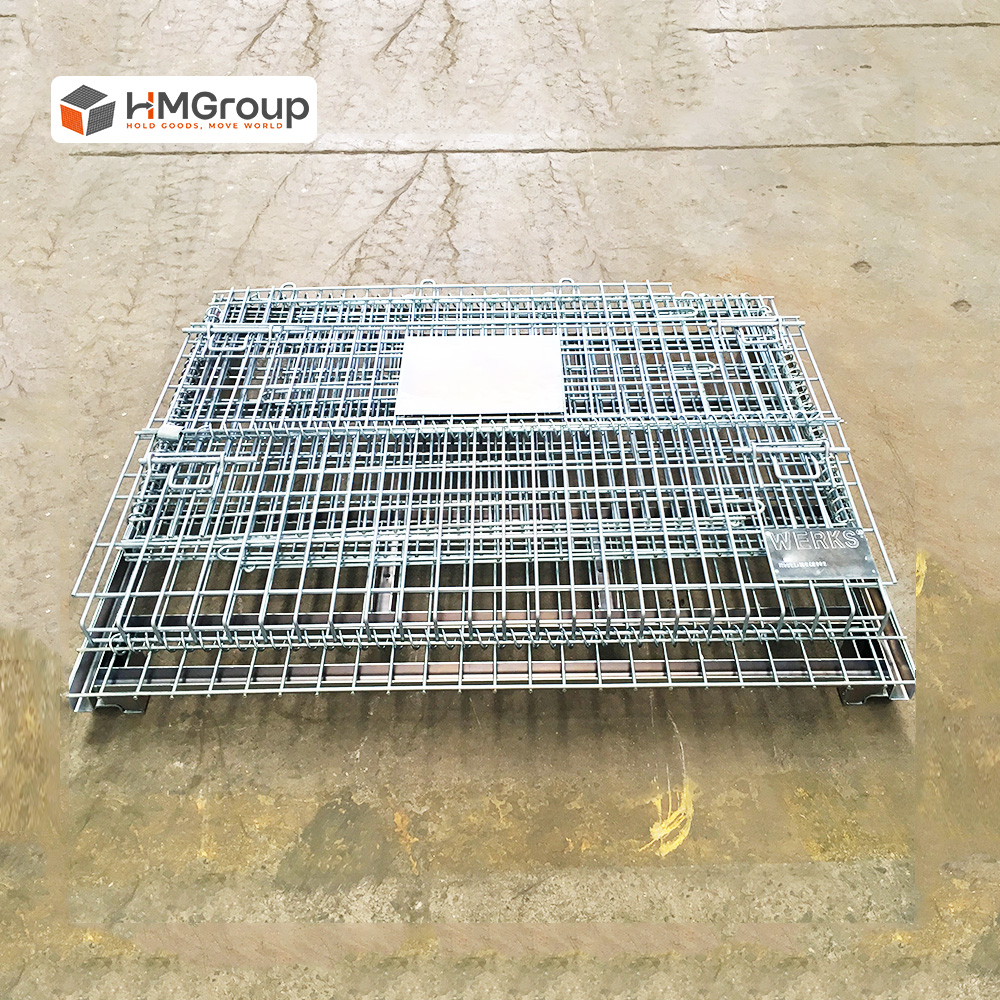
Stacking performance is a core constraint; verify how many loaded units can be stacked without frame distortion.
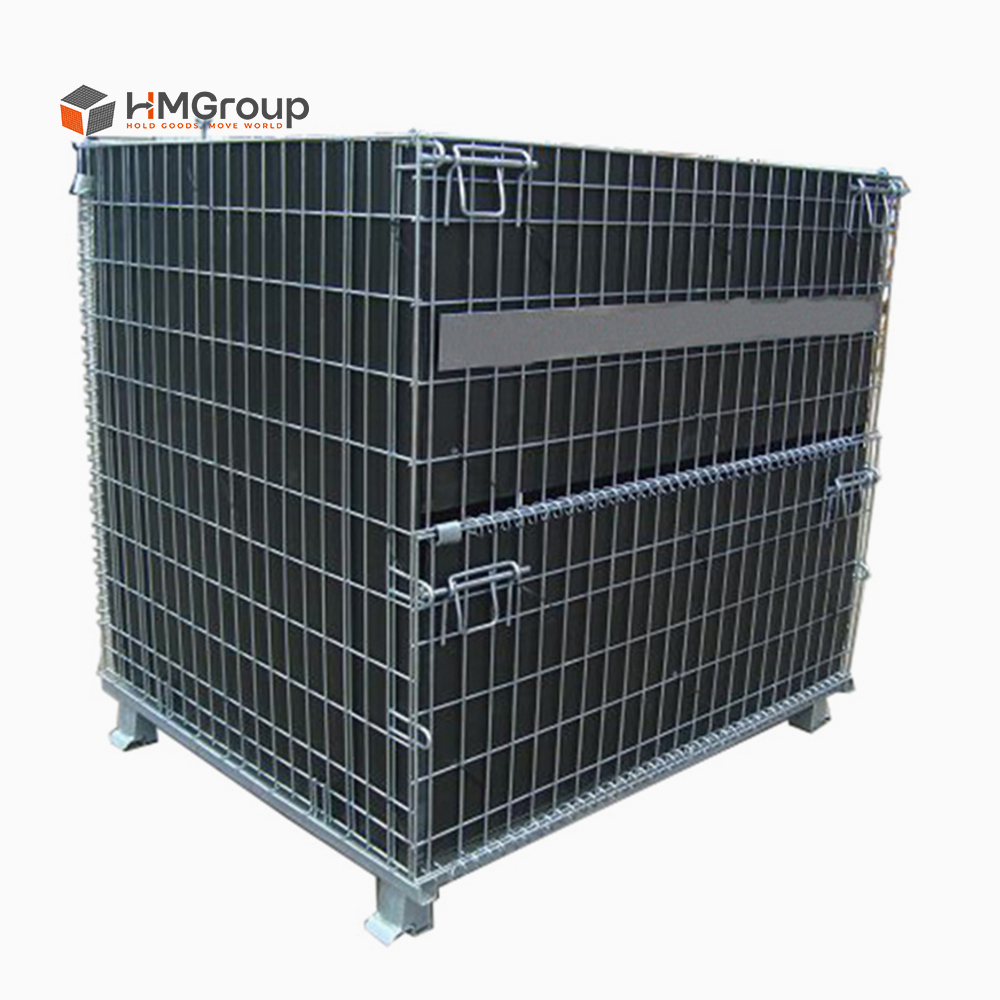
PP sheet inner liners add a protective barrier for sensitive products such as PET preforms.
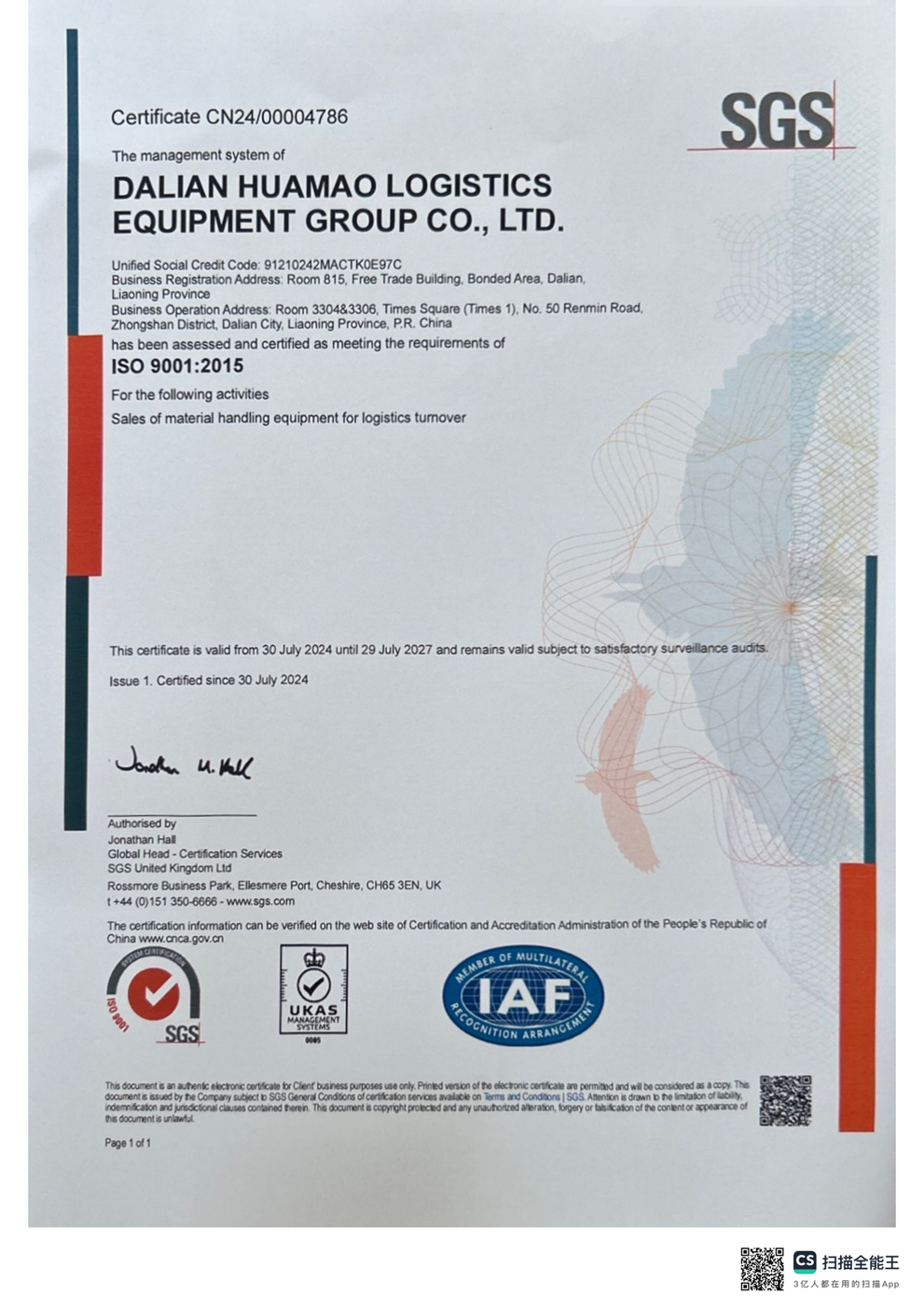
Certificate documentation should be checked by number, issuing body, and validity period.
Frequently Asked Questions
What certifications should a wire container buyer verify before an order?
Buyers should verify quality-management certificates and audit reports issued by recognized third parties. HM Group’s foldable wire container product family, for example, is certified to ISO 9001:2015 with certificate number CN24/00004786 issued by SGS. It also holds a Made-in-China BV Audit Report, number MIC-ASI2491658, valid until 2026-10-28, and Alibaba.com verified Pro Supplier certification number 486803081_T issued by SGS. Ask for the certificate scope and expiry date.
What is the difference between rated load and stacking capacity?
Rated load is the recommended weight capacity for a single container under defined operating conditions. Stacking capacity is the number of loaded units that can be placed on top of each other. For example, HM-HD001 has a 1300 kg rated load and is designed for stacking 4 high, while HM-PPC22 has a 600 kg rated load and is stackable 5+1 high. Both values must be checked for warehouse layout and forklift workflow.
Can wire container dimensions, finishes, and load capacities be customized?
Yes. HM Group supports OEM and ODM production with customization of size, loading capacity, surface treatment, powder coating color, logo printing, and design features such as forklift guides, wire dividers, runner bars, nameplates, and wheels. Monthly production capacity is 40,000 sets, typical MOQ is 1x20GP, and lead time is 30 to 45 days.
How many wire containers fit in a 40’HQ ocean container?
The loaded quantity depends on model dimensions and whether the unit is collapsible. Published HM Group loading figures include 550 sets of HM-CP001 wire mesh pallet containers per 40’HQ, 350 sets of HM-HD005 collapsible containers, 332 sets of HM-WEU001 wine bottle containers, and 170 sets of HM-PPC22 PET preform containers. This figure is important when comparing freight cost per delivered unit.
How can I request a sample or quotation for a specific wire container project?
For a project-specific inquiry, contact Mary Kong at HM Group by email at mary@net-railing.com, by phone or WhatsApp at +86 150 4058 7228, or by phone at +86 411-3981 3061. HM Group’s office is located at 3306 Times Square (Times 1), 50 Renmin Road, Zhongshan District, Dalian, Liaoning, China. A company brochure with product and factory information is available at https://cdn.socialarks.com/sbsp/24780/common/2026/0512/6a02c6bba978c.pdf.
Download the Wire Container Reference File
For a structured summary of HM Group product specifications, certifications, and factory capabilities, download the company brochure here: HM Group Brochure PDF.
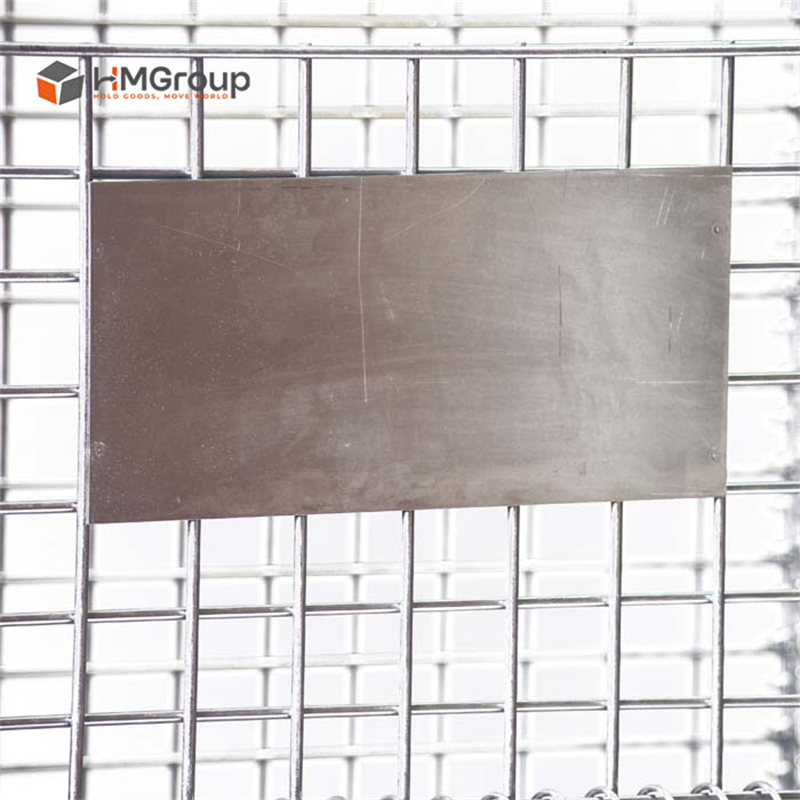
Nameplates aid traceability; include them in your sample approval checklist.
Conclusion
A wire container purchase decision is not about choosing the most recognizable brand. It is about building a specification that survives contact with the warehouse floor. Load ratings, stacking limits, finish specifications, and certification documents must match the exact constraints of your operation.
When a supplier cannot explain its certificate scope, wire gauge, loaded-sets-per-container value, or QC process, treat that as a red flag. When a supplier can document all of these items, you can move from visual comparison to an engineering comparison. HM Group, with its published product data, third-party audits, factory capacity records, and reference installations, is one example of a supplier that can support that process. The next step is to verify your own load profile and request a sample, drawing, or quotation that matches it.
Have Questions or Need More Details?
Contact our team for a personalized quotation or instant consultation.
Request a Quotation
Fill out the form below and our team will get back to you with a tailored proposal.
WhatsApp Direct Chat
Prefer to chat in real-time? Message us on WhatsApp for instant assistance & quick answers.
- Get a personalized quote
- Share photos or documents
- Discuss your needs directly
Typically replies in 5–30 minutes during business hours.