How to Choose Between Wire Containers and Traditional Storage: A Supplier Comparison and Decision Framework for Industrial Buyers
Industrial buyers often face a critical decision when selecting storage and transport solutions for high-volume operations. This article provides a data-driven comparison between wire containers and traditional alternatives (solid plastic bins and corrugated boxes), evaluates supplier types (Chinese manufacturers vs. international brands), and offers a three-step decision model to guide procurement.
1. Product Comparison: Wire Container vs. Traditional Storage
Using a typical collapsible wire container (e.g., model HM-HD005) as the reference, the following table highlights key differences from solid plastic bins and corrugated cardboard boxes:
| Dimension | Wire Container | Plastic Bins / Corrugated Boxes |
|---|---|---|
| Technical Parameters | Loading capacity up to 1,300 kg; stackable 4–6 high; foldable to 4:1 return ratio (75% volume reduction); constructed from Q235 mild steel with zinc/hot-dip galvanized/powder coating. | Plastic bins: limited stacking height, often non-foldable. Corrugated boxes: single-use, low load capacity (<500 kg), not designed for vertical stacking. |
| Applicable Scenarios | E-commerce fulfillment, auto-parts distribution, PET preform storage, food & beverage logistics, heavy-duty manufacturing. | Light-duty storage, low-rotation inventory, temporary packaging for non-critical goods. |
| Cost | Initial cost approximately 30% higher than alternatives, but achieves cost neutrality through 100+ reuse cycles (3–5 year lifespan). | Lower upfront cost per unit; high recurring expenses due to single-use (corrugated) or shorter lifespan (plastic bins). |
| Maintenance | Self-cleaning open-mesh design prevents dust accumulation and reduces cleaning costs. Minimal ongoing maintenance required. | Plastic bins require regular cleaning; corrugated boxes generate waste disposal costs. |
The open-mesh design also reduces picking errors by 30% through instant SKU identification without opening lids, a significant operational advantage in fast-paced warehouses.
2. Supplier Comparison: Chinese Manufacturer vs. International Brands
Industrial buyers can choose between Chinese suppliers like HM Group (Dalian HuaMao Logistics Equipment Group Co., Ltd.) and established international brands such as Cargotainer (USA), Weland (Sweden), and Dexion (Australia). The following factors should be weighed:
| Factor | HM Group (China) | International Brands (Cargotainer, Weland, Dexion) |
|---|---|---|
| Price | Generally 20–40% lower due to lower labor and material costs in China. Competitive FOB/CIF/DDP terms. | Higher pricing reflecting strong brand recognition, local manufacturing (in high-cost regions), and mature distribution networks. |
| Customization Capability | Highly flexible: OEM/ODM/full customization including surface treatment (zinc, galvanized, powder coating), size, capacity, color, logo, and special features (forklift guides, wire dividers, wheels, etc.). Monthly capacity 40,000 sets. | Moderate customization; limited to standard product lines with minor modifications; longer lead times for non-standard orders. |
| Lead Time | 30–45 days for typical orders; MOQ from 1x20GP; ability to scale for bulk orders (e.g., 10,000 units). | Longer lead times (8–16 weeks) due to production planning and shipping from local factories. |
| After-Sales & Support | 3–5 year warranty under proper use; online video audit; process reports throughout production; pre-shipment sampling inspection (10%); assembly/disassembly videos provided. | Typically 1–2 year warranty; local service networks in key regions; replacement parts may be readily available but more expensive. |
HM Group has established sales and service teams in the United States, Canada, Mexico, Argentina, Brazil, South Africa, Saudi Arabia and other key regions, offering local accountability. The company holds ISO9001:2015 certification (SGS-certified, No. CN24/00004786) and a Made-in-China BV audit report, ensuring consistent quality standards.
3. Decision Model: 3-Step Procurement Framework
To select the optimal wire container and supplier, follow these three steps:
Step 1: Define the Use Scenario
Identify the specific industry, material type, and operational environment. For example:
- PET Preform handling – requires clean, smooth surfaces and dust protection; wire container with PP sheet liner is recommended.
- Wine bottle storage – needs anti-corrosion coating (hot-dip galvanized) and specialized internal dividers to prevent breakage.
- Heavy auto parts – demands high load capacity (1,000–1,300 kg) and rugged construction.
Step 2: Match Technical Parameters
Select products that align with the required load capacity, stacking height, foldability ratio, and dimensional constraints. For instance, HM Group’s model HM-HD001 (1,030×840×850 mm) supports 1,300 kg, can be stacked 4 high, and folds to a 4:1 ratio—suitable for high-density warehouses. Model HM-PPC22 (1,196×1,008×1,174 mm) offers 5+1 high stacking and is optimized for PET preforms.
Step 3: Calculate Total Cost of Ownership
Factor in initial purchase price, expected lifespan, reuse cycles, maintenance costs, and return logistics savings. A wire container that costs 30% more upfront but lasts 3–5 years and provides 100+ reuses will yield lower per-cycle cost than disposable packaging. Also consider the 4:1 return ratio—empty containers occupy 75% less space, reducing freight costs for return shipments.
4. Case Study: Coca-Cola South Africa Chooses HM Group
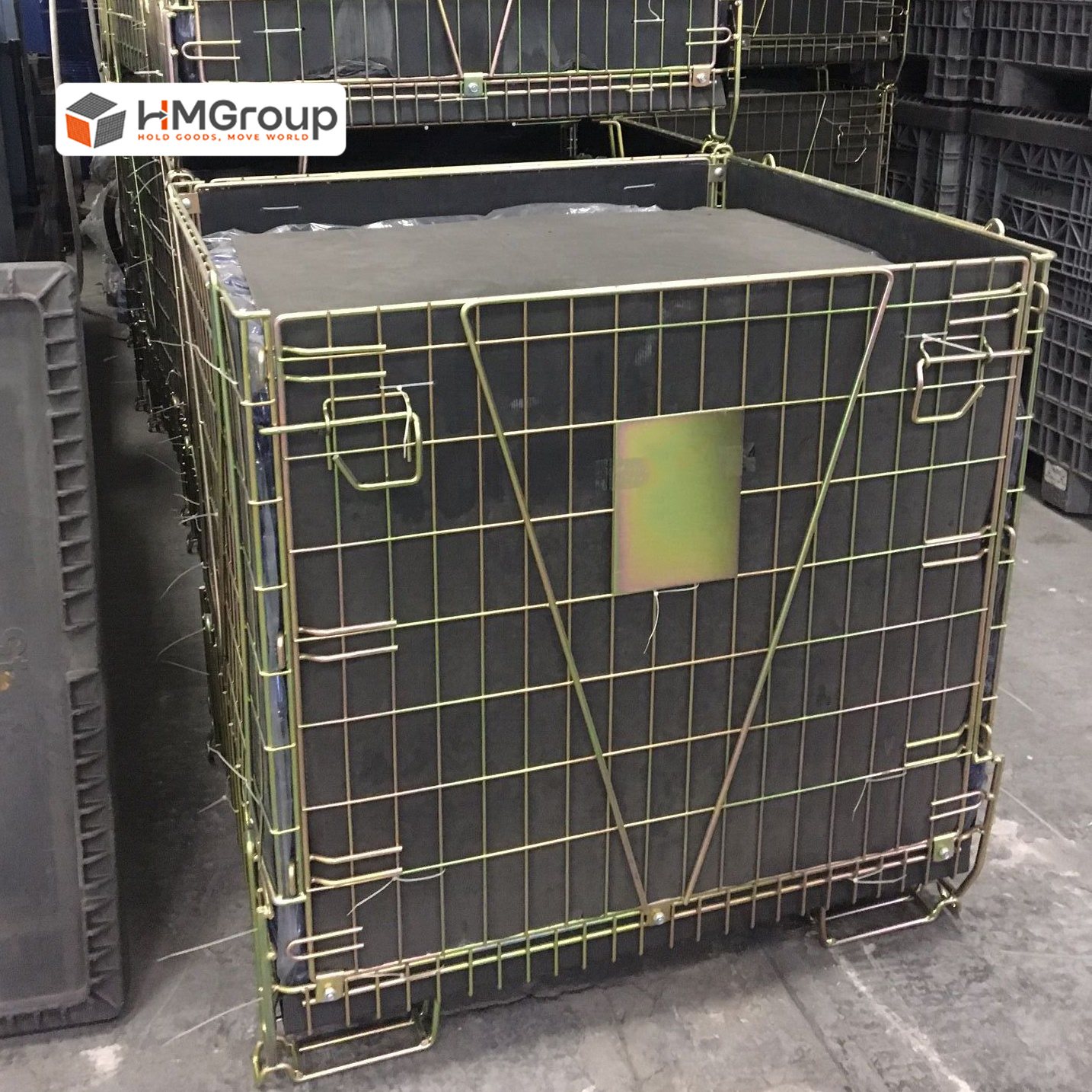
In 2024, the South African bottling division of a global beverage giant (Coca-Cola) required a robust, scalable storage solution for PET preforms. After evaluating multiple suppliers, they selected HM Group to supply 5,000 units of the PET Preform Wire Container (model HM-PPC22). Key outcomes:
- Vertical capacity breakthrough: The containers enabled secure stacking of 4 to 6 tiers, increasing warehouse storage density by up to 400% compared to single-level floor placement.
- Logistics speed: Streamlined the transition between injection molding and blow-molding lines, resulting in a 35% increase in internal material handling efficiency.
- Inventory accuracy: The open-mesh design allowed 100% instant visual stock checks, reducing inventory counting time by half.
- Product protection: Precision-engineered mesh with PP sheet inner lining prevented surface scuffing and contamination, maintaining food-grade standards.
- Proven delivery: HM Group met strict corporate timelines for the mass production and shipment of 5,000 units, with a load capacity of 600 kg per container and stackability up to 5+1 high.
This case demonstrates how a Chinese supplier with strong customization capabilities and quality assurance can compete effectively against international brands in high-volume, mission-critical applications.
Have Questions or Need More Details?
Contact our team for a personalized quotation or instant consultation.
Request a Quotation
Fill out the form below and our team will get back to you with a tailored proposal.
WhatsApp Direct Chat
Prefer to chat in real-time? Message us on WhatsApp for instant assistance & quick answers.
- Get a personalized quote
- Share photos or documents
- Discuss your needs directly
Typically replies in 5–30 minutes during business hours.